Decoding Trump’s MAGA National Security Strategy and Global Impact
The return of Donald Trump to the political forefront has sent ripples through capitals worldwide, prompting a urgent re-examination of what a second “America First” term would mean for global stability. His proposed MAGA national security strategy represents not merely a shift in tactics, but a fundamental philosophical revolution in how America engages with the world. Moving beyond traditional alliances and multilateral frameworks, this vision promises a more transactional, sovereignty-centric, and confrontational approach to international relations. This article decodes the core tenets of Trump’s strategy and explores its potential seismic impact on allies, adversaries, and the global order itself.
The Pillars of “America First” Security: A New Doctrine
At its heart, the MAGA foreign policy doctrine is built on a rejection of the post-World War II liberal international order that the United States helped to create and lead. It replaces collective security and shared democratic values with a stark focus on unilateral advantage and bilateral deal-making. Several key pillars define this approach:
Unapologetic Sovereignty and Transactionalism: The concept of national sovereignty is paramount. International organizations and treaties are viewed not as pillars of stability, but as constraints on American power and independence. Under this lens, relationships are evaluated purely through a cost-benefit analysis—what does America get, and what does it give up? This could manifest in renegotiated trade deals, demands for increased financial burden-sharing from allies, and a willingness to withdraw from international agreements perceived as unfavorable.
The End of “Forever Wars” and a Focus on Deterrence: A consistent theme is the aversion to prolonged military engagements and nation-building. The strategy emphasizes a formidable, rebuilt military not for protracted interventions, but for overwhelming deterrence. The goal is to make conflict so costly for adversaries that they never dare to initiate it, while simultaneously avoiding new quagmires. This could lead to a more unpredictable military posture, where the threat of force is used more readily as a negotiating tool, but its application is more restrained.
Economic Security as National Security: This is perhaps the most transformative element. The line between economic policy and foreign policy is deliberately blurred. Trade deficits are framed as direct threats to American power and prosperity. The strategy advocates for aggressive protectionism, including widespread tariffs, reshoring of critical industries, and decoupling from strategic competitors—most notably China. In this view, winning the economic competition is synonymous with winning the geopolitical competition.
The Global Ripple Effect: Allies, Adversaries, and the In-Between
The implementation of such a strategy would create winners, losers, and a great deal of uncertainty across the globe, fundamentally reshaping decades-old partnerships and rivalries.
Strained Alliances: Europe and NATO in the Crosshairs
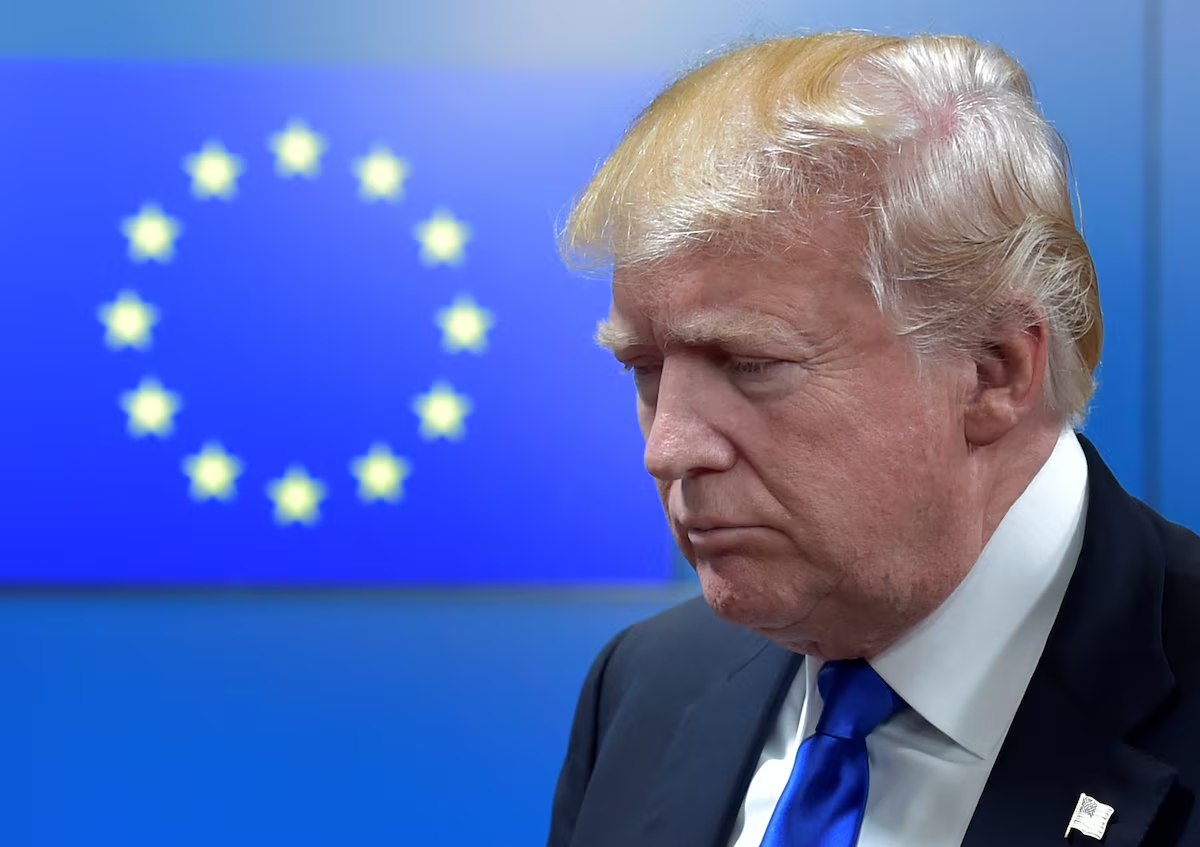
The transatlantic alliance faces its most severe stress test. Trump’s skepticism of NATO is well-documented, with past threats to withdraw U.S. commitment if members did not meet defense spending targets. A second term would likely see this pressure intensify, potentially conditioning U.S. participation on immediate, tangible financial contributions. For the European Union, this creates a dual crisis: a urgent need for strategic autonomy in defense and the terrifying prospect of a reduced U.S. nuclear security umbrella. The EU would be forced to accelerate its integration as a security power, a process fraught with internal disagreement, while navigating a more hostile relationship with Russia largely on its own.
The Adversaries: China, Russia, and a Strategy of Confrontation
The approach to strategic competitors is one of unambiguous confrontation, but with distinct flavors.
The “In-Between”: Middle East and Indo-Pacific Volatility
In regions defined by complex rivalries, the transactional approach introduces high volatility.
Conclusion: A World Reordered by Transaction
Donald Trump’s MAGA national security strategy promises a world where certainty is scarce and every relationship is re-evaluated through the lens of immediate American gain. It is a vision that empowers nationalist movements globally while undermining the multilateral systems designed to manage conflict and foster cooperation.
The potential global impact is a descent into a more fragmented, volatile, and transactional international environment—a neo-Westphalian order where great powers assert spheres of influence, middle powers scramble for security, and the rules-based system frays at the edges. For America’s allies, it necessitates a painful and rapid move toward self-reliance. For its adversaries, it presents both risk and opportunity: the risk of sudden, overwhelming confrontation, and the opportunity to exploit a divided and introspective West.
Ultimately, decoding this strategy reveals a fundamental choice not just for the United States, but for the world: whether the coming decades will be guided by collective, albeit imperfect, institutions or by the raw, unilateral pursuit of national interest in an arena where might makes right, and every deal is temporary. The ripple effects of this American revolution in foreign policy are only just beginning to be felt.