
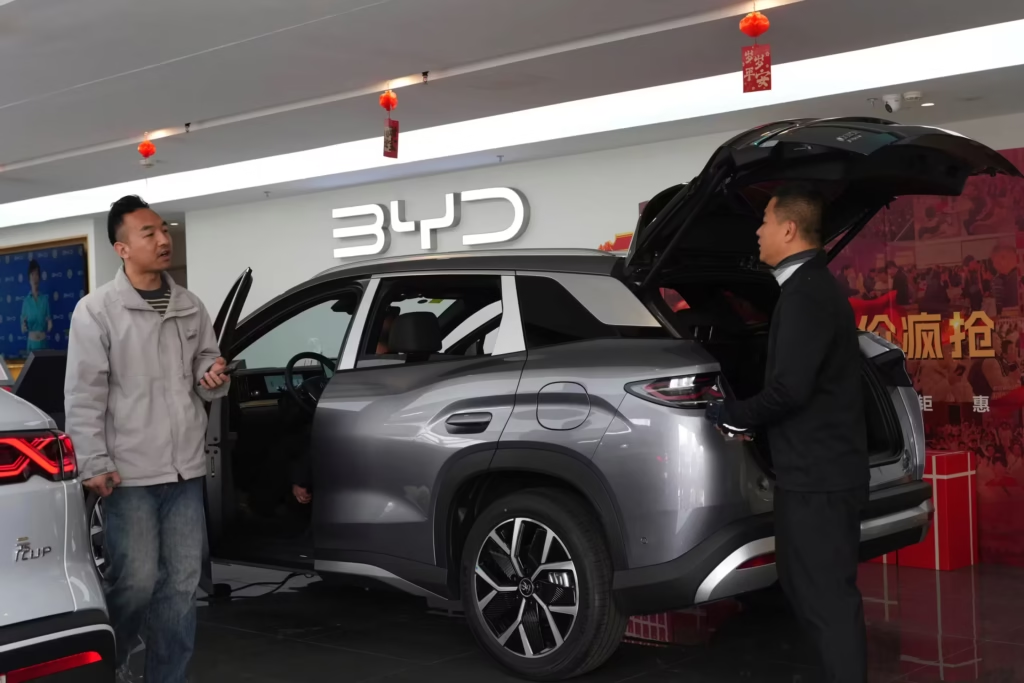
BYD Profits Fall Despite Becoming Top Global EV Seller
In the high-stakes race for electric vehicle supremacy, a fascinating and complex story is unfolding. The Chinese automotive giant BYD has officially unseated Tesla as the world’s top seller of battery electric vehicles (BEVs), a monumental shift in the industry’s power dynamics. However, this crowning achievement arrives with a significant caveat: BYD has reported its first quarterly profit decline since 2021. This paradox of rising sales and falling profits reveals the intense pressures and strategic battles defining the current EV landscape.
The Dual Reality: A Sales Crown Tarnished by Shrinking Margins
The numbers tell a tale of two competing narratives. On one hand, BYD’s sales volume is nothing short of spectacular. The company sold a staggering 526,409 all-electric cars in the final quarter of 2023, surpassing Tesla’s 484,507 deliveries. For the full year, BYD’s BEV sales soared by 73% to 1.57 million, cementing its position as a production powerhouse.
On the other hand, the financial engine behind this growth is sputtering. BYD’s net profit for the fourth quarter fell by 47% to 8.7 billion yuan (approximately $1.2 billion). This marks the first year-on-year profit drop in over two years, a clear signal that the breakneck expansion is coming at a cost. The primary culprit? A ferocious price war in China, the world’s largest auto market.
Dissecting the Profit Plunge: Why is BYD Making Less Money?
Several interconnected factors are squeezing BYD’s bottom line, even as its vehicles fly off lots.
The Relentless Chinese Price War
The Chinese EV market is a battleground, with over 50 brands vying for consumer attention. To capture market share, companies, including BYD, have aggressively slashed prices. While effective for volume growth, this strategy dramatically erodes profit margins on each vehicle sold. BYD isn’t just participating in this war; it has often been the one launching the first salvo, forcing competitors to follow suit and compressing profitability industry-wide.
Intense Competition at Every Level
BYD faces a multi-front competitive struggle:
- Against legacy automakers like Volkswagen and General Motors who are pouring billions into their own EV transitions.
- Against domestic rivals such as Nio, Xpeng, and Li Auto, which are fighting for the same tech-savvy Chinese consumer.
- Against the specter of Tesla, which retains formidable brand power and profitability in key markets like North America and Europe.
This crowded field means massive continuous investment in technology, marketing, and sales infrastructure, all of which weigh on profits.
Global Expansion Costs
To truly become a global titan, BYD is investing heavily overseas. Establishing dealership networks, navigating different regulatory environments, building brand awareness from scratch, and potentially setting up local production are all capital-intensive endeavors. These are necessary long-term investments but create significant short-term financial drag.
BYD’s Strategic Arsenal: How It Won the Volume Race
Understanding how BYD achieved its sales crown is key to contextualizing its profit challenge. The company’s success is built on several formidable advantages.
Vertical Integration Mastery: Unlike most automakers, BYD manufactures its own batteries, semiconductors, and many other critical components. This control over the supply chain insulates it from external shortages and allows for significant cost management, a crucial edge in a price-sensitive market.
The “Build Your Dreams” Product Blitz: BYD employs a shotgun strategy, releasing a wide array of models across multiple segments and price points—from the affordable Seagull hatchback to the luxury Yangwang U8. This ensures a vehicle for nearly every type of buyer in its core market.
PHEV Power: It’s critical to note that when including plug-in hybrid electric vehicles (PHEVs), BYD’s lead is even more dominant. Its PHEVs, like the best-selling Song and Qin models, offer a practical transition for consumers wary of pure electric range, significantly broadening its addressable market.
The Road Ahead: Challenges and Opportunities for the New King
Sitting atop the global sales podium brings a new set of challenges and scrutiny for BYD.
Navigating International Headwinds
BYD’s global push is meeting political and regulatory resistance. The European Union is investigating Chinese EV subsidies, which could lead to tariffs. In the United States, geopolitical tensions and existing tariffs make market entry difficult. Success will depend on skillful navigation of these trade barriers and building a brand associated with quality, not just value.
Sustaining Innovation and Brand Premium
To improve profitability, BYD must move beyond competing solely on price. This means:
- Continuing to pioneer battery technology (like its Blade Battery).
- Advancing autonomous driving and smart car features.
- Successfully cultivating its luxury brands (Yangwang, Fangchengbao) to capture higher-margin sales.
The Tesla Shadow and the Profitability Benchmark
While BYD has won the volume battle, Tesla still wins the profitability war. Tesla’s industry-leading margins, built on brand prestige, software revenue, and manufacturing efficiency, remain the benchmark. For BYD, the long-term goal must be to close this margin gap while maintaining its sales leadership.
Conclusion: A Pivotal Moment for the EV Industry
BYD’s quarterly report is more than a financial statement; it’s a snapshot of the EV industry’s volatile adolescence. It proves that scale alone does not guarantee prosperity in the electric age. The company’s achievement in dethroning Tesla is historic, demonstrating the sheer might and speed of China’s automotive rise.
However, the accompanying profit drop serves as a stark reminder of the challenges ahead. The transition to electric mobility is a marathon, not a sprint, characterized by immense capital requirements, brutal competition, and geopolitical complexity. BYD has secured the first-mover advantage in volume. The next, and perhaps more difficult, phase of its journey will be to translate that massive scale into sustained, resilient profitability that can fund the innovation required for the long road ahead. The entire automotive world will be watching to see if the new king can solidify its reign.

