
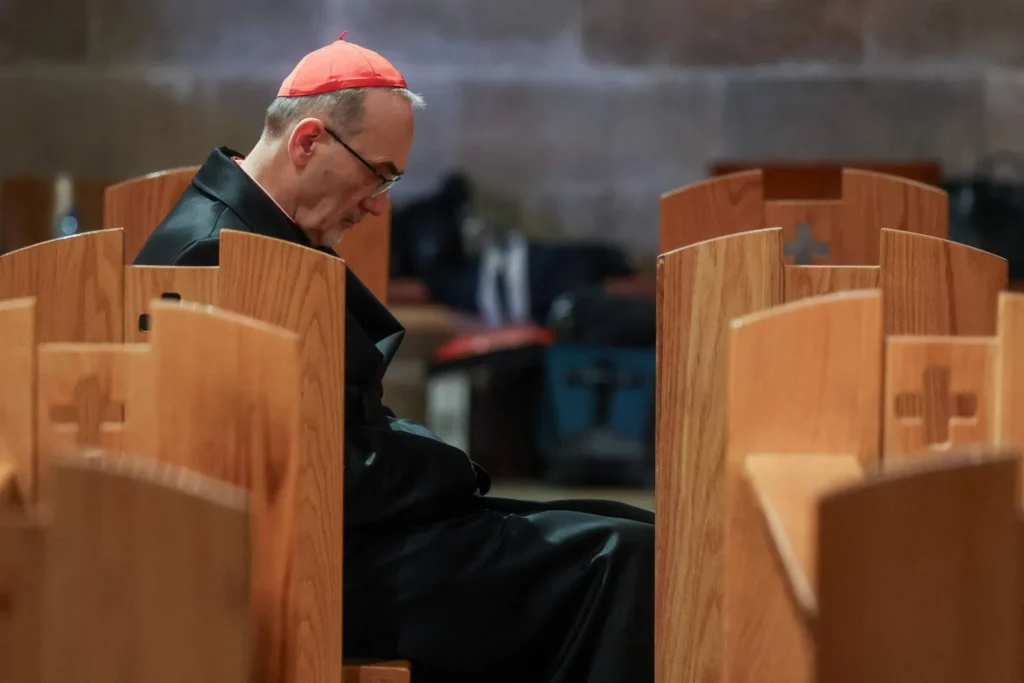
Israeli Police Block Cardinal from Holy Sepulchre, Sparking Outcry
In a move that has sent shockwaves through the Christian world and ignited a diplomatic firestorm, Israeli police prevented the Latin Patriarch of Jerusalem, Cardinal Pierbattista Pizzaballa, from entering the Church of the Holy Sepulchre on a recent Sunday. This site, revered as the location of Jesus Christ’s crucifixion, burial, and resurrection, is Christianity’s holiest shrine. The incident, which occurred without prior warning or clear explanation, has raised profound questions about religious freedom, sovereignty, and the fragile status quo governing Jerusalem’s sacred spaces.
A Stunning Scene at Christianity’s Holiest Site
The confrontation unfolded as Cardinal Pizzaballa, the highest-ranking Catholic official in the Holy Land, arrived to celebrate Sunday Mass. According to church officials, Israeli police officers stationed at the church’s entrance physically barred him from passing through the main door. The Cardinal was reportedly told the site was “closed,” despite the presence of other clergy and pilgrims inside. After a tense standoff, he was forced to abandon his plans and leave the area.
This was not a minor administrative hiccup. For the spiritual leader of the region’s Catholic community to be denied access to his own church for worship is an event without modern precedent. The Church of the Holy Sepulchre is jointly managed by several Christian denominations under a centuries-old agreement known as the “Status Quo,” and access for designated clergy is a fundamental, non-negotiable right.
Immediate Condemnation and Demands for Answers
The reaction from church authorities was swift and severe. The Latin Patriarchate of Jerusalem issued a strongly worded statement expressing “shock and regret” over the “serious and unprecedented incident.” They condemned the police action as a violation of the Status Quo and of fundamental rights to freedom of worship. Other Christian leaders in Jerusalem quickly rallied in solidarity, calling the blockade a dangerous provocation.
The outcry extended to the international diplomatic sphere. The Vatican, through its Secretariat of State, is said to be seeking urgent clarifications from Israeli authorities. Several countries with deep interests in the protection of Christian holy sites have also raised the issue, concerned about the stability of longstanding arrangements in Jerusalem.
Israeli Explanations and Deepening Controversy
In the aftermath, Israeli officials offered conflicting explanations, which only served to deepen the controversy. Initial statements from police suggested the action was taken due to concerns over a potential protest by a fringe Jewish group and was intended as a security measure. They claimed the decision was meant to “prevent friction” and ensure public order.
However, this rationale was met with skepticism and outright rejection by church leaders. They argued that policing decisions should never come at the expense of the basic religious rights of the community’s most senior cleric. Critics pointed out that if a specific threat existed, the solution was to address the threat, not to lock out the Patriarch.
More Than Security: A Political and Symbolic Flashpoint
Many analysts and local observers see the incident as part of a broader, more troubling pattern. They argue it is impossible to separate the event from the highly charged political context of Jerusalem and ongoing tensions over sovereignty and control. The Church of the Holy Sepulchre has often been a flashpoint in the complex relationship between Israeli authorities and Christian churches, who are deeply sensitive to any perceived encroachment on their autonomy.
In recent years, churches have protested against Israeli municipal tax policies and property laws they view as threatening. The sudden, unexplained blockade of the Cardinal is perceived by many as another, more dramatic pressure tactic—or at minimum, a sign of profound disrespect and poor coordination by state authorities.
- Violation of Status Quo: The event is seen as a direct breach of the delicate legal and customary balance that has allowed shared worship for centuries.
- Question of Sovereignty: It raises the raw question of who ultimately controls access to the holy site: the churches or the state.
- Erosion of Trust: For Christian communities, it shatters hard-earned trust and creates a climate of fear and uncertainty about their future in the Holy Land.
The Wider Impact on Christians in the Holy Land
For the small and often beleaguered Christian community in Jerusalem and the wider Holy Land, this incident is not an abstract diplomatic dispute. It is a deeply personal and symbolic affront. Many local Christians see themselves as living stones of the faith, custodians of a heritage under constant strain. Actions that marginalize their leadership or restrict access to their most sacred spaces are felt as existential threats.
The blockade sends a chilling message about their place in the social fabric of Jerusalem. If the Cardinal can be turned away, what security do ordinary faithful have? This incident risks accelerating the already worrying trend of Christian emigration from the region, further diminishing the ancient, living Christian presence there.
Pathways Forward: Apology, Dialogue, and Guarantees
To repair the significant damage, several steps are urgently required from Israeli authorities:
- A Formal and Public Apology: Clear accountability for the decision and a direct apology to Cardinal Pizzaballa and the Christian community is a non-negotiable first step.
- Transparent Investigation: A thorough review must be conducted to determine how and why such a decision was made, with findings shared with church leadership.
- Reaffirmation of Commitments: Israeli authorities must explicitly and unequivocally recommit to upholding the Status Quo at the Holy Sepulchre and guaranteeing unimpeded access for worship.
- Establishment of Clear Protocols: New, direct channels of communication must be established to prevent any future unilateral actions by police or other state bodies at sensitive holy sites.
A Test for Coexistence in Jerusalem
The shocking image of a Prince of the Church being barred from the tomb of Christ is one that will linger. This incident is a stark test for the principles of religious freedom and mutual respect in a city claimed as sacred by billions. How Israeli authorities choose to respond—whether with deflection or with genuine corrective action—will have lasting repercussions.
The Church of the Holy Sepulchre stands as a monument to faith, but also to fragile coexistence. Its survival through centuries of conflict depends on rules, respect, and restraint. The blockade of Cardinal Pizzaballa violated all three. Mending this rupture is not just a matter of diplomatic necessity; it is essential for preserving the very possibility of a shared, peaceful future in Jerusalem. The world is watching to see if the path to the empty tomb remains open for all who seek it in peace.

