
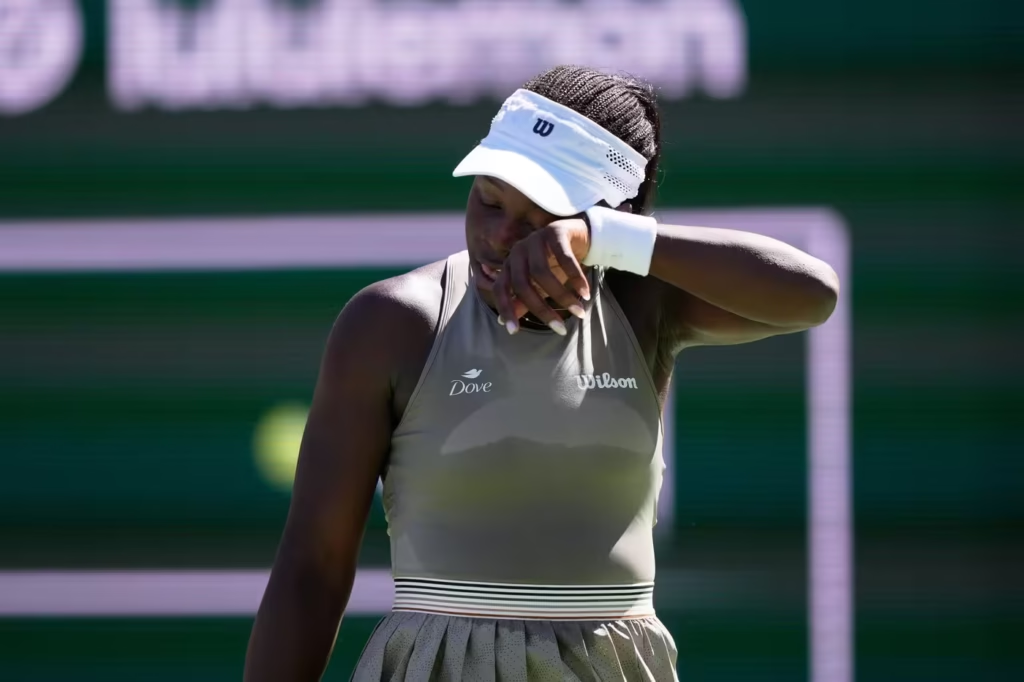
Canada’s BJK Cup Team Faces Kazakhstan Without Star Marina Mboko
The Canadian Billie Jean King Cup team’s journey to Nur-Sultan has been dealt a significant blow ahead of their crucial qualifying tie against Kazakhstan. Marina Mboko, the World No. 9 and the squad’s highest-ranked player, has withdrawn due to injury, forcing captain Heidi El Tabakh into a last-minute tactical reshuffle. This unexpected development casts a new shadow of challenge over Canada’s quest to advance to the 2026 Billie Jean King Cup Finals, transforming a difficult away fixture into a monumental test of depth and resilience.
For a nation riding a wave of tennis success, Mboko’s absence is a stark reminder of the fine margins in elite team competition. Her powerful baseline game and big-match temperament were seen as essential weapons against a formidable Kazakhstani side known for its tenacity on hard courts. Her withdrawal not only removes a potential two-point anchor from the singles lineup but also shifts immense pressure onto the shoulders of her teammates.
The Stakes: A Direct Path to the Finals on the Line
This tie represents far more than a friendly international clash. It is a direct qualifier for the 2026 Billie Jean King Cup Finals. The winner of this best-of-five match series (featuring four singles rubbers and one doubles) will earn a coveted spot in next year’s championship event, joining the world’s top tennis nations. For Canada, a perennial contender in recent years, missing the Finals would be a considerable setback.
Kazakhstan, led by the experienced and always-dangerous Yulia Putintseva and the rising power of Elena Rybakina, presents a daunting challenge on home soil. Their team is built around relentless aggression and fearless shot-making, perfectly suited to the indoor hard courts of the National Tennis Centre. Even with a full-strength squad, Canada would have been considered the underdog. Without their leading star, the mountain to climb becomes significantly steeper.
Who Steps Up? The Revised Canadian Lineup
With Mboko sidelined, Captain Heidi El Tabakh has turned to a blend of experience and promising talent to carry the Canadian colors.
* Leylah Annie Fernandez: The veteran of the team and a former Grand Slam finalist instantly becomes the de facto leader. Fernandez’s trademark fighting spirit, creative game, and experience in these high-pressure team environments will be invaluable. She will likely be tasked with facing the top Kazakh players, and her performance could set the tone for the entire tie.
* Rebecca Marino: The powerful veteran brings a crucial element of firepower. Her massive serve and first-strike tennis can overpower any opponent on her day. On a fast indoor court, Marino’s game is a potent weapon, and she will be looked upon to secure critical points in the middle of the lineup.
* Katherine Sebov: The call-up for Sebov is a testament to her steady climb and resilience. A gritty competitor with solid groundstrokes, she offers a different look and unwavering determination. Her role may be pivotal in what could be a decisive fourth or fifth rubber.
* Gabriela Dabrowski: The world-class doubles specialist remains the team’s not-so-secret weapon. While the focus will initially be on singles, any tie that goes down to the decisive doubles rubber will see Canada fielding one of the best pairs in the world, likely with Fernandez or Sebov as her partner. Her leadership and doubles expertise are a huge asset.
Strategic Implications and the New Game Plan
Mboko’s withdrawal forces a complete strategic rethink. Initially, the plan might have centered on splitting the top two singles matches with Mboko and hoping to secure the remaining points. Now, the path to victory is less straightforward.
The key for Canada will be to target specific matchups and create an upset early. A win from Marino or Sebov against a higher-ranked Kazakh player could swing the momentum entirely. Fernandez will need to be near her brilliant best to counteract the host nation’s top stars. Furthermore, the potential of forcing a deciding doubles rubber, where Dabrowski’s skill gives Canada a pronounced advantage, becomes an even more critical part of the game plan.
The team must also rally around the collective “us-against-the-world” mentality. The pressure has visibly shifted to Kazakhstan, who are now overwhelming favorites on paper. Canada can embrace the underdog role, playing with freedom and nothing to lose, which is often when teams are at their most dangerous.
The Bigger Picture: Depth and Development in Canadian Tennis
While immensely challenging, this situation also serves as an unintended stress test for the health of Canadian women’s tennis. It asks a profound question: Does the system have the depth to withstand the loss of a top-10 player?
The call-up of Katherine Sebov is a positive sign, indicating a pipeline of players ready to answer the national call. The presence of a seasoned champion like Dabrowski and a battle-tested fighter like Fernandez provides a stable core. This tie offers Sebov and others a priceless opportunity to gain experience on one of the biggest stages in team tennis, experience that will pay dividends for the program in the years to come.
It also highlights the importance of the Billie Jean King Cup itself as a development tool. For players outside the absolute top echelon, representing their country in a live away tie provides a unique and intense competitive environment that differs greatly from the weekly tour grind.
A Dauntless Challenge Awaits in Nur-Sultan
There is no sugarcoating the reality: Canada’s task in Kazakhstan just became exponentially harder. The loss of a player of Marina Mboko’s caliber is a deficit no team can easily cover. The host nation boasts elite talent and will be confident in front of their home supporters.
Yet, to write off this Canadian team would be a mistake. They are captained by a leader who knows what it takes to win in this competition. They have players who have thrived in hostile environments before. They have a mix of power, grit, tactical guile, and world-class doubles prowess.
This tie is no longer about relying on a single star. It is now a pure test of heart, strategy, and collective will. Each player will need to dig deeper, play smarter, and fight for every single point. The dream of reaching the 2026 Finals is still alive, but the path is now a narrow, arduous one. The Canadian team’s response to this adversity will define their legacy and reveal the true character of this next generation of tennis stars. The world will be watching to see if they can rise to the occasion.

