
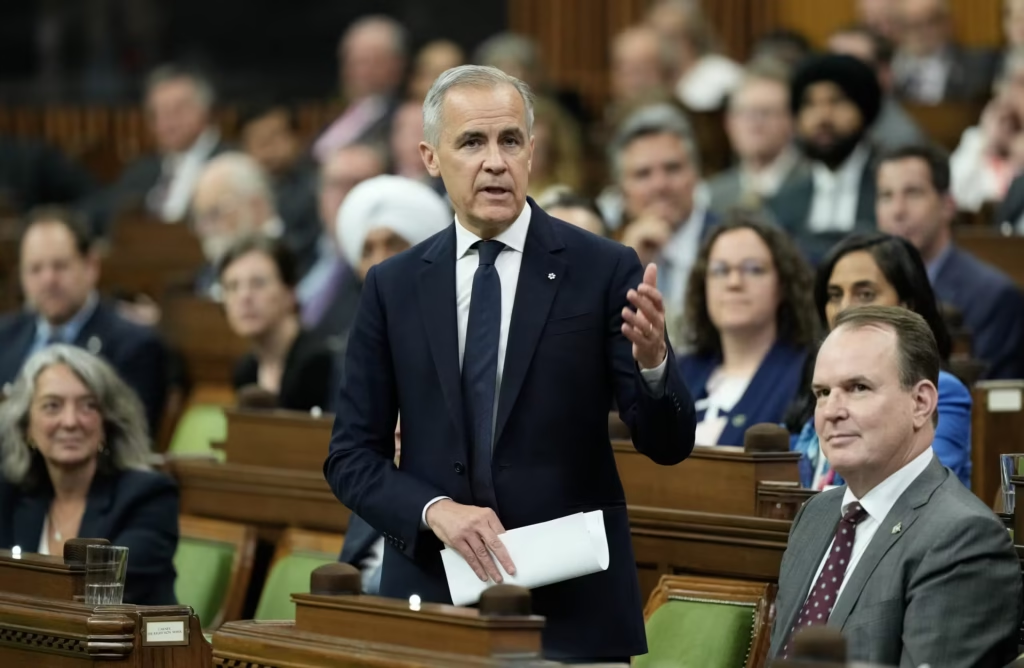
Why PM Mark Carney Chooses to Skip Question Period
The spectacle of Question Period is a cornerstone of Canadian parliamentary democracy. It’s the daily, televised gladiatorial contest where the government is held to account by the opposition, a forum for fiery rhetoric, pointed inquiries, and performative politics. So, when a sitting Prime Minister makes a conscious choice to largely absent themselves from this arena, it raises immediate and profound questions. Such is the developing narrative surrounding Prime Minister Mark Carney, whose notable pattern of skipping Question Period has become a defining, and contentious, feature of his early tenure.
This isn’t merely a scheduling quirk; it’s a calculated statement. To understand why PM Mark Carney strategically avoids the QP spotlight, one must look beyond the political playbook and into the core of Carney’s identity: that of a technocrat, a global economist, and a leader who believes governance is separate from political theatre.
The Technocrat vs. The Theatre
Mark Carney did not ascend to the highest office through the traditional, grinding path of constituency barbecues and partisan backrooms. His reputation was forged in the boardrooms of the Bank of Canada, the hallways of the Bank of England, and the high-stakes meetings of global climate finance. His currency is data, economic models, and international diplomacy, not partisan zingers.
For a leader of this mould, Question Period can appear less as a tool of accountability and more as an inefficient relic designed for conflict over solutions. The format—with its 35-second questions and often meandering, pre-scripted answers—is structurally antithetical to the nuanced, evidence-based discussion Carney prefers. In his view, the complex challenges of economic stabilization, energy transition, and housing affordability cannot be distilled into soundbites meant to score points on the evening news.
A Deliberate Delegation of Duty
Critics, primarily from the opposition benches, lambast the Prime Minister’s absence as a dereliction of democratic duty. They argue that facing Parliament is the most fundamental obligation of the head of government, a direct line of accountability to the people’s representatives. By delegating this task almost exclusively to his House Leader and ministers, Carney is accused of insulating himself from scrutiny.
However, his supporters and analysts see a different strategy. They frame it not as avoidance, but as a deliberate organizational and prioritization choice.
*
- Focus on Governance: Carney’s calendar is reportedly packed with policy deep-dives, international calls, and stakeholder meetings. His team argues that time spent preparing for and participating in QP’s theatrical combat is time stolen from the actual work of running the country and navigating global crises.
*
- Empowering the Cabinet: By having ministers front and center on their specific files, the government argues it provides more substantive, portfolio-specific answers. It reinforces the authority of the cabinet and forces a discipline where ministers are the experts on their dossiers.
*
- Controlling the Narrative: Away from the unpredictable fray of QP, Carney can communicate directly with the public through controlled, policy-focused announcements, press conferences, and international forums, where his strengths are most pronounced.
The High-Stakes Gamble of a QP Absence
This approach, while philosophically consistent for Carney, is not without significant political risk. The decision to sidestep the traditional arena of political combat is a gamble with several potential consequences.
Potential Pitfalls and Opposition Attacks
*
- The Accountability Deficit: The most potent attack line is that Carney is “too elite” or “above” answering to Parliament. This can erode public trust and feed a narrative of an aloof, unelected leader disconnected from the cut and thrust of domestic politics.
*
- Empowering the Opposition: His empty chair becomes a powerful symbol. Opposition leaders can directly challenge his courage and commitment to democracy, framing his absence as weakness rather than wisdom. It allows them to own the QP narrative uncontested.
*
- The Ministerial Pressure Cooker: While intended to empower, this strategy can overwhelm ministers. Without the Prime Minister to deflect or absorb the broadest attacks, individual ministers face heightened, concentrated fire, potentially exposing weaker performers.
*
- Undermining Parliamentary Primacy: It risks diminishing the stature of the House of Commons itself, suggesting the real work happens elsewhere—in cabinet, in bureaucracies, or on the global stage.
The Counter-Argument: A New Model of Leadership?
Carney’s defenders urge a recalibration of what we expect from a modern Prime Minister. In an era of constant media noise and hyper-partisanship, is the daily theatrical confrontation still the best marker of accountability and competence? They posit that Carney is attempting to pioneer a post-theatrical style of leadership, where results and substantive policy outcomes are the true metrics, not QP performance.
His public appearances, when they do happen, are meticulously crafted. He chooses settings where he can explain multi-step economic plans or complex international agreements, often flanked by charts and experts. This is the “Carney brand”: sober, serious, and solution-oriented. Question Period, with its heckling and gotcha moments, fundamentally clashes with this brand. His avoidance may be a protective measure to preserve the authoritative, data-driven persona that forms the core of his political appeal.
Historical Context and the Carney Precedent
While unusual, Carney is not the first prime minister to chafe at Question Period. Past leaders have expressed frustration with its format. However, few have made such a consistent and overt practice of absence so early in their mandate. Previous PMs, even those with global statures, understood QP as a non-negotiable, if unpleasant, ritual of the job—a place to demonstrate command, defend their team, and connect, however combatively, with the elected chamber.
Carney’s actions suggest he is willing to break this convention. He is betting that the Canadian public, weary of political noise and hungry for competent management, will reward substance over ceremony. He is wagering that his work on the world stage to attract investment, or his government’s progress on housing starts, will matter more to voters than his absence from a shouting match in Ottawa.
The Verdict: Strategic Finesse or Democratic Failure?
The question of “Why PM Mark Carney Chooses to Skip Question Period” ultimately has two divergent answers, depending on one’s philosophy of democracy.
From one perspective, it is a dangerous abdication. Democracy is messy, adversarial, and demanding. The Prime Minister, as the most powerful person in the country, must stand in the arena and be held to account in its most public forum. There is no substitute.
From the other perspective, it is a pragmatic and modern recalibration. It reflects a leader who prioritizes governance over politics, who believes his time is better spent solving problems than performing them. It is a rejection of outdated political theatre in favor of a more serious, results-driven approach to running a country.
Only time will reveal which interpretation the public accepts. Will Mark Carney be remembered as the leader who dared to transcend political theatre to deliver competent governance? Or will he be seen as a technocrat who never fully embraced the democratic rough-and-tumble required of a Canadian Prime Minister? His empty chair in the House of Commons is not just a physical absence; it is the quiet epicenter of a profound debate about the very nature of political leadership in the 21st century.

