
Analyzing Canada’s Prolonged Curling World Championship Drought and Niklas Edin’s Unmatched Dominance
The 2024 BKT Tires World Men’s Curling Championship in Schaffhausen, Switzerland, has concluded, leaving in its wake a story that is both triumphant and troubling for the sport’s global landscape. On one hand, the ice witnessed the further ascension of a living legend. On the other, it echoed with the silent frustration of a nation whose curling identity is intrinsically linked to gold. For the seventh consecutive year, the podium’s top step remained just out of reach for Canada, while Sweden’s Niklas Edin skated to a record-shattering seventh world title. This event wasn’t just a tournament; it was a clear snapshot of a new era in men’s curling, one defined by a Scandinavian dynasty and a Canadian conundrum. Let’s delve into the layers of this narrative, exploring the mastery of Edin, the deepening drought for Canada, and what it all means for the future of the sport.
The Unwavering Brilliance of Niklas Edin: Cementing a Legacy
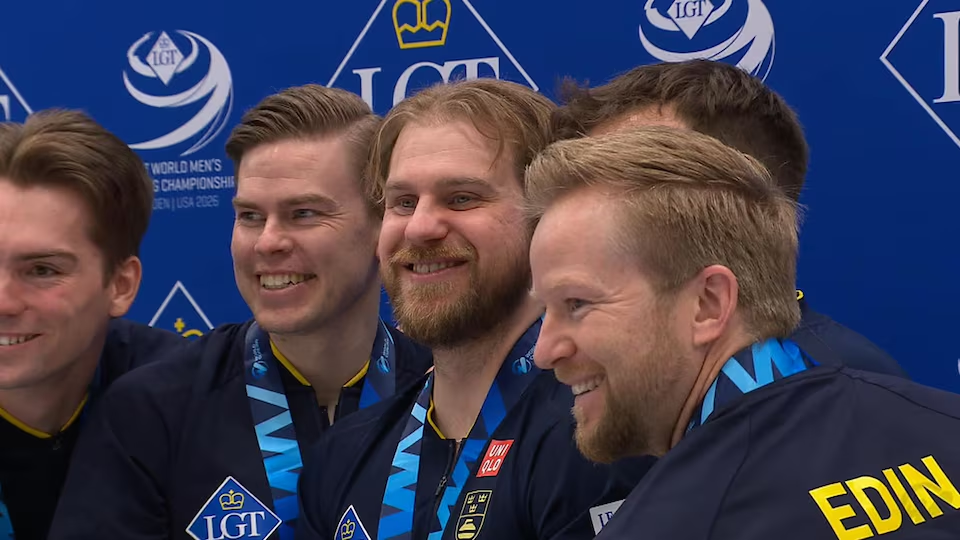
To call Niklas Edin’s performance at the 2024 worlds merely “winning” would be a profound understatement. What he and his team—Oskar Eriksson, Rasmus Wranå, and Christoffer Sundgren—delivered was a masterclass in sustained excellence. Securing a seventh world championship crown places Edin in a stratosphere entirely of his own, distancing him from all other skips in history. This victory wasn’t a fluke or a product of luck; it was the result of a system, a mentality, and a synergy that has been honed over a decade of dominance.
A Dynasty Built on Precision and Poise
The Swedish quartet operates with a chilling, machine-like efficiency. Every call, every sweep, every release seems part of a grand, pre-ordained plan. Their success is built on a foundation of:
- Strategic Depth: Edin’s game management is peerless. He consistently puts opponents in difficult positions, forcing errors while minimizing his own team’s risks.
- Clutch Shot-Making: When the pressure reaches its peak, the Swedish team elevates. The ability to make the perfect draw or a spectacular double takeout in the final ends of close games has become their trademark.
- Unshakeable Team Synergy: This is perhaps their greatest asset. The communication, trust, and collective calm exhibited by the team, regardless of the scoreboard, create a psychological fortress that is incredibly hard to breach.
Edin’s legacy now transcends statistics. He has redefined what is possible in modern curling, setting a benchmark for preparation, athleticism, and mental fortitude. He is not just winning tournaments; he is defining an era, and every team arriving at a world championship does so with the primary goal of finding a way to beat Sweden.
The Deepening Puzzle of Canada’s Gold Drought
While Edin celebrated, Canadian curling fans were left to ponder another near-miss. Brad Gushue, Mark Nichols, E.J. Harnden, and Geoff Walker performed admirably, battling through a tough field to secure the bronze medal. Yet, the color of that medal underscored a growing, undeniable trend: Canada’s men have not won a world championship since 2017, when Gushue himself stood atop the podium. This seven-year drought is the longest in the country’s storied men’s championship history, a startling fact for a nation that considers curling a winter pastime and a point of national pride.
Beyond a Bad Week: A Systemic Challenge
The narrative can no longer be dismissed as a simple “off year” or a single missed shot in a semifinal. Canada’s 6-5 loss to eventual runner-up Scotland in the 2024 semis was a perfect microcosm: a game of inches where one or two stones decided the fate. The issue is broader. The world has not only caught up to Canadian curling; in some respects, it has surged ahead. Nations like Sweden, Scotland, and Italy have invested in centralized programs, year-round training, and sports science that mirror professional athletic models.
The traditional Canadian pathway, often built around club-based excellence and seasonal play, is facing unprecedented pressure. While Canadian teams remain among the world’s best—evidenced by consistent podium finishes—climbing that final step to gold requires overcoming dynasties that are built for the modern, grueling championship circuit. The question for Curling Canada and its high-performance program is no longer about talent, which is abundant, but about bridging that microscopic margin through strategic innovation, psychological conditioning, and sustained international competition.
Strategic Takeaways from the 2024 World Championship
The events in Schaffhausen offered clear lessons for any team with aspirations of claiming the world title. The modern game demands more than just skillful shot-making; it requires a comprehensive championship mentality.
Blueprints for Success in Elite Curling
- The Four-Round Marathon: Winning a world championship is a test of endurance as much as skill. Success demands peak performance through the round-robin, qualification games, playoffs, and the final. Edin’s team is the prototype for this, maintaining a remarkably consistent level over two grueling weeks. Teams must be built and conditioned for this specific format.
- Victory Hinges on a Single Stone: The margins at this level are virtually non-existent. As seen in Canada’s semifinal, games are routinely decided by one precise shot or one minor error. Training must now simulate that intense, end-game pressure where every heartbeat matters. The ability to execute the “shot of the game” under duress separates champions from contenders.
- The Psychology of Dynasty: Beating a team like Sweden involves a dual challenge: outplaying them on the ice and overcoming their aura of invincibility. Legacy creates a psychological hurdle. Opponents know that Edin’s team has been in every situation and prevailed, which can subconsciously affect decision-making and confidence in critical moments. Developing mental resilience to counter this is crucial.
Looking Ahead: The Road to 2026 and Beyond
The cycle of world championships and Olympic Games waits for no one. The conclusion of the 2024 event immediately resets the clock, with teams now focusing on the next quadrennial leading to the 2026 Winter Olympics in Milan-Cortina.
Canada’s Path to Redemption
For Canada, the mission is clear but formidable. The system must find ways to convert podium potential into gold-medal performance. This likely involves:
* **Enhanced High-Performance Integration:** Leveraging data analytics, sports psychology, and more frequent international squad competitions to build experience.
* **Cultivating a Killer Instinct:** Fostering the kind of closing mentality that defines teams like Sweden. This means playing to win in big moments, rather than playing not to lose.
* **Strategic Patience and Support:** Recognizing that the gap is small and requires sustained investment in athletes, coaching, and innovation rather than reactive changes.
The talent pipeline in Canada remains robust, with young teams emerging and veteran skips like Gushue still at the top of their game. The challenge is systemic, but the resources and passion to solve it exist.
The Era of Edin and the Chase for the Crown
For the rest of the world, the target remains firmly on Niklas Edin’s back. Yet, at 38, he shows no signs of decline. His continued motivation and his team’s relentless pursuit of perfection suggest the dynasty is far from over. He has become the benchmark, the constant against which all other teams are measured.
The most compelling subplot in men’s curling today is the pursuit of this seemingly untouchable king. Can Scotland’s Bruce Mouat, Italy’s Joel Retornaz, or a renewed Canadian contender finally dethrone him? Or will Edin continue to extend his records into the 2026 Olympic cycle and beyond?
The 2024 World Men’s Curling Championship solidified two defining truths: Niklas Edin is the greatest to ever play the game, and the path to beating him runs through a level of excellence that the entire sport is still scrambling to reach. Canada’s drought is a symptom of this new reality—a reality where gold is no longer a birthright but a prize that must be wrestled from the hands of a legend. The journey to 2026 promises to be an fascinating battle between a reigning dynasty and a chasing pack hungry for change.

