
Mi’kmaq Students Connect with NASA’s Artemis II Moon Mission Crew
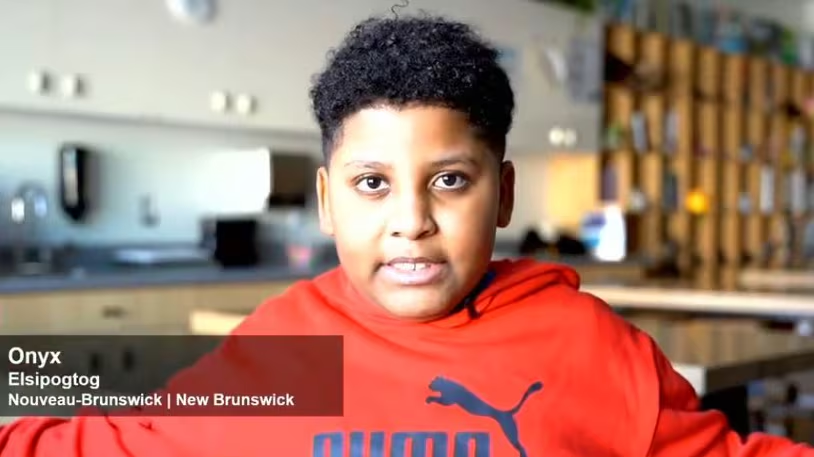
In a powerful moment of cosmic connection, students from Elsipogtog First School in New Brunswick recently bridged the gap between their Mi’kmaq community and the vast expanse of space. The students participated in a once-in-a-lifetime video call with astronauts Jeremy Hansen and Victor Glover, key members of NASA’s upcoming Artemis II mission. This historic conversation wove together cutting-edge space exploration with deep cultural heritage, offering a profound lesson in how the journey to the Moon is also a journey of understanding our shared home on Earth.
A Historic Mission Meets Ancient Wisdom
NASA’s Artemis II mission is a landmark endeavor. Slated to launch in September 2025, it will be the first crewed mission to orbit the Moon in over 50 years. The four-person crew, which includes Canadian astronaut Jeremy Hansen, will not land but will pave the way for future lunar surface missions, including the first woman and the first person of color to walk on the Moon.
For the students of Elsipogtog, this mission took on a special significance. Their questions for the astronauts went beyond the technical details of rocket science. They delved into themes of stewardship, perspective, and the interconnectedness of all things—concepts deeply rooted in Indigenous worldviews. By asking how space travel changes an astronaut’s view of Earth, the students initiated a dialogue that connected NASA’s “Overview Effect” with Indigenous principles of environmental care.
Questions from Elsipogtog: Bridging Worldviews
The students prepared thoughtful questions that revealed their unique perspective. One poignant inquiry was about how the astronauts would honor and represent Mother Earth while looking back at her from the darkness of space. This question beautifully frames the planet not as a resource, but as a familial entity to be respected.
Another student asked about the potential for discovering water on the Moon, a topic that resonates deeply with Mi’kmaq teachings about water as a sacred life-giving force. The dialogue created a unique intersection where scientific curiosity met spiritual reverence, showing that the quest for knowledge in space can be enriched by ancient wisdom from Earth.
Jeremy Hansen’s Message of Inspiration and Inclusion
For Canadian astronaut Jeremy Hansen, the call was a meaningful part of his role. He emphasized to the students that the Artemis missions are about more than just returning to the Moon; they are about building a permanent and inclusive presence in space. “We are going to the Moon to learn to live there, to work there, so we can go on to Mars,” Hansen explained. “And we’re doing it with all of international partnership, and that includes Indigenous Peoples.”
His message was one of direct inspiration: “You can be a part of this,” he told the young listeners. He highlighted the diverse team behind the missions—engineers, technicians, communicators, and scientists—stressing that there is a place for everyone, including those who carry the knowledge and values of their Indigenous communities.
Victor Glover on the “Overview Effect” and Unity
NASA astronaut Victor Glover, who will pilot the Artemis II spacecraft, shared his insights on the profound shift in awareness many astronauts experience, known as the “Overview Effect.” He described it as seeing the Earth without borders, a fragile and beautiful oasis in the void. This perspective, he suggested, fosters a sense of global unity and responsibility.
When responding to the students’ questions about honoring the Earth, Glover connected this astronaut experience to their cultural values. He affirmed that carrying the awareness of Earth’s fragility and beauty is a way to honor it, a sentiment that aligns perfectly with the stewardship principles the students learn in their community.
Why This Connection Matters for the Future of Space Exploration
This interaction between Mi’kmaq youth and NASA astronauts is not just a feel-good story; it represents a significant step toward a more inclusive and holistic vision for space exploration. For too long, the narrative of space travel has been dominated by a single perspective. Engaging with Indigenous students and their worldviews introduces crucial questions about:
- Ethics in Exploration: How do we explore new worlds responsibly?
- Cultural Representation: Whose stories and values are carried forward into this new chapter?
- Environmental Stewardship: How can lessons from space inform our care for Earth?
The Artemis program, with its goals of sustainability and international partnership, provides a perfect platform for this broader conversation. Including Indigenous voices ensures that as humanity reaches for the stars, it does so with wisdom that has nurtured our planet for millennia.
Empowering the Next Generation of Trailblazers
The ultimate impact of this event may be seen in the halls of Elsipogtog First School and in the hearts of its students. By seeing themselves reflected in the grand endeavor of space exploration—not just as spectators, but as contributors with valuable knowledge—their sense of possibility is expanded.
- They learn that their cultural perspective is an asset to science.
- They understand that careers in STEM (Science, Technology, Engineering, and Mathematics) are within their reach.
- They carry forward the powerful idea that protecting Earth and exploring space are two sides of the same coin.
A Lasting Legacy: From Elsipogtog to the Moon
The video call may have lasted only an hour, but its resonance will endure. As Jeremy Hansen, Victor Glover, and their crewmates orbit the Moon in 2025, they will carry with them not only the hopes of nations but also the thoughtful questions and deep respect for Earth voiced by Mi’kmaq students in New Brunswick.
This connection reinforces a vital truth: space exploration is a human journey. It is enriched by the diversity of thought, experience, and heritage that all of humanity brings to the table. The students of Elsipogtog have shown that looking to the future requires listening to the wisdom of the past, creating a powerful synergy that will guide us as we venture, responsibly and reverently, into the cosmic ocean. Their conversation is a small but brilliant step toward ensuring that the path to the Moon, and beyond, is walked by and for all of humanity.

