
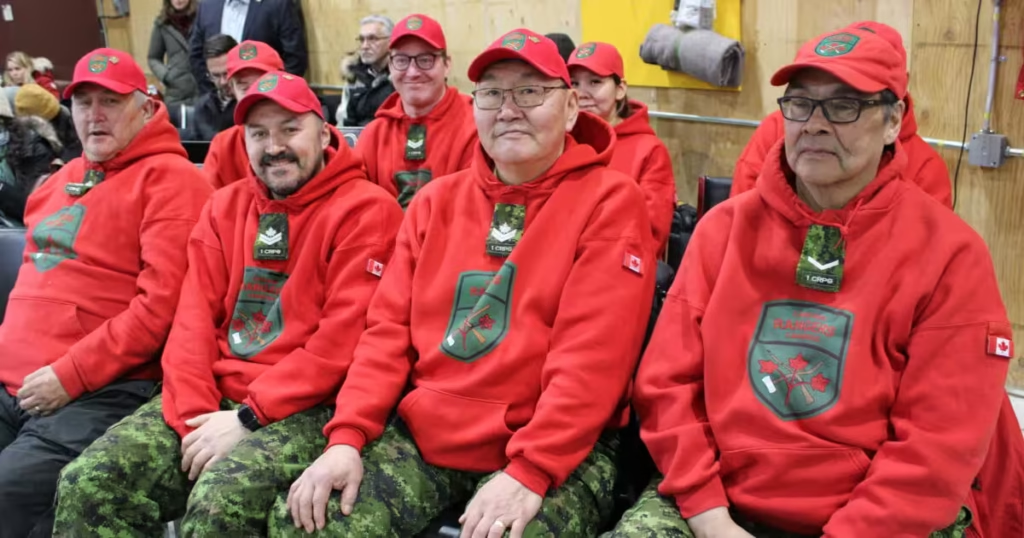
Canadian Rangers Deploy to Aid Nunavut Community in Energy Crisis
In the vast, breathtaking expanse of Canada’s Arctic, where temperatures can plummet to life-threatening lows with little warning, a reliable power source isn’t just a convenience—it’s a lifeline. This stark reality recently came into sharp focus for the remote Hamlet of Kinngait, Nunavut, as the community grappled with a severe energy crisis. In a decisive move underscoring the federal government’s commitment to Northern security, Northern Affairs Minister Dan Vandal approved the deployment of the legendary Canadian Rangers to provide critical support. This mobilization highlights not only the vulnerability of isolated Northern infrastructure but also the unique and indispensable role the Rangers play as the “eyes, ears, and voice” of the Canadian Armed Forces in these regions.
A Community in the Dark: The Kinngait Power Crisis
Kinngait, formerly known as Cape Dorset, is a vibrant Inuit community of approximately 1,400 residents, renowned globally as a capital of Inuit art. In late October, the hamlet faced a dire situation. Its aging power plant, operated by Qulliq Energy Corporation (QEC)—Nunavut’s crown-owned utility—experienced critical failures. With winter’s grip tightening, the community was thrust into a cycle of rotating blackouts and dangerously low power generation.
The scenario presented an immediate multi-layered threat:
- Public Safety: Extended power outages in Arctic conditions risk hypothermia, especially for elders and vulnerable populations. The functionality of critical facilities like the health centre, water treatment plant, and shelter were compromised.
- Food Security: Prolonged blackouts threaten to spoil food stores in homes and at the local store, a catastrophic loss in a region where groceries are already astronomically expensive.
- Economic and Social Disruption: The renowned artist studios, the lifeblood of Kinngait’s economy, ground to a halt. Schools closed, and daily life was profoundly disrupted, creating immense stress for residents.
Local and territorial governments worked tirelessly with QEC technicians, flying in specialized parts and personnel. However, the scale of the problem, compounded by the logistical nightmare of transporting heavy equipment to a remote fly-in community, demanded additional, specialized manpower. This is where the Canadian Rangers were called to step in.
The Sentinels of the North: Who Are the Canadian Rangers?
To understand the significance of this deployment, one must understand who the Canadian Rangers are. They are not conventional soldiers. Established in 1947, the Rangers are a unique sub-component of the Canadian Armed Forces Reserve, consisting primarily of Indigenous and local residents who live and work in remote, isolated, and coastal communities across Canada.
Their motto, “Vigilans” – “The Watchers” – perfectly encapsulates their role. They provide a light-footprint military presence in Canada’s vast North, conducting sovereignty patrols, supporting search and rescue operations, and assisting in natural disasters. Their greatest strength is their local knowledge and expertise. They are experts in surviving and operating in the harsh Arctic environment, skills honed over lifetimes, not just in training exercises.
Operation LENTUS: Domestic Disaster Response
The deployment to Kinngait falls under the Canadian Armed Forces’ Operation LENTUS, the framework for domestic disaster relief. When provincial or territorial resources are overwhelmed or lack specific capabilities, the federal government can authorize military assistance. Minister Vandal’s approval signified that the situation in Kinngait had reached a threshold where the Rangers’ unique skills were deemed essential for the health and safety of Canadians.
The Rangers’ tasks in Kinngait were practical and vital:
- Providing local logistics and transportation support for QEC technicians and equipment across difficult terrain.
- Assisting with community wellness checks, ensuring residents, particularly elders, were safe and had essential supplies.
- Offering general labour and manpower to help with the physical work of repairs and stabilization efforts.
- Serving as a crucial liaison and communication link between the community leadership, territorial officials, and military command.
Their deep community ties ensured their work was culturally sensitive and effective, building trust and streamlining efforts in a high-pressure situation.
Beyond the Emergency: Systemic Challenges in Northern Infrastructure
While the Rangers’ intervention provided immediate relief, the Kinngait crisis is a symptom of a much larger, systemic issue: the aging and fragile state of critical infrastructure in Canada’s Arctic. Most of Nunavut’s 25 communities are powered by isolated diesel-fired generating plants. These systems are:
- Extremely Costly: Diesel fuel must be shipped in via sealift during a short summer window, leading to exorbitant energy costs subsidized by the territory.
- Vulnerable to Failure: Many plants, like Kinngait’s, are decades old and operating beyond their intended lifespans. Spare parts are often scarce.
- Environmentally Unsustainable: They produce significant greenhouse gas emissions and risk devastating fuel spills in pristine ecosystems.
This emergency reignites urgent conversations about energy sovereignty and resilience in the North. There is a growing push for investment in renewable microgrids incorporating wind, solar, and run-of-river hydro to reduce diesel dependence. However, these projects require massive capital investment, specialized technical training for local residents, and must be engineered to withstand the Arctic’s extreme climate.
A Model for Community-Centric Support
The Kinngait deployment exemplifies the ideal model for military aid in a domestic, community-based crisis. The Rangers did not arrive as an external, imposing force. They arrived as neighbours, relatives, and experts wearing a recognizable uniform. This community-centric approach minimizes disruption and maximizes the efficacy of the support provided. It stands in contrast to more conventional disaster deployments in the south, where troops may be unfamiliar with the local environment and culture.
The situation also underscores the importance of continued federal investment in the Canadian Rangers program. Equipping and training these part-time soldiers ensures Canada has a ready-made, culturally attuned response force for Northern emergencies, whether they are man-made crises like power failures or natural disasters exacerbated by climate change.
Conclusion: Resilience in the Face of Adversity
The lights are slowly coming back on in Kinngait, thanks to the combined efforts of QEC technicians, hamlet staff, territorial emergency officials, and the Canadian Rangers. Yet, the community’s ordeal is a powerful reminder of the stark challenges facing Canada’s Arctic regions.
The deployment of the Rangers is a story of swift response and specialized skill, but it should also be a catalyst for long-term action. It highlights the urgent need for sustainable, reliable, and modern energy infrastructure across the North to ensure communities are not left in the cold. It celebrates the invaluable asset that is the Canadian Rangers—a force that embodies the resilience of the North itself. As climate change and aging infrastructure test these remote communities, the partnership between the people of the North and the watchers who protect them will remain one of Canada’s most crucial safeguards.

