
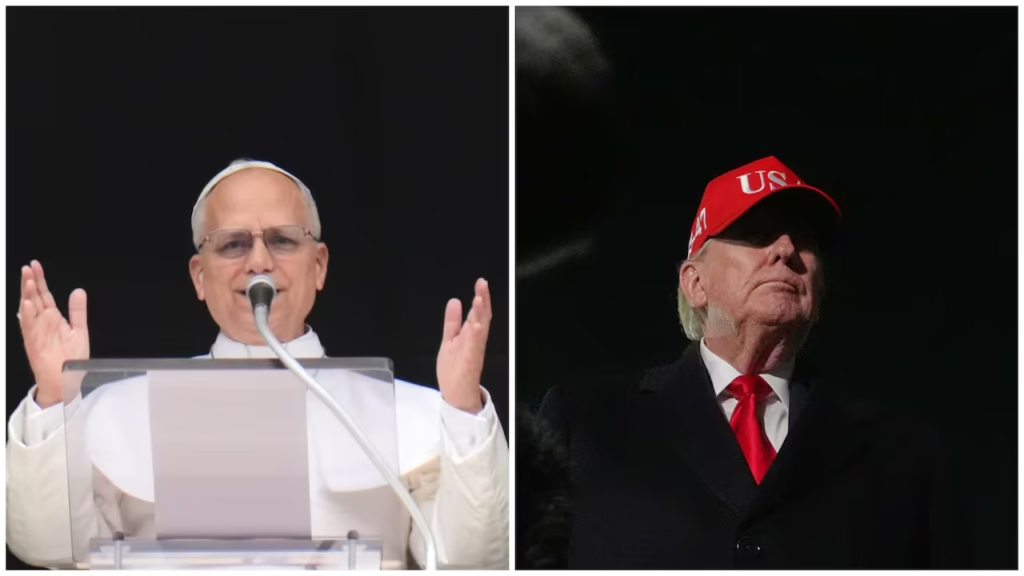
Trump’s Fiery Response to Pope Francis on Iran Stuns Observers
The world of diplomacy is often a stage for carefully measured words and calibrated gestures. But when former U.S. President Donald Trump and Pope Francis, two of the globe’s most influential figures, clash publicly, that stage is set ablaze. A recent, sharp exchange over the Pope’s comments on Iran has sent shockwaves through political and religious circles, revealing deep ideological rifts and stunning seasoned observers with its intensity.
The Spark: Pope Francis’s Call for Diplomacy with Iran
The controversy ignited when Pope Francis, during an interview, addressed the complex and volatile situation in the Middle East. The Pontiff, a consistent advocate for peace and dialogue, suggested that the international community should avoid escalating tensions with Iran. He emphasized a path of prudent diplomacy and negotiation, warning against the dangers of a hardened, confrontational stance that could lead to broader conflict.
For Pope Francis, this position is a cornerstone of his papacy. He has frequently positioned the Vatican as a neutral broker for peace, advocating for de-escalation in hotspots around the world. His comments on Iran were framed within this context—a pastoral and diplomatic plea for cooler heads to prevail, focusing on the humanitarian cost of potential conflict.
The Explosive Retort: Trump’s Scorching Rebuttal
The Pope’s measured call for dialogue was met with a characteristically forceful and public rebuttal from Donald Trump. Taking to his Truth Social platform, the former president unleashed a fiery response that left little room for interpretation.
Trump’s statement was a direct condemnation of the Pope’s stance, framing it as dangerously naive in the face of what he perceives as a grave threat. He argued that the Iranian regime, which he has long labeled as a leading sponsor of terrorism, only understands strength. His core argument was that appeasement and open-handed diplomacy are futile with such an adversary, and that the Pope’s approach would effectively empower a hostile state.
The language was stark, personal, and politically charged. It transcended a simple policy disagreement, morphing into a stark commentary on worldview. Observers were particularly stunned by the bluntness of the attack on a religious figure who commands the respect of over a billion Catholics worldwide.
Why This Clash Is So Unprecedented
While world leaders and popes have disagreed before, the public nature and tone of this exchange are exceptional.
- The Breach of Diplomatic Protocol: Direct, personal criticism of a sitting Pope by a major political figure, especially a former U.S. president, breaks longstanding norms of reserved discourse.
- The Fusion of Politics and Faith: The clash forces a uncomfortable public conversation about where moral authority on international conflict resides—in the diplomatic and spiritual guidance of the Vatican or in the hard-nosed, realpolitik approach championed by Trump.
- A Proxy for Broader Divides: This isn’t just about Iran. It’s a microcosm of the global divide between multilateralist, dialogue-driven institutions and unilateralist, power-centric approaches to foreign policy.
Analysts and Observers React: A Stunning Political Moment
The reaction from political analysts, diplomats, and religious commentators has been one of profound surprise. Many noted that such a public and vehement disagreement is rare in modern history.
- Foreign Policy Experts: Many saw the exchange as a crystallization of two irreconcilable foreign policy doctrines. One expert noted, “We are witnessing the purest form of the ‘clash of civilizations’ rhetoric versus the ‘dialogue of cultures’ ideal, personified by two titans.”
- Vatican Watchers: Some expressed concern that the Pope’s moral authority on peace issues was being directly challenged not by a rival state, but by a populist political movement’s standard-bearer.
- Political Strategists: Observers pointed out that for Trump, this serves to galvanize his base, drawing a clear “us versus them” line and positioning himself as the unambiguous strongman against what he frames as weak globalism.
The consensus is that this moment is more than a spat; it’s a symptom of a fragmented global order where traditional sources of moral and diplomatic authority are in open contest with nationalist-populist power.
The Deeper Implications: Faith, Power, and Global Order
Beyond the immediate headlines, this fiery exchange raises profound questions.
The Role of Religious Leadership in Geopolitics
Is the Pope’s voice as a peacemaker still heeded in an era of “America First” and hard power politics? The Vatican’s influence has always been soft, rooted in persuasion. Trump’s dismissal questions the very efficacy of that model in today’s world.
The Politicization of International Stances
Trump’s response effectively politicizes a stance on Iran that many nations share. It transforms a diplomatic strategy into a partisan lightning rod, making bipartisan or global consensus even harder to achieve.
A Preview of Future Global Discourse
This incident may be a template for future conflicts. As populist leaders continue to rise, direct clashes with multilateral institutions—be they the UN, the EU, or the Vatican—could become more common and more acrimonious.
A World Watching and Waiting
The fallout from this stunning exchange continues to unfold. The Vatican has maintained a dignified, silent stance in the face of the criticism, likely adhering to its philosophy of not fueling public feuds. Meanwhile, Trump’s comments have been amplified by his supporters and condemned by his critics, ensuring the story remains at the intersection of faith, politics, and global security.
What remains clear is that the battle for the narrative on how to engage with adversarial states is now playing out in the most public and personal of ways. The Pope’s cross and the former president’s Twitter feed have become the symbols of a deep and unresolved struggle over the soul of international relations. As the world watches, the question isn’t just about Iran, but about what kind of dialogue—if any—is possible in an age of fiery responses and shattered norms.

