
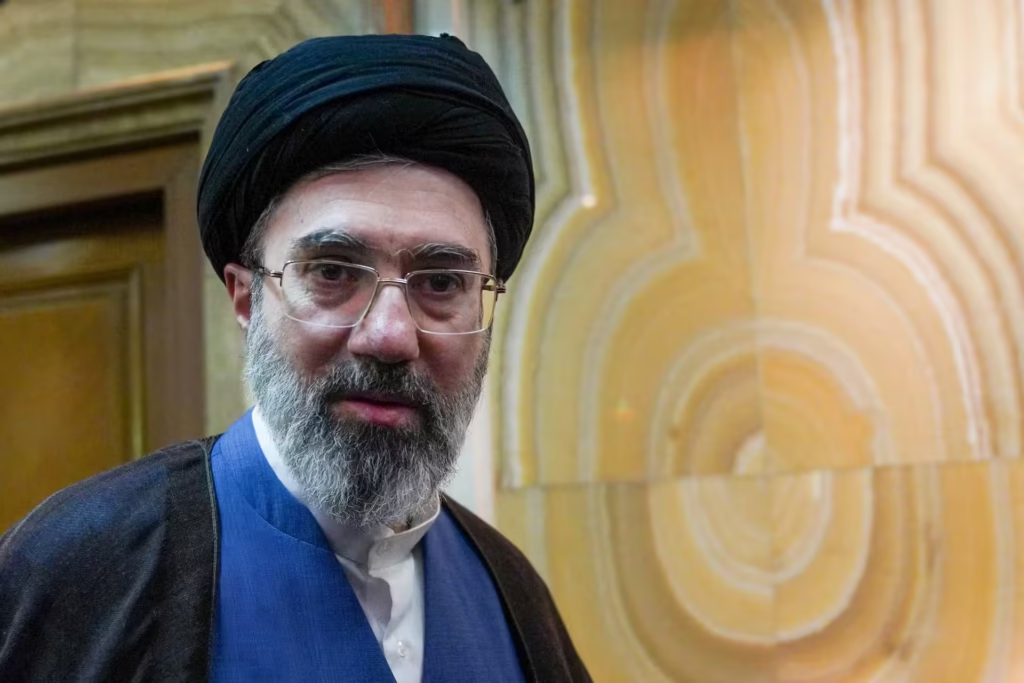
Iran’s Succession Crisis Deepens: Mojtaba Khamenei Severely Injured but Cognitively Unimpaired
The political landscape of the Islamic Republic of Iran has been violently disrupted. In a development that few anticipated, Mojtaba Khamenei, the 54-year-old son of Supreme Leader Ayatollah Ali Khamenei, has been reported as gravely wounded following a high-profile security incident. Yet, according to intelligence sources cited by RNZ and corroborated by regional analysts, the cleric’s mental faculties remain entirely intact. He is described as “mentally sharp,” fully lucid, and capable of issuing strategic directives despite his immobilizing injuries.
This duality—a broken body paired with a clear mind—creates a paradox for Iran’s opaque succession mechanism. It simultaneously signals vulnerability and resilience within the regime’s innermost circle. As Tehran’s power brokers scramble to assess the damage, the world watches to see if this is merely a setback or the beginning of a fundamental fracture in Iran’s command chain.
The Incident: What the Reports Reveal
Details are scarce, as is typical with matters involving the Office of the Supreme Leader. However, a consensus is forming among intelligence and diplomatic sources regarding the key facts.
- Nature of the Attack: The incident reportedly took place within a high-security compound traditionally considered impervious to infiltration. This suggests either a severe lapse in internal security or a targeted strike by a highly capable adversary.
- Physical Condition: Mojtaba is described as “gravely wounded,” requiring immediate and continuous intensive medical care. The specific nature of his injuries has not been disclosed, but the language used indicates life-threatening trauma.
- Cognitive Function: This is the critical variable. Sources close to his inner circle insist that his decision-making capacity is unaffected. He is reportedly communicating with senior aides, receiving intelligence briefings, and maintaining operational awareness.
Who Is Mojtaba Khamenei?
To understand the seismic implications of this event, one must first understand the man. Mojtaba is not merely the Supreme Leader’s son; he is the architect of much of the regime’s recent consolidation of power.
- Shadow Manager: For over a decade, he has effectively run the Beyt-e Rahbar (Office of the Supreme Leader), acting as a gatekeeper for access to his father.
- Military Liaison: He has cultivated deep ties with the Islamic Revolutionary Guard Corps (IRGC), serving as a crucial bridge between the clerical class and the military elite.
- Succession Front-Runner: While the constitution does not mandate hereditary succession, the political reality is that Mojtaba has been groomed for decades to assume the mantle of leadership. His intellectual rigor and political ruthlessness have made him the most powerful figure in the race to succeed the aging Ayatollah.
The Core Tension: Mental Sharpness vs. Physical Incapacitation
The most intriguing aspect of this story is the implied dichotomy between mind and body. For a theocratic state built on the image of the infallible Vali-ye Faqih (Guardian Jurist), the sight of a wounded heir is deeply problematic. However, the regime is adept at projecting strength through narrative.
If Mojtaba Khamenei remains mentally sharp, he can still govern. He can still issue commands. He can still negotiate with factions. He can still oversee the nuclear file and the “Axis of Resistance” from a gurney.
Why his lucidity matters more than his mobility:
- Command Continuity: As long as he can speak and think, he can direct the IRGC and intelligence services. The regime has successfully operated with aged and ailing leaders before.
- Factional Control: His physical absence from the public eye may actually allow him to mediate between hardliners and pragmatists without the pressure of constant visibility.
- Succession Timelines: The attack does not remove him from the list of candidates; it merely complicates the timing. A “sharp” Mojtaba can still dictate the terms of the transition.
Why his physical wounds pose an existential risk:
- Symbolism of Invulnerability: The Supreme Leader is theoretically protected by divine will. A successful attack on his designated heir shatters that aura. It paints the regime as penetrable.
- Internal Scapegoating: The security breach will inevitably trigger a brutal purge within the IRGC and the Ministry of Intelligence. Factions will blame each other, potentially leading to internal conflict.
- Succession Race Reopened: Rivals who had accepted Mojtaba’s ascendancy may now see a window of opportunity. Figures like Ebrahim Raisi (if alive and active) or Saeed Jalili could gain renewed relevance.
Geopolitical Implications: What Comes Next?
Iran is currently navigating a delicate balancing act. It is engaged in a shadow war with Israel, seeking to manage relations with Gulf states, and attempting to negotiate a palatable exit from crippling Western sanctions. The incapacitation of the acting Supreme Leader’s son throws gasoline on this fire.
Impact on Regional Policy
- Axis of Resistance: Hezbollah, Hamas, and the Houthis look to Tehran for strategic guidance. If Mojtaba is unable to resume public functions within weeks, the chain of command could become bureaucratic and slow, reducing Iran’s ability to react to Israeli strikes.
- Nuclear Negotiations: The West may see this as a moment of weakness, potentially increasing pressure on Iran for concessions. Conversely, a wounded leadership often becomes more aggressive to prove its strength.
- Domestic Stability: The Iranian public, already restless from years of economic hardship and protest, will see this as a sign of regime frailty. The security apparatus will crack down harder, but the underlying tension will remain.
The Bottom Line: A Regime Under Medical Triage
The report that Mojtaba Khamenei is gravely wounded but mentally sharp is not a contradiction; it is a new reality. It suggests that Iran’s next Supreme Leader may begin his de facto reign from a hospital bed, directing the country’s fate through encrypted messages and whispered orders.
The key variable is time. Can he recover physically to a functional state? Or will the regime be forced to operate with a disembodied brain at the helm? For now, the cleric’s mind remains the most powerful weapon in Iran’s arsenal.
However, the attack on his person is a stark warning to the entire establishment: No one is safe. Not even the son of God’s representative on Earth.
As the dust settles in Tehran, one question echoes louder than any other: Was this a failed assassination, or was it the opening shot in a civil war for the soul of the Islamic Republic?
We will continue to monitor this developing story as regional sources provide further verification.

