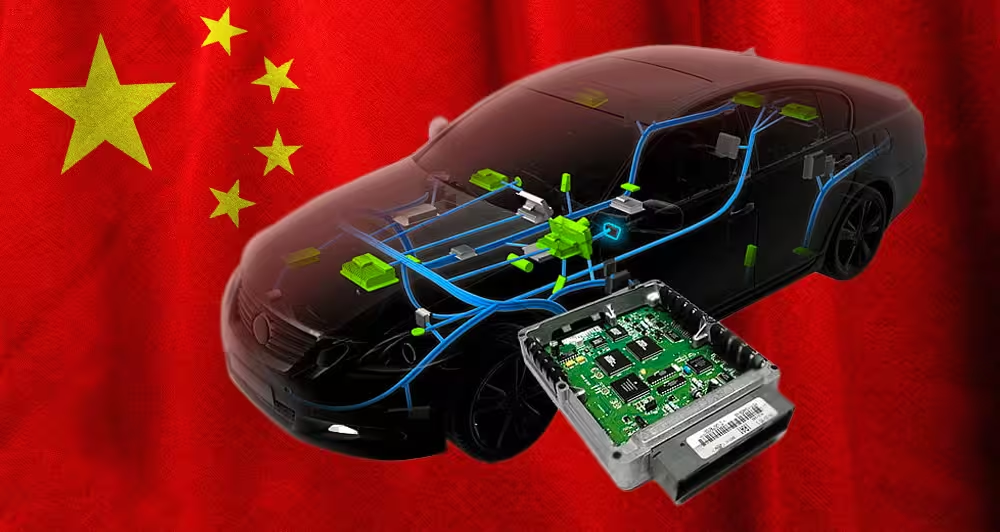
Ex-Canadian Intel Officer Warns MPs on Chinese Car Tracking Tech
In a startling revelation that has sent ripples through Canada’s national security community, a former Canadian intelligence officer has issued a stark warning to Members of Parliament about the sophisticated tracking technology embedded in imported Chinese vehicles. The testimony, delivered during a parliamentary committee hearing, raises urgent questions about data privacy, national sovereignty, and the hidden capabilities of modern automobiles entering the Canadian market.
The Warning That Shook Parliament Hill
The former intelligence professional, whose identity remains protected for security reasons, appeared before the House of Commons committee on public safety and national security. With decades of experience in signals intelligence and counter-espionage, the officer detailed how Chinese-manufactured cars are equipped with advanced telematics systems that go far beyond standard navigation or entertainment features.
Key concerns raised during the testimony include:
- Continuous real-time location tracking that transmits data directly to servers in China
- Microphone and camera systems that can be activated remotely without driver awareness
- Data collection protocols that harvest driver behavior, travel patterns, and personal information
- Potential for remote vehicle control through embedded cellular modems
The officer emphasized that these capabilities are not merely theoretical. “We have confirmed through multiple intelligence channels that certain vehicle models contain hardware and software components that cannot be explained by any legitimate commercial or safety function,” the former intel officer stated.
Understanding the Technology Behind the Threat
Modern vehicles are rolling computers with dozens of electronic control units (ECUs) and multiple connectivity points. What makes Chinese imports particularly concerning, according to the intelligence assessment, is the integration of government-mandated communication modules designed originally for China’s domestic surveillance infrastructure.
How the tracking technology reportedly works:
- Beidou satellite navigation system integration providing precise geolocation
- Always-on cellular connections using Chinese telecom protocols
- Over-the-air software update capabilities that could alter vehicle behavior
- Biometric sensors including driver-facing cameras and seat occupancy detectors
The officer explained that while many global automakers collect vehicle data, the Chinese systems are designed with direct government access in mind. “This is not the same as a German or Japanese car sending diagnostic data to the manufacturer. These are systems built to Chinese state standards that explicitly allow government agencies to query any vehicle at any time.”
The Scale of the Issue
Canada’s automotive market has seen a significant influx of Chinese-branded vehicles in recent years. Major manufacturers like BYD, MG (now Chinese-owned), and Geely have expanded aggressively into North America. Additionally, many vehicles assembled in North America contain Chinese-sourced components, including critical communication modules.
Statistics that highlight the scope:
- Over 150,000 Chinese-built vehicles were imported to Canada in 2023
- Chinese auto parts are present in approximately 40% of all vehicles sold in Canada
- Several Canadian police forces have begun testing Chinese-made electric vehicles
- Fleet operators, including government agencies, have purchased Chinese vehicles
The intelligence officer warned that the threat is not limited to passenger cars. Commercial trucks, buses, and even specialized government vehicles sourced from China present similar vulnerabilities.
National Security Implications
The parliamentary committee heard that the tracking capabilities pose risks across multiple domains. Military personnel driving personal vehicles to bases could unwittingly expose sensitive locations and movement patterns. Government officials, politicians, and civil servants face similar exposure.
Potential national security concerns:
- Compromise of critical infrastructure locations through vehicle tracking
- Pattern-of-life analysis on government employees and their families
- Data exfiltration through vehicle-to-everything (V2X) communication systems
- Vulnerability to cyber attacks leveraging the vehicle’s onboard networks
The former officer drew parallels to the widely publicized Huawei 5G controversy, noting that vehicle connectivity represents an even more intimate and persistent surveillance vector. “A phone can be left at home. A car follows you everywhere—to work, to your doctor’s appointments, to your secret meetings, to your vacation spots. It sees who you travel with and where you go in emergencies.”
Economic and Trade Dimensions
The warning comes at a delicate time for Canada-China trade relations. Canada has maintained economic ties with China while also expressing concerns about technology security. The automotive sector represents billions of dollars in bilateral trade, and any restrictions could have significant economic repercussions.
Factors complicating the response:
- Trade agreements that may limit Canada’s ability to unilaterally ban Chinese vehicles
- Potential retaliation from China affecting other Canadian exports
- Global supply chain reliance on Chinese automotive components
- Consumer demand for affordable electric vehicles
The intelligence officer acknowledged these complexities but argued that national security must take precedence. “We have intelligence-sharing agreements with Five Eyes partners that could be compromised if our allies lose trust in our communications security. A fleet of Chinese surveillance vehicles roaming Canadian roads undermines that trust.”
What Canadian MPs Can Do
The parliamentary committee is now considering multiple recommendations for immediate action. Several MPs from both government and opposition benches have expressed alarm and called for swift measures.
Proposed actions under discussion:
- Immediate moratorium on government procurement of Chinese vehicles
- Comprehensive security audits of Chinese-brand vehicles already on Canadian roads
- Legislation requiring data localization and independent security verification
- Enhanced cybersecurity standards for all imported connected vehicles
- Coordinated response with Five Eyes intelligence partners
Some MPs have suggested following the approach taken by other Western nations that have restricted certain Chinese automotive technologies, while others warn against escalation that could disrupt trade.
Consumer Awareness and Privacy Rights
For Canadians who already own or are considering purchasing Chinese vehicles, the situation presents a difficult dilemma. The intelligence officer urged consumers to be aware of the data they are surrendering when they get behind the wheel.
Tips for current vehicle owners:
- Review privacy policies and data-sharing agreements
- Disable unnecessary connectivity features where possible
- Be aware that removing connectivity hardware may affect warranties
- Use high-connectivity vehicles cautiously in sensitive contexts
- Monitor software updates and system behavior
Privacy advocates argue that beyond national security concerns, consumers deserve full transparency about what their vehicles collect and transmit.
Looking Ahead: The Future of Automotive Security
The former intelligence officer concluded the testimony with a sobering assessment. As vehicles become increasingly autonomous and connected, surveillance and cybersecurity risks will only expand.
“We are not dealing with a hypothetical future threat. The technology is here. It is operating on Canadian roads right now. Every day we delay, more data flows out of this country, and more vulnerabilities are embedded into our transportation infrastructure.”
The parliamentary committee is expected to release its findings and recommendations in the coming weeks, potentially shaping Canada’s automotive import and cybersecurity policy for years to come.