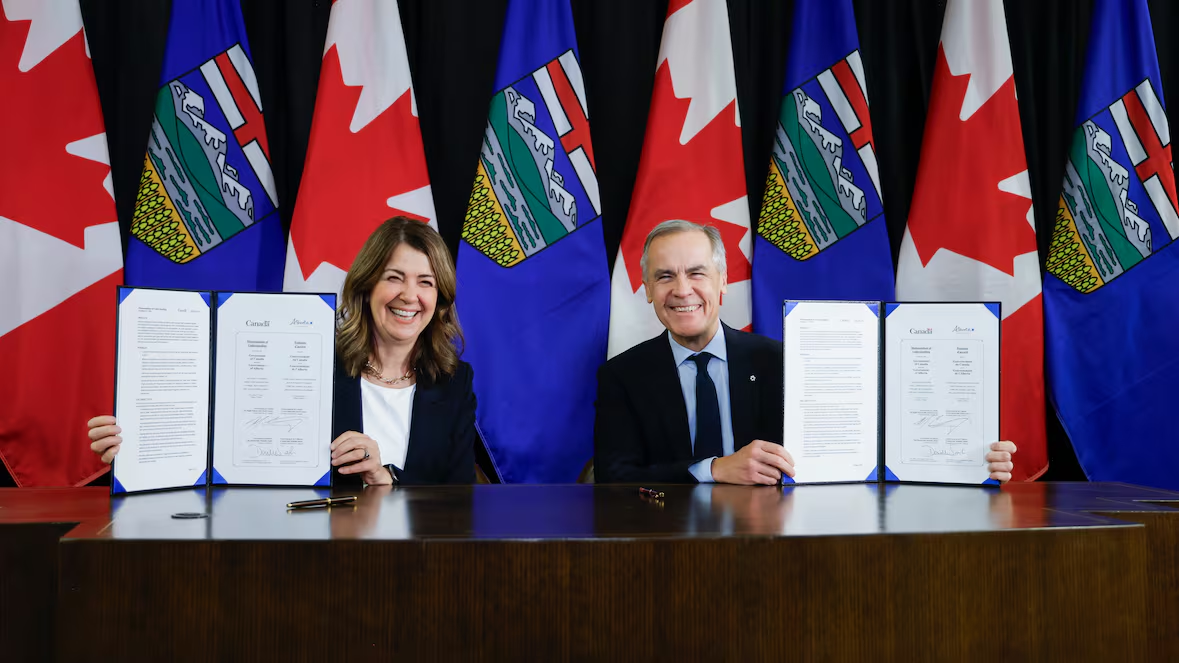
The relationship between Alberta and the federal government has long been defined by a single, potent resource: oil. For decades, this relationship has oscillated between uneasy partnership and outright conflict, with pipelines serving as the primary battleground. The recent agreement on the Trans Mountain Expansion (TMX) project, however, marks a historic and complex turning point. This isn’t just a story about moving crude; it’s a masterclass in political negotiation, shifting economic realities, and a fragile consensus that could redefine Canadian energy policy for a generation.
At its core, this deal represents a delicate political truce. For Alberta, securing a path forward for TMX was non-negotiable—a symbol of economic sovereignty and future prosperity. For the federal government, it was a perilous tightrope walk between upholding climate commitments, navigating Indigenous rights and title, and addressing the very real economic concerns of a region feeling left behind. The resulting agreement is a mosaic of compromises, where political survival met economic necessity.
The Rocky Road to Resolution: More Than Just a Pipeline
To understand the significance of this moment, one must first appreciate the depth of the discord that preceded it. The TMX project became a lightning rod for every major tension in Canadian society:
- Federal-Provincial Friction: Alberta’s sense of alienation peaked with the perception that federal environmental assessments and regulatory hurdles were designed to landlock its resources. The “Turn Off the Taps” rhetoric and the “Fair Deal” panel were symptoms of a deep-seated grievance.
- Indigenous Sovereignty and Partnership: The project faced staunch opposition from certain Indigenous communities along the route concerned about environmental risks, while others saw it as a vital source of economic development and ownership. This was never a monolithic issue.
- Environmental Advocacy vs. Economic Reality: The project sat at the epicenter of the national debate on climate change, pitting the urgent call for a energy transition against the immediate livelihoods of thousands of workers and a significant portion of Canada’s GDP.
The federal government’s eventual decision to purchase the pipeline in 2018 was a staggering political and financial intervention, born out of a stalemate that threatened to fracture the federation. It transformed the government from regulator to owner, blurring lines and intensifying scrutiny from all sides.
Decoding the Deal: Key Components and Concessions
The historic deal is not a simple handshake. It is a multi-faceted arrangement built on several key pillars that made agreement possible.
1. The Fiscal Framework and Royalty Structure
A central component was the establishment of a clear fiscal framework that gives Alberta greater certainty and a fairer share of the economic benefits. While details are complex, the deal likely involves adjustments to how resource revenues are managed or shared, providing Alberta with more autonomy over its economic destiny. This was a crucial concession to provincial sovereignty.
2. Indigenous Equity and Ownership Stakes
Perhaps the most groundbreaking aspect is the formal pathway created for Indigenous communities to acquire a meaningful ownership stake in the project. This moves beyond consultation to concrete partnership, aligning economic interests with environmental stewardship and addressing calls for economic reconciliation. It transforms the project from something done *to* or *near* Indigenous lands to something they can potentially own and benefit from directly.
3. Regulatory Certainty and “No Surprises” Commitments
The agreement seeks to draw a line under years of regulatory uncertainty. It includes commitments from both sides to uphold streamlined processes and avoid introducing new, last-minute regulatory barriers for approved projects. For industry, this “no surprises” clause is as valuable as any financial term, as it reduces political risk—a major deterrent to investment.
4. The Unspoken Climate Bargain
Looming over the entire deal is an implicit bargain on climate policy. For Alberta, movement on TMX was a prerequisite for any serious collaboration on federal climate goals like the carbon tax or the cap on emissions from the oil and gas sector. The deal likely foreshadows a more collaborative, rather than adversarial, approach to achieving Canada’s 2030 emissions targets, with Alberta having secured its key economic priority.
Political Winners, Losers, and the Lingering Challenges
In the immediate term, the Alberta government can claim a massive victory, having delivered on its core promise to get resources to tidewater. The federal government, meanwhile, can argue it preserved national unity, advanced economic reconciliation, and created the political space to aggressively pursue its climate agenda.
However, significant challenges remain:
- The Green Opposition: Environmental groups view the deal as a betrayal of climate commitments, locking in decades of fossil fuel dependence. Their legal and activist challenges may diminish but will not disappear.
- Economic Viability in a Transitioning World: The global energy landscape is shifting rapidly. The deal secures the pipeline’s construction, but its long-term profitability in a world moving toward net-zero is an open question that markets, not governments, will ultimately decide.
- The Implementation Trap: The history of Canadian energy is littered with agreements that unraveled during implementation. Ensuring the spirit of the partnership—particularly regarding Indigenous equity and regulatory fairness—is upheld in practice will be the ultimate test.
A New Chapter or a Temporary Ceasefire?
The historic Alberta pipeline deal is more than a transaction; it is a recalibration of the Canadian federation’s most volatile relationship. It demonstrates that in the face of mutual political and economic pain, compromise is possible. It has moved the conversation from whether a pipeline gets built to how the benefits are shared and how the project fits into a broader climate strategy.
Ultimately, this deal does not end the debate over Canada’s energy future. Instead, it changes the terms of the debate. The conflict is no longer about obstruction versus construction, but about stewardship, ownership, and managing a transition that is already underway. The success of this political bargain will not be measured by barrels shipped on the first day, but by whether it fosters a more stable, collaborative, and prosperous path for all parties in the difficult years to come. The pipeline is now being built, but the real work of building a lasting consensus has only just begun.