
Canada’s Black Loyalist History Gains UNESCO Memory of the World Honour
For generations, the dominant narrative of Canada’s founding often centered on a specific thread: the arrival of British Loyalists fleeing the American Revolution. But within that broader tapestry, a crucial and profoundly resilient strand was frequently overlooked. Now, that strand has been elevated to the world stage. The history of the Black Loyalists—the thousands of free and enslaved Black people who sought liberty behind British lines—has been inscribed into UNESCO’s Memory of the World Register, a prestigious honour that safeguards humanity’s documentary heritage.
This recognition is more than an archival accolade; it is a powerful act of reclamation. It validates the struggles, contributions, and enduring legacy of these pioneering individuals, ensuring their stories are not just remembered, but are integral to our understanding of Canadian identity.
Who Were the Black Loyalists?
The story begins in the crucible of the American Revolutionary War (1775-1783). In a strategic move to destabilize the rebel colonies, the British Governor of Virginia, Lord Dunmore, issued a proclamation in 1775 promising freedom to enslaved people who would flee their rebel masters and join the British forces. This promise was later extended broadly by Sir Henry Clinton in 1779.
Tens of thousands of Black men, women, and children risked everything to reach British lines. They served as soldiers, scouts, labourers, cooks, and pioneers. Their quest was not for crown or empire, but for a fundamental human right: liberty. When the war ended in a British defeat, they faced a terrifying prospect of being returned to slavery. The British, honouring their commitments, evacuated approximately 3,000 Black Loyalists to Nova Scotia in 1783.
The Promise and Hardship of “Nova Scarcity”
The journey to Nova Scotia was one of hope, but the reality was harsh. The Black Loyalists arrived in a colony unprepared for them. They faced:
- Broken promises of land grants, which were often smaller, less fertile, and delivered later than those given to white Loyalists.
- Systemic discrimination and legal inequality that limited their economic opportunities.
- Brutal winters and a struggle to establish communities from the wilderness.
Despite these immense challenges, they persevered. They built settlements like Birchtown, which briefly became the largest free Black community in North America. They founded schools and churches, becoming the bedrock of a new African Canadian society. Yet, the persistent injustice led many to seek a new exodus.
The Sierra Leone Exodus: A Quest for True Freedom
Disillusioned by the unfulfilled promises in Nova Scotia, over 1,000 Black Loyalists made the monumental decision in 1792 to sail across the Atlantic to found a new colony in Sierra Leone, West Africa. Led by figures like Thomas Peters, this journey represents one of the first organized back-to-Africa migrations in history. It was a defiant act of self-determination, a search for a homeland where they could govern themselves freely and fully. Their legacy is deeply embedded in the foundation of modern Sierra Leone.
Why UNESCO Recognition Matters
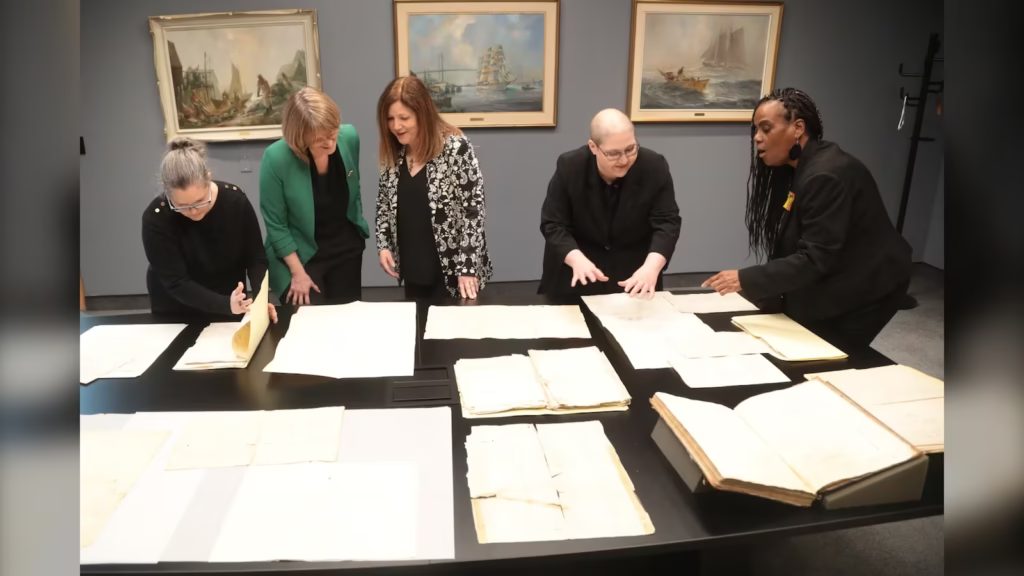
The inscription into UNESCO’s Memory of the World Register focuses on the Book of Negroes and associated documents. This ledger, a meticulous British military record, is the single most important document detailing the identities of the Black Loyalists who evacuated from New York. It lists names, ages, physical descriptions, and former owners, transforming statistics into human stories.
This UNESCO honour achieves several critical things:
- Global Validation: It places a pivotal chapter of the African diaspora on a global platform, acknowledging its universal significance.
- Preservation Imperative: It underscores the importance of preserving these fragile documents for future generations.
- Narrative Correction: It officially corrects the historical record, insisting that the Black Loyalist experience is not a sidebar, but a central narrative in the story of Canada, the Atlantic world, and the fight for freedom.
- Educational Catalyst: It provides a powerful tool for educators to teach a more complete and honest history.
Living Legacy: From Archives to Community
The UNESCO recognition is not just about old papers; it’s about living history. The legacy of the Black Loyalists is alive in:
- The vibrant African Nova Scotian communities that have thrived for over 230 years.
- The work of institutions like the Black Loyalist Heritage Centre in Birchtown, Nova Scotia, which keeps these stories alive.
- The research of scholars and genealogists who help descendants connect with their ancestors’ journeys.
- Influential cultural works like Lawrence Hill’s novel *The Book of Negroes*, which brought this history to a mass audience.
A More Complete Canadian Story
Inscribing the Black Loyalist history into the Memory of the World Register is a profound step toward a more honest national consciousness. It forces a reckoning with the fact that Canada was both a promised land and a site of profound inequality for these early Black settlers. Their story encapsulates the dual themes of refuge and racism that have echoed throughout Canadian history.
By honouring their documentary heritage, we honour their courage. We acknowledge that Canada’s origins are deeply intertwined with the global struggle for Black freedom. This UNESCO designation is a reminder that our national memory is multifaceted. It challenges us to listen to the stories that were silenced and to see the foundational role that Black Canadians have played from the very beginning. The journey of the Black Loyalists—from the battlefields of the American Revolution, to the rocky shores of Nova Scotia, and across the ocean to Sierra Leone—is ultimately a timeless story of resilience, agency, and the unyielding pursuit of liberty. It is a story that now, rightfully, belongs to the world.

