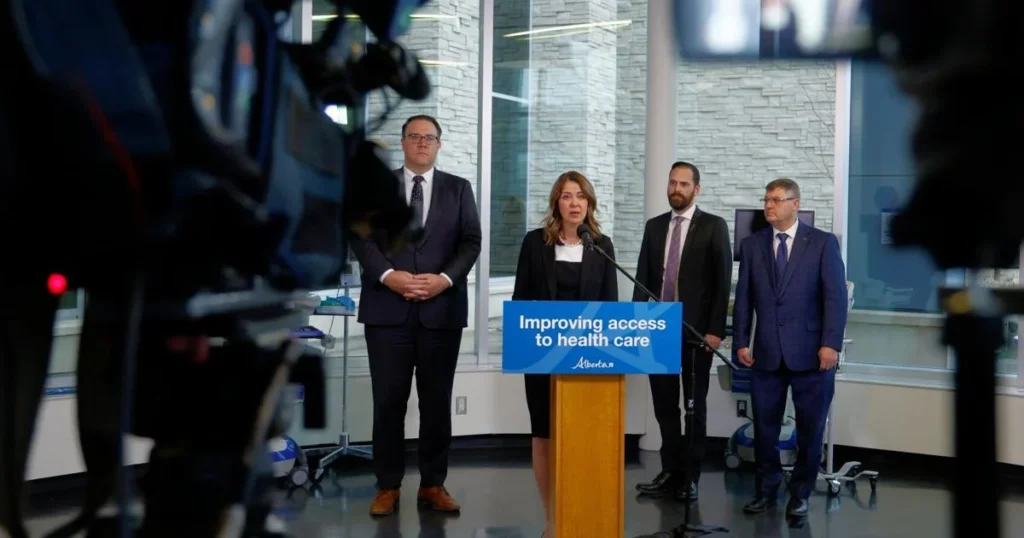
Alberta’s Private Healthcare Shift Poses a National Public System Risk
The foundation of Canada’s healthcare identity—a publicly funded, universally accessible system—is facing a profound test. The epicenter of this challenge is not in Ottawa, but in Alberta, where a series of legislative and policy changes are aggressively expanding the role of for-profit delivery and private payment. This isn’t just a provincial debate; it’s a blueprint that threatens to reshape the very fabric of Medicare from coast to coast, risking a future of tiered access based on wealth, not need.
The Alberta Experiment: From Policy to Practice
Alberta’s government has moved beyond theoretical discussions to enact concrete reforms that pivot toward a public-private model. Key legislative changes, such as Bill 41, have created new legal and financial structures that facilitate private clinics performing publicly-funded surgeries while also allowing them to offer identical services for private payment. This dual-track system creates inherent conflicts of interest and perverse incentives.
The core mechanisms of Alberta’s shift include:
- Expanding For-Profit Surgical Delivery: A massive push to contract more surgeries—from hips and knees to cataracts—to private, investor-owned facilities.
- Enabling Extra-Billing and Queue-Jumping: By allowing clinics to operate in both the public and private spheres, the door is opened for patients to pay out-of-pocket to receive faster care, effectively creating a two-tier queue.
- Redirecting Public Funds: Public money follows the patient to these private clinics, siphoning critical resources, including staff, from the public hospital system.
This model is often misleadingly framed as “innovation” or “partnership.” In reality, it sets a dangerous precedent where healthcare is increasingly seen as a market commodity rather than a public good.
The National Domino Effect: Why Alberta’s Path Matters to Every Canadian
The risk of Alberta’s model is not contained by its borders. It acts as a powerful precedent that other provinces, facing similar political pressures and surgical backlogs, may feel compelled to follow.
Erosion of the Canada Health Act
The Canada Health Act is the federal law designed to protect the principles of universality and accessibility. Its core provisions prohibit extra-billing and user charges for medically necessary care. Alberta’s approach tests the limits of this law, challenging federal authorities to enforce it. If the federal government is perceived as weak in its response, it signals to other provinces that they, too, can bend or bypass the rules without consequence, leading to a nationwide erosion of standards.
The Critical Drain of Human Resources
Perhaps the most immediate national threat is the poaching of healthcare professionals. Private clinics do not magically create new surgeons or nurses; they recruit them from the public system, often offering better hours and higher pay. When an Alberta clinic lures a surgeon from a public hospital, it doesn’t just affect Albertans—that surgeon may have been recruited from Halifax, Toronto, or Vancouver. This internal brain drain exacerbates staffing crises in public hospitals across the country, making wait times longer for everyone who relies on the public system.
The False Promise of “Reducing Wait Times”
Proponents argue that private clinics clear the public backlog. Evidence from other jurisdictions suggests otherwise. A finite pool of doctors and nurses working on privately-paid patients is not working on publicly-funded ones. This can actually lengthen wait times for the vast majority of patients who cannot afford to pay, while providing faster care for a privileged few. It solves a waitlist problem for individuals with money while worsening the systemic problem for society.
The Real-World Consequences: A Tale of Two Tiers
The endgame of this shift is a stratified system. Imagine two patients with identical knee pain and the same level of need:
- Patient A can pay thousands of dollars out-of-pocket, accesses a private MRI within days, sees a specialist quickly, and has surgery at a private clinic within weeks.
- Patient B, relying on the public system, waits months for an MRI, more months to see a specialist, and joins a growing surgical waitlist that is starved of staff and operating room time.
Their health outcomes will diverge not based on urgency, but on economic status. This undermines the fundamental Canadian value of equal care for all.
Strengthening the Public System: The Alternative Path
The solution to the healthcare crisis is not to abandon the public model but to reinvest in and innovate within it. The focus must be on systemic fixes that benefit all Canadians.
- Strategic Public Investment: Targeted funding to expand public hospital capacity, including more operating rooms and recovery beds, run within the non-profit system.
- Innovative Public Delivery: Supporting publicly-owned and managed specialized surgical centers that focus on high-volume, low-complexity procedures to improve efficiency without profit motives.
- Retaining and Recruiting Staff: Addressing the core reasons for burnout and attrition in the public system—including wages, working conditions, and respect—to keep professionals in public service.
- Federal Leadership and Enforcement: The federal government must unequivocally uphold the Canada Health Act, using financial levers to ensure provinces comply with the principles of Medicare.
A Crossroads for Canadian Healthcare
Alberta’s pivot toward private healthcare is more than a local policy shift; it is a stakes-laden experiment with national implications. It promises short-term, selective relief at the cost of long-term, systemic erosion. The path it charts leads away from the collective promise of Medicare—that your health and your care depend on your needs, not your net worth.
The rest of Canada must watch closely and understand the stakes. The choices made in Alberta today could very well determine the accessibility and equity of the healthcare system available to all Canadians tomorrow. Defending and improving our public healthcare system is not an act of nostalgia, but a necessary fight to preserve a cornerstone of Canadian society that ensures we are all cared for, especially when we are most vulnerable.