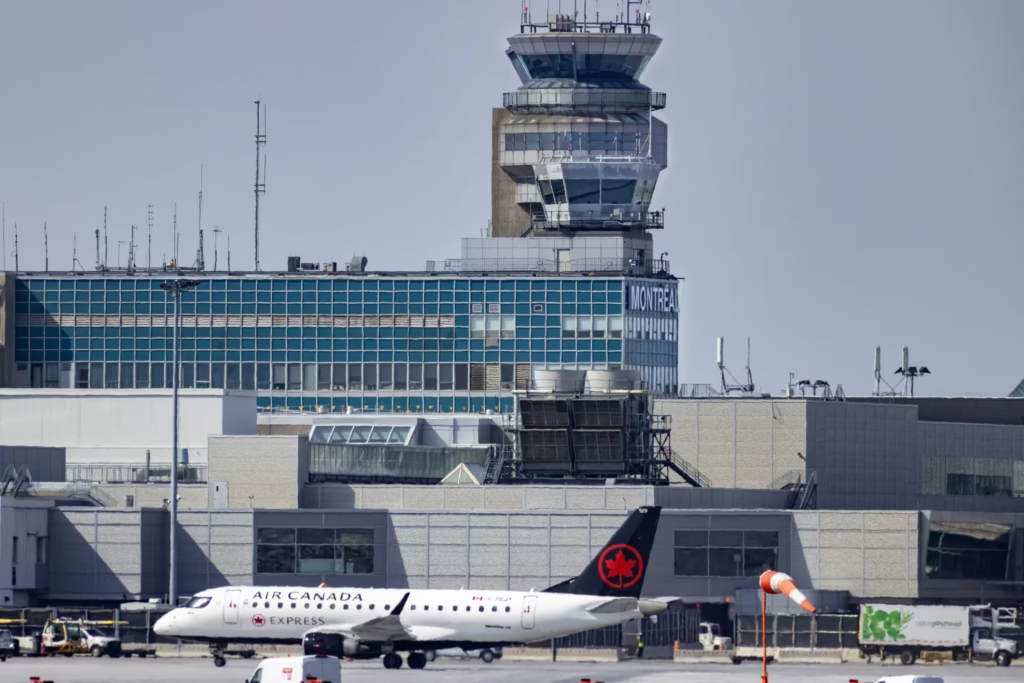
Navigating the Skies: How Canada’s Air Traffic Controller Shortage Compares to the U.S. Crisis
The hum of jet engines is the sound of a connected world, a symphony orchestrated from the ground by a highly skilled and often unseen workforce: air traffic controllers. Their role is paramount to safety and efficiency in our national airspace. Recently, headlines on both sides of the border have highlighted a critical shortage of these essential professionals. While Canada faces a significant gap of approximately 200 controllers, a deeper look reveals a starkly different reality from that of its southern neighbor. In the face of a shared challenge, Canada’s aviation system is demonstrating a notable comparative advantage.
The Scale of the Shortage: A Tale of Two Systems
At first glance, a shortage of 200 controllers in Canada sounds alarming. It represents a tangible strain on the system, leading to potential delays, increased overtime for existing staff, and operational pressures at key facilities like those in Toronto, Vancouver, and Montreal. This gap is a result of a predictable wave of retirements, pandemic-related training pauses, and the lengthy, rigorous process of certifying new controllers.
However, this number must be viewed in context. South of the border, the United States is grappling with a deficit of air traffic controllers that is an order of magnitude larger. The Federal Aviation Administration (FAA) is short by roughly 3,000 controllers. This massive shortage has had direct and visible consequences for travelers, including widespread flight delays and cancellations, particularly during peak travel periods and severe weather events. The U.S. system is operating under such strain that it has, at times, prompted calls for airlines to reduce schedules at major New York-area airports.
Why Canada is on a Firmer Flight Path
Several key structural and operational differences explain why Canada, while challenged, is in a more manageable position.
- A Single, National Service Provider: Canada operates under a unified model with NAV CANADA, a private, not-for-profit corporation. This allows for centralized hiring, training, and resource allocation. The U.S. system is managed by the FAA, a government agency subject to federal budgeting cycles, political pressures, and hiring freezes, which have historically disrupted staffing pipelines.
- Proactive and Streamlined Training: NAV CANADA runs its own world-renowned training academy in Cornwall, Ontario. While the training is exceptionally demanding with a high attrition rate, the process is integrated and controlled. In the U.S., controller training can be fragmented, involving initial FAA Academy training followed by lengthy on-the-job training at individual facilities, a process that can take years to produce a fully certified controller.
- Technology and Efficiency Gains: Canada has been a global leader in implementing advanced air traffic management technology, such as satellite-based navigation (GPS) and more efficient airspace procedures. These technological investments increase the capacity of each controller to manage more traffic safely, somewhat mitigating the impact of fewer personnel.
- Earlier Recognition and Action: The industry in Canada has been vocal about the impending retirement wave for years. While the shortage is real, the foresight allowed NAV CANADA to ramp up recruitment and training efforts in advance, a head start that the more crisis-driven U.S. system has struggled to match.
The Canadian Challenge: Real but Manageable
To be clear, Canada’s shortage is not without consequence. The gap of 200 controllers creates pressure points. It can limit operational flexibility, contribute to fatigue management challenges among existing staff, and slow the recovery from disruptive events like storms. The focus for NAV CANADA and industry partners is on a multi-pronged strategy:
- Aggressive Recruitment: Campaigns are targeting a diverse range of candidates, highlighting the career’s competitive salary, pension, and unique challenges.
- Optimized Training Throughput: Efforts are continuous to refine the training program at the NAV CANADA Academy to maintain its high standards while improving success rates.
- Retention and Wellness: Keeping experienced controllers is as important as hiring new ones. This means focusing on workplace culture, fatigue risk management, and ensuring controllers feel supported in a high-stakes profession.
A Warning Signal, Not an Emergency Siren
For the Canadian traveling public, the current situation is more of a warning signal than an emergency siren. Travelers may experience occasional delays attributed to “ATC staffing,” but they have not faced the systemic meltdowns seen in parts of the U.S. system. The stability is a testament to the underlying strength of the Canadian model and the proactive steps taken so far.
The comparative advantage Canada holds is not a reason for complacency. The global demand for air travel is rebounding strongly, and the need for controllers will only grow. The 200-controller shortfall must be closed. However, the Canadian system has the foundational advantages—a single, self-funded provider, advanced technology, and a controlled training environment—to navigate this challenge more effectively than its U.S. counterpart.
Clearing for the Future: Lessons from the Comparison
The parallel shortages in North America offer critical lessons. They underscore the non-negotiable importance of long-term, stable investment in human capital and technology in aviation. Canada’s model shows that insulating critical infrastructure from political budgetary volatility allows for more consistent planning. The U.S. situation illustrates the severe operational risks that emerge when hiring and training fall behind the curve for prolonged periods.
For Canada, the path forward involves doubling down on its existing strengths. Continued investment in next-generation technology will further enhance safety and efficiency. Sustained, predictable funding for recruitment and training through NAV CANADA’s user-pay system is essential. Furthermore, fostering a national dialogue to raise the profile of the profession can help ensure a steady stream of qualified candidates for years to come.
In the high-stakes realm of air traffic control, Canada, while facing a genuine staffing headwind, has managed to keep its skies notably clearer of crisis. By learning from the contrast with the U.S. and maintaining its strategic course, Canada can ensure its safety record remains pristine and its airspace remains efficient for the long haul. The destination is a fully staffed, resilient system, and Canada’s current navigation, though requiring careful attention, is on a more direct route to get there.