
Could Canada Join the EU? New Poll Reveals Surprising Public Openness
A recent survey has sent a intriguing ripple through conversations about Canada’s place in the world. The notion of Canada joining the European Union, long considered a political pipe dream or a topic for academic debate, appears to find a noteworthy level of support among the Canadian public. This unexpected data opens a fascinating window into the evolving geopolitical sentiments of Canadians and prompts a deeper look at what this openness truly signifies.
A Nation Leaning In: Breaking Down the Poll Numbers
The survey, conducted by the Macdonald-Laurier Institute, asked Canadians for their stance on potential EU membership. The results were far more positive than many would have predicted, painting a picture of a nation curious about deeper transatlantic bonds.
Key findings from the poll include:
- Significant Support Base: 42% of respondents indicated they would support Canada joining the EU, compared to just 29% who were opposed. The remaining respondents were unsure or neutral, suggesting a population willing to entertain the idea.
- The Youthful Vanguard: Support was most pronounced among younger Canadians aged 18-34, with a striking 55% in favor. This generational divide hints at shifting attitudes toward sovereignty and global cooperation among younger demographics.
- A Regional Mosaic: Interest was not uniform across the country. Quebec (50% support) and Atlantic Canada (48%) showed the highest levels of openness, while the Prairie provinces exhibited greater skepticism, reflecting regional economic priorities and political cultures.
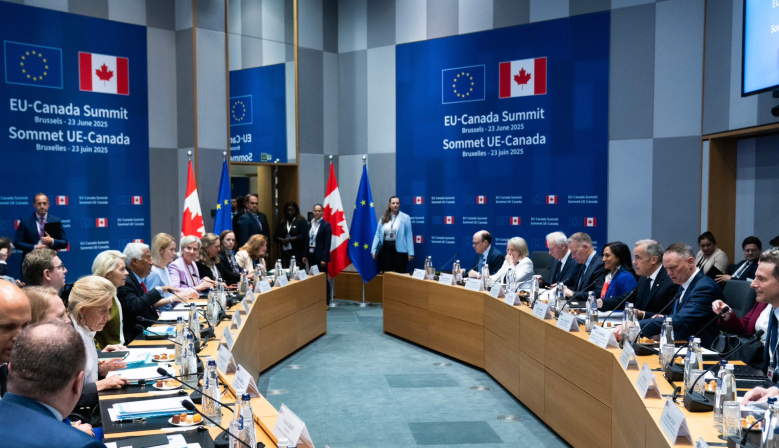
This broad openness is particularly timely, as Canada and the European Union are currently engaged in talks to modernize the existing Comprehensive Economic and Trade Agreement (CETA). The poll suggests the public appetite for European partnership may extend beyond simple trade upgrades.
Reading Between the Lines: What Does This Sentiment Really Mean?
Before visions of a Canadian star on the EU flag take hold, it’s crucial to contextualize this poll. Political scientists and policy experts are quick to note that the question likely measures affinity and aspiration more than a literal policy demand.
For many respondents, supporting “EU membership” may be a shorthand for expressing:
- A strong pro-European, multilateralist worldview.
- A desire for deeper economic, cultural, and strategic ties with Europe.
- A rejection of isolationist or protectionist tendencies in an unstable world.
- Frustration with the perpetual uncertainties of the Canada-U.S. relationship and a desire to diversify international partnerships.
In this light, the poll is less a blueprint for constitutional change and more a robust indicator of Canada’s diplomatic direction. It signals to policymakers that efforts to strengthen the Canada-EU relationship have a willing and interested public behind them.
The Generational Divide: A Glimpse into Canada’s Future
The strong support among Canadians under 35 is perhaps the most telling data point. This generation has come of age in a world defined by global challenges—climate change, digital interconnectedness, and geopolitical volatility—that demand multinational solutions. Their openness to supranational bodies like the EU may reflect a pragmatic view of shared sovereignty as a tool for greater influence and problem-solving, rather than a diminishment of national identity.
The Reality Check: The Monumental Hurdles of Actual EU Membership
While the poll is a fascinating thought experiment, the practical and political barriers to Canada becoming the 28th member state are, in a word, colossal. EU membership is not merely a trade pact; it is a profound legal, economic, and political integration.
Should Canada ever embark on this hypothetical path, it would entail:
- Legal and Regulatory Alignment: Canada would need to adopt and implement a vast corpus of EU law covering everything from environmental standards and consumer protections to agricultural policy and digital regulations.
- Budgetary Contributions: As a wealthy nation, Canada would become a significant net contributor to the EU budget, sending billions annually to Brussels.
- Shifts in Sovereignty: Canada would cede a degree of decision-making authority to EU institutions in areas of common policy, impacting domestic governance.
- Trade Policy Surrender: Canada would lose its independent seat at the World Trade Organization and the ability to negotiate its own trade deals, including with its largest partner, the United States.
- The “Geography Question”: While not a formal rule, the EU is a primarily European project. Canada’s physical detachment from the continent presents a unique and likely insurmountable political obstacle.
The sheer scale of these changes makes actual membership a distant prospect. The constitutional amendments alone would be a historic undertaking, requiring unprecedented national consensus.
CETA: The Pragmatic and Powerful Alternative
Rather than a leap toward full membership, the poll strengthens the case for maximizing the framework that already exists: the Comprehensive Economic and Trade Agreement (CETA). This modern trade deal, one of the most ambitious the EU has ever concluded, already provides:
- Tariff-free trade on over 98% of goods.
- Improved access to services and public procurement markets.
- Mechanisms for regulatory cooperation and mutual recognition of professional qualifications.
The current work to modernize CETA is the real-world manifestation of closer ties. Enhancing this agreement to cover emerging areas like artificial intelligence, green technology, and sustainable supply chains is the tangible, achievable path forward that the public’s pro-European sentiment supports.
Conclusion: A Symbolic Vote for a Closer Partnership
The surprising poll revealing Canadian openness to EU membership is ultimately a powerful symbol. It is a vote of confidence in the European Union as a project and a clear signal that Canadians see their future intertwined with like-minded democracies across the Atlantic.
While the complexities of full integration make it a political fantasy for the foreseeable future, the desire for a stronger, more strategic bond is unequivocally real. The data provides a compelling mandate for Canadian leaders to deepen the bilateral relationship through enhanced cooperation, diplomacy, and the ongoing improvement of CETA. In an era of strategic competition, the poll reminds us that the Canada-EU partnership is not just a bureaucratic linkage, but a connection with deep and growing resonance among the Canadian people.
**What do you think? Does the public’s openness to the EU idea reflect a smart vision for global engagement, or does it underestimate the value of national sovereignty? Should Canada focus all its energy on enhancing CETA, or does this poll suggest we should be thinking even bigger? Share your perspective below.**

