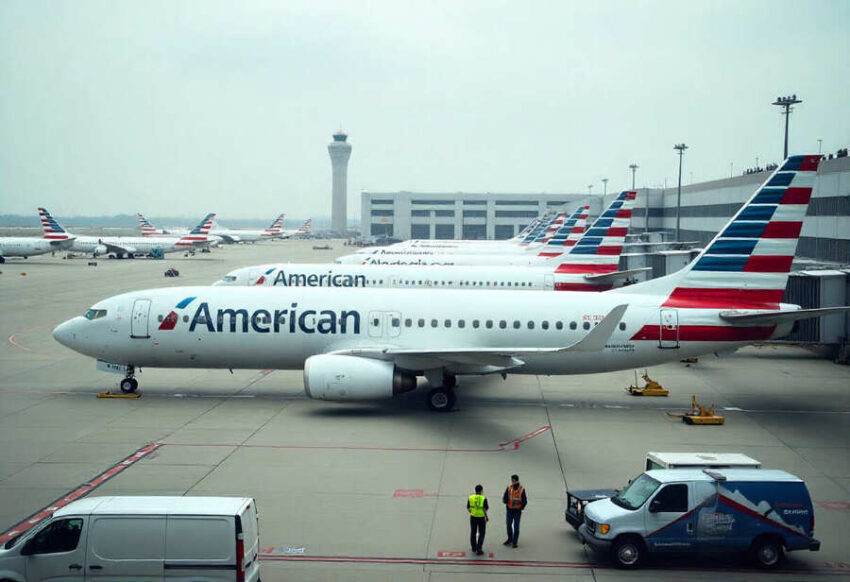
American Airlines Raises Baggage Fees and Debuts Touchless ID Tech
In a week of significant updates, American Airlines has announced a series of strategic moves that will impact travelers from the check-in counter to the boarding gate. The carrier is implementing a notable increase in checked baggage fees for many North American routes, while simultaneously forging new international partnerships and rolling out cutting-edge technology designed to streamline the airport experience. This multifaceted strategy highlights the airline’s efforts to navigate operational challenges, expand its global reach, and invest in a more efficient future for passengers.
Navigating Costs: A Shift in Baggage Fee Structure
One of the most immediate changes for passengers is an adjustment to American Airlines’ baggage fee policy. Effective for tickets purchased on or after February 20, 2024, the cost for a first checked bag on most domestic U.S., short-haul international, and Canadian itineraries has risen.
Here’s a breakdown of the new standard fees:
- The first checked bag now costs $40 (up from $35) if paid online in advance, or $45 at the airport.
- The second checked bag fee has increased to $50 (up from $45) for advance payment, or $55 at the airport.
It’s important to note that these changes primarily affect passengers who do not hold elite status with American Airlines’ AAdvantage program or who are not flying in a premium cabin. The airline emphasizes that fees for overweight and oversized bags remain unchanged. This move aligns with a broader industry trend as carriers seek to manage rising operational costs, including fuel and labor, while offering a lower base fare structure.
Expanding Horizons: New Codeshare Partnerships Unveiled
Concurrent with its fee adjustments, American Airlines is significantly expanding its global network through new and enhanced partnerships. The airline has announced a major new codeshare agreement with Mexico’s premier carrier, Aeroméxico. This partnership will allow customers to seamlessly book travel on a combined network of over 40 routes between the U.S. and Mexico, connecting key business and leisure destinations like Dallas-Fort Worth (DFW) to Mexico City (MEX) and Miami (MIA) to Cancún (CUN).
Beyond Mexico, American is deepening its ties in South America. The existing partnership with Guyana Airways has been expanded, providing better connectivity from North America to Georgetown (GEO). Furthermore, American has solidified its presence in the Caribbean by finalizing a partnership with Caribbean Airlines, facilitating travel to destinations such as Trinidad and Tobago.
Overcoming Operational Hurdles: The Airbus Software Resolution
These customer-facing announcements come as American Airlines reports progress on a significant technical challenge. The carrier has successfully overcome persistent software issues related to its Airbus A321neo fleet. These glitches, which affected the aircraft’s performance calculation software, had previously led to operational delays and required manual workarounds by pilots.
American’s technical teams, in close collaboration with Airbus, have now deployed a permanent software fix. This resolution is a critical step in ensuring the reliability and efficiency of a key part of its narrow-body fleet, allowing for more predictable operations and reducing potential for last-minute schedule disruptions.
The Future is Touchless: Biometric ID Technology Takes Flight
Perhaps the most forward-looking development is the official debut of American Airlines’ new touchless identification technology at its hub at Dallas/Fort Worth International Airport (DFW). This system utilizes biometric facial matching to allow eligible customers to move through the airport without repeatedly presenting physical identification documents.
Here’s how the streamlined process works:
- Passengers opt-in during online check-in or at specific kiosks in Terminal D.
- At dedicated TSA checkpoints and boarding gates, a camera captures a live image.
- The image is securely matched to a stored passport photo or photo from the Department of Homeland Security.
- Upon verification, the passenger is cleared to proceed—no need to hand over a boarding pass or driver’s license.
This technology, developed in partnership with the Transportation Security Administration (TSA) and U.S. Customs and Border Protection (CBP), is designed to enhance security, reduce physical contact points, and significantly speed up the journey through the airport. American Airlines plans to expand this biometric option to other hubs following the DFW rollout.
Analyzing the Strategic Direction
American Airlines’ recent announcements paint a picture of a carrier executing a complex, multi-pronged strategy. The increase in baggage fees represents a straightforward revenue management tactic, a common lever pulled in the industry to offset expenses while keeping base fares competitive.
The expansion of codeshare partnerships, particularly the flagship deal with Aeroméxico, is a strategic growth play. It allows American to rapidly increase its market presence in key regions without the massive capital expenditure of adding new aircraft and routes itself. This “asset-light” growth strengthens its network against competitors.
Finally, the investment in resolving the Airbus software issue and deploying touchless ID technology underscores a commitment to operational integrity and customer experience innovation. Reliable aircraft are the foundation of any airline’s schedule, while biometrics represent the next frontier in efficient and modern air travel.
What This Means for Travelers
For the flying public, these changes have clear implications. Travelers on economy tickets within North America should budget for higher checked baggage costs or consider packing lighter to avoid fees. At the same time, passengers flying to destinations in Mexico, Guyana, and the Caribbean may find more convenient routing options and smoother connections thanks to the new partnerships.
Frequent flyers and tech-savvy passengers, especially those traveling through DFW, stand to benefit the most from the touchless ID initiative, enjoying a faster, more seamless journey from curb to cabin. As American Airlines balances cost pressures with network growth and technological investment, its evolving approach will continue to shape the passenger experience in the years to come.