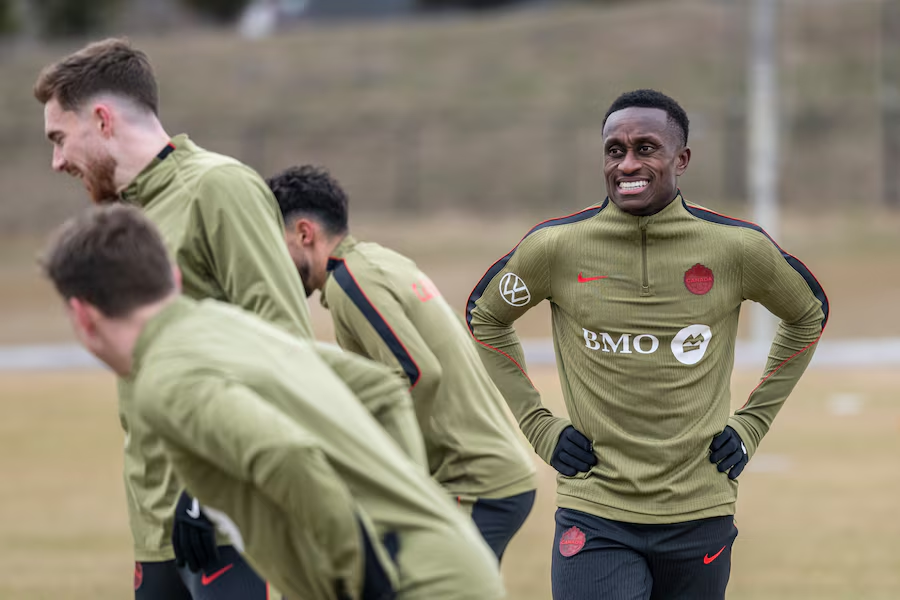
Can Canada’s World Cup Dreams Survive Their Injury Crisis?
The final whistle in Qatar felt like a beginning, not an end. Canada’s men’s national soccer team, after a 36-year wait, announced itself on the world’s biggest stage with a fearless, energetic brand of football. The results—three losses—belied the promise and the palpable sense that this team was building towards something greater. As the 2026 World Cup approaches, co-hosted on home soil, expectations have skyrocketed. However, a looming shadow threatens to derail the narrative before the first ball is kicked in Vancouver, Toronto, or Montreal: a pervasive and alarming injury crisis gripping the squad’s most vital players.
For Head Coach John Herdman, the challenge is no longer about unearthing talent or instilling a defiant mentality. That work is done. The new, more precarious task is shepherding his core group of stars to the tournament in one piece. Unlike traditional soccer powers with deep reserves of elite talent, Canada’s success is hyper-concentrated. The nation’s World Cup hopes are not just tied to its starting eleven; they are irrevocably dependent on the health of about seven or eight key figures. As the injury list grows, the question becomes: can the dream survive the treatment table?
The Walking Wounded: A Star-Studded Medical Room
The list of concerns reads like a team sheet for Canada’s all-time best XI. Each name represents a potential tactical cornerstone, and each ailment a potential catastrophe.
Alphonso Davies: The Irreplaceable Catalyst
At the very top sits Alphonso Davies. The Bayern Munich superstar is more than just a player; he is the team’s engine, its primary source of world-class brilliance, and its most potent marketing tool. A lingering myocarditis issue kept him out of crucial qualifiers, and while he has returned, his recent history with muscular injuries is a constant anxiety. Davies’ ability to play left-back or as a devastating left-winger gives Herdman tactical flexibility. Without Davies, Canada loses its transformational gear—the player capable of single-handedly changing a game against the world’s best.
Jonathan David: The Goal-Scoring Lifeline
If Davies provides the spark, Jonathan David is the cold-blooded finisher. The Lille striker is the consistent goal threat Canada has craved for generations. An unspecified injury saw him miss Lille’s recent season finale, a minor scare that sent ripples across the Atlantic. Canada’s attacking structure is built to service David. His movement, hold-up play, and clinical edge are non-negotiable for turning promise into points. There is simply no like-for-like replacement for his quality in the squad.
Stephen Eustáquio: The Indispensable Orchestrator
Perhaps the most understated yet critical piece is Stephen Eustáquio. The FC Porto midfielder emerged as the team’s pivotal metronome during qualifying—dictating tempo, breaking up play, and linking defense to attack with intelligent passing. A serious knee injury in 2023 was a devastating blow. His return to form is paramount. In his absence, Canada’s midfield often looked disjointed and vulnerable. The system relies on his composure and football IQ; without it, the foundation crumbles.
The Domino Effect: Where One Injury Creates Many Problems
The issue extends beyond just missing individual talent. The interconnected nature of the squad means one key absence forces destabilizing adjustments.
- Squad Depth on Trial: While the player pool is improving, the drop-off from the top-tier stars to the next in line remains significant. Injuries force less experienced players into high-leverage roles, altering the team’s ceiling.
- Defensive Fragility: The center-back partnership remains a work in progress. An injury to a leader like Kamal Miller or a forced reshuffle due to a full-back absence (like the versatile Alistair Johnston) could expose a defensive line that already requires protection.
- Attacking Reliance: With Cyle Larin battling for consistent club minutes and other attacking options like Tajon Buchanan also needing to find peak fitness, the burden on David and Davies becomes immense. An injury to either drastically reduces Canada’s goal probability.
The 2026 Equation: Pressure, Expectation, and Physiology
The path to 2026 is uniquely pressurized. As co-hosts, Canada will bypass the grueling qualification campaign—a double-edged sword. While it avoids the physical toll of CONCACAF travel, it also deprives the team of competitive, high-stakes matches to build rhythm and test depth. Friendlies and the 2024 Copa América are vital, but they cannot fully replicate the intensity of must-win qualifiers.
This places an extraordinary premium on player management at the club level. Herdman and his staff have no control over the minutes Davies logs for Bayern, the tackles Eustáquio faces in Portugal, or the fixtures David plays through in France. They can only watch, communicate, and hope. The coming two years are a marathon of preventative care, rehabilitation precision, and delicate load management.
A Historical Crossroads: Seizing the Moment
This generation represents a golden opportunity that may not come again soon. The convergence of a world-class talent like Davies, a prolific striker like David, a cohesive tactical identity, and home-field advantage is rare. An injury crisis that sidelines key actors for the main event would be a cruel twist of fate, a story of “what could have been” forever etched in Canadian sports lore.
Conversely, navigating this period successfully and arriving at the 2026 opener with a fit and firing core could unlock unprecedented success. The home crowd, powered by a healthy Davies, David, and Eustáquio, could propel Canada beyond the group stage and into the knockout rounds, fundamentally altering the sport’s landscape in the country.
Conclusion: A Race Against Time and Fate
Canada’s World Cup dream is alive and well, pulsating with the skill of its stars and the passion of a nation ready to embrace them. But it is currently in intensive care. The margin for error is razor-thin. John Herdman’s most important work between now and 2026 may not happen on the training pitch, but in collaboration with medical teams across Europe, in carefully managing minutes during international windows, and in fostering a resilience that can withstand the absence of a key player.
The beautiful game is often a war of attrition. For Canada, the first battle of the 2026 World Cup is not against Belgium, Argentina, or Croatia. It is a relentless, ongoing battle against the physio’s table. The dream depends on winning it.