
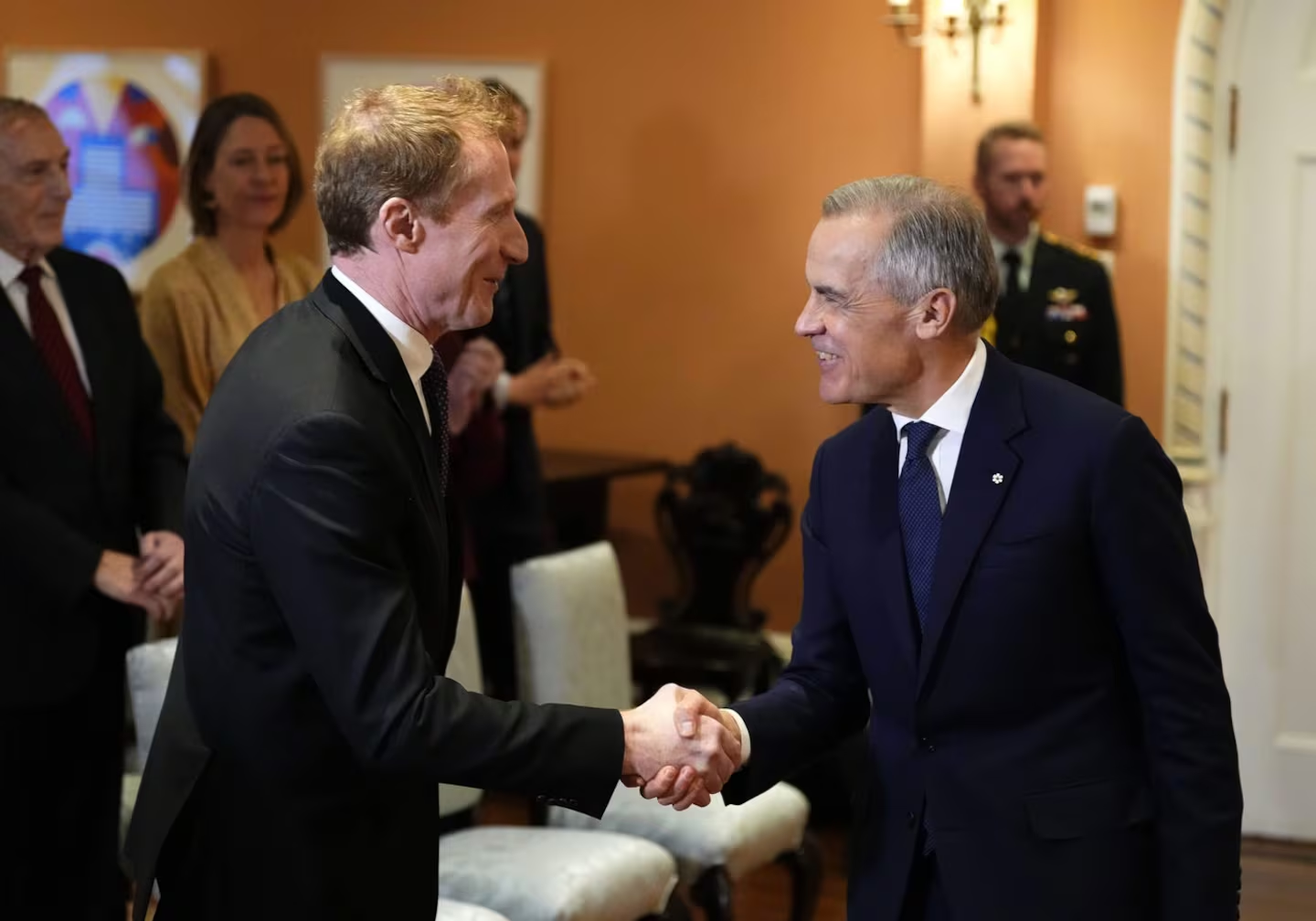
Mark Carney’s Cabinet Shuffle Reshapes Canada’s Climate Agenda
In a move that signals a significant strategic pivot for the Liberal government, Prime Minister Mark Carney has undertaken a major cabinet reshuffle, triggered by the resignation of high-profile Environment Minister Steven Guilbeault. This reorganization is more than a routine change of personnel; it represents a recalibration of Canada’s approach to climate policy, economic growth, and political messaging at a critical juncture.
The departure of Minister Guilbeault, a staunch environmentalist and former activist, removes a defining figure from the federal climate portfolio. His tenure was characterized by ambitious regulatory frameworks and a firm stance on emissions reductions, which earned both praise from climate advocates and criticism from industry and some provincial leaders. Carney’s subsequent appointments suggest a shift towards a policy model that seeks to more explicitly bridge the gap between climate action and economic competitiveness.
The New Faces Steering Canada’s Climate and Economic Future
At the heart of this shuffle is the appointment of Jonathan Wilkinson, previously the Minister of Energy and Natural Resources, to the expanded role of Minister of Environment and Climate Change. Wilkinson, seen as a pragmatic and collaborative figure, brings a deep understanding of the energy sector’s complexities. His mandate is expected to balance continued decarbonization with a focus on investment, innovation, and implementation of clean technologies.
Simultaneously, the promotion of François-Philippe Champagne to the pivotal role of Minister of Finance places a seasoned economic minister at the fiscal helm. Champagne, known for his work attracting major investments in sectors like electric vehicles and batteries, is tasked with crafting budgets and policies that fuel the green industrial transition. This duo of Wilkinson and Champagne is widely interpreted as Carney’s “economic-climate” engine, designed to align environmental goals with job creation and industrial strategy.
Decoding the Strategic Shift in Policy Direction
This reshuffle sends several clear signals about the Carney government’s revised priorities:
- From Regulation to Incentive: While the regulatory pace may steady, expect a stronger emphasis on tax credits, investment frameworks, and public-private partnerships to drive the energy transition.
- Economic Integration: Climate policy is being further woven into the fabric of economic policy. The goal is to frame climate action not as a cost, but as the core of Canada’s future economic prosperity and industrial advantage.
- Collaborative Federalism: After periods of tension with provinces, particularly over the carbon tax and clean electricity regulations, Wilkinson’s style suggests a more consultative approach to achieve national buy-in.
- Electoral Recalibration: With an eye on the next election, the government appears to be moderating its tone to address voter concerns about affordability and economic stability, without abandoning its core climate targets.
Immediate Challenges on the Horizon for the New Team
The new ministerial team inherits a formidable in-tray. Their success will be measured by how they navigate a series of pressing challenges:
The Carbon Price Crucible: The consumer carbon price remains the government’s most contentious climate policy. While Carney has reaffirmed its centrality, the new climate minister must manage intense political pressure and communicate its benefits amidst cost-of-living concerns.
Clean Electricity Regulations: The ambitious goal of a net-zero grid by 2035 requires delicate negotiations with provinces reliant on fossil fuels for power generation. Wilkinson’s ability to find a workable path forward will be a key early test.
Competing in the Clean Economy: Champagne’s finance portfolio must respond to the massive subsidies of the U.S. Inflation Reduction Act. Canada needs a compelling investment proposition to secure its share of global capital for clean tech, critical minerals, and clean manufacturing.
Maintaining Climate Credibility: The government must prove that this pragmatic shift is not a dilution of ambition. Meeting its 2030 emissions reduction targets under the Paris Agreement requires accelerated, tangible progress that the new ministers will be accountable for delivering.
Stakeholder Reactions and the Road Ahead
Reactions to the shuffle have been mixed, reflecting the divergent pressures on the government. Environmental groups have expressed cautious concern, urging the new ministers to uphold strong standards and accelerate action. Industry associations have welcomed the appointments, highlighting the need for predictability and partnership to deploy capital. Opposition critics have labeled the changes as mere optics, arguing that the underlying policies remain flawed.
The true impact of this cabinet reshuffle will unfold in the coming months through policy announcements, budget details, and intergovernmental negotiations. Mark Carney, with his unique background in central banking and climate finance, has placed his trusted lieutenants in charge of executing a vision where environmental and economic portfolios are two sides of the same coin.
Conclusion: A Pivotal Moment for Canadian Policy
The resignation of Steven Guilbeault and Mark Carney’s subsequent cabinet shuffle marks a definitive turning point. It closes one chapter of Canadian climate policy, defined by activist-driven regulation, and opens another focused on integration, investment, and implementation. The Carney government is betting that a team led by pragmatic ministers can build a broader, more durable consensus for the energy transition—one that delivers both a stable climate and a thriving economy.
The world is watching to see if Canada can successfully navigate this complex balance. The success or failure of this recalibrated approach will not only define the Carney premiership but will also shape Canada’s economic and environmental trajectory for decades to come. The shuffle is complete; now the real work begins.

