The US Nearly Abandoned a Downed F-15 Pilot Over Iran Fears
The fog of war is thick, and split-second decisions at the highest levels can alter the course of history—or end a life. A recently revealed incident from the tense days following the 2020 U.S. airstrike that killed Iranian General Qasem Soleimani exposes a chilling moment of hesitation at the very top of American command. According to insider accounts, President Donald Trump almost called off a critical rescue mission for a downed U.S. Air Force pilot, fearing the entire situation was an elaborate Iranian trap.
This story is more than a military anecdote; it’s a stark lesson in the complexities of modern warfare, the psychological impact of high-stakes brinkmanship, and the vital importance of trusting frontline intelligence.
The Prelude: A Volatile Backdrop of Brinkmanship
To understand the gravity of this moment, we must revisit the white-hot tension of early January 2020. The U.S. drone strike that eliminated Qasem Soleimani, a powerful Iranian military figure, in Baghdad was a seismic event. Iran vowed “severe revenge,” and the entire region braced for a full-scale conflict. The U.S. military was at its highest alert level.
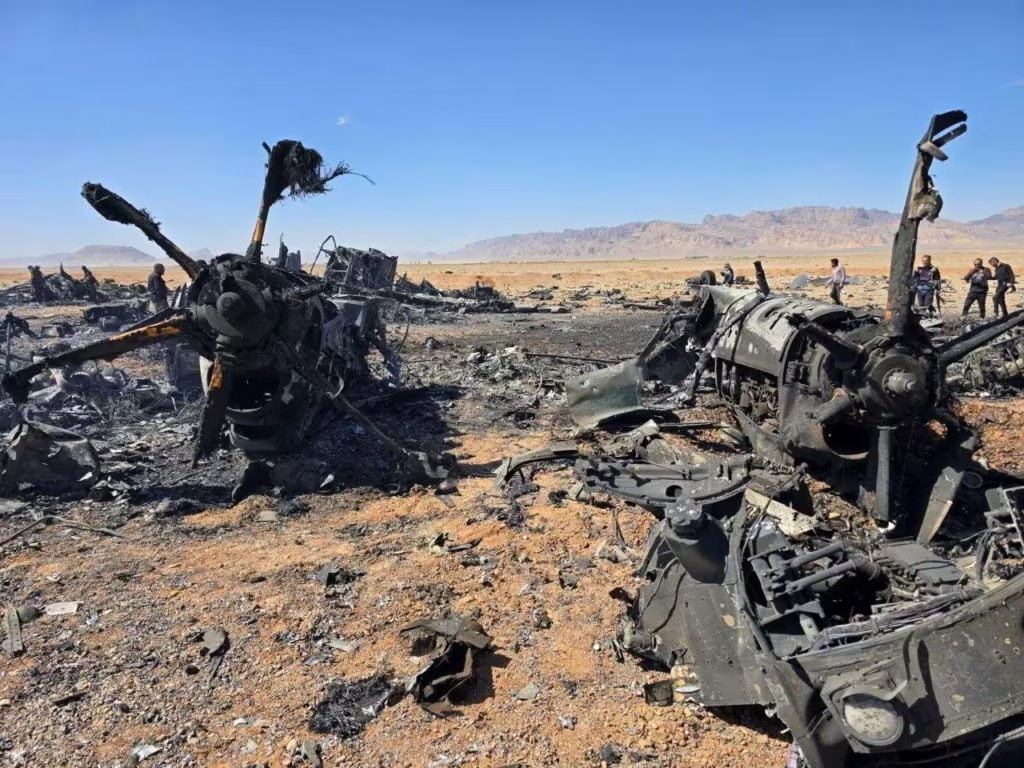
In this tinderbox environment, any unexpected event was viewed through the lens of potential escalation. When an American F-15E Strike Eagle experienced a catastrophic mechanical failure and crashed in a remote, hostile area of Yemen, the immediate assumption in the Situation Room wasn’t accident—it was ambush.
Why the Immediate Fear of a Trap?
The crash site itself raised massive red flags for security officials advising the President:
- Proximity to Iranian Proxies: The aircraft went down in territory controlled by Houthi rebels, a group armed and supported by Iran.
- Perfect Bait: A downed U.S. pilot is the ultimate high-value target. Iranian forces could quickly move to capture the airman, creating a hostage crisis to leverage against the U.S.
- Ambush Potential: The area was ideal for setting up a “rescue force trap,” where U.S. special ops teams could be lured in and attacked, leading to further casualties and a major propaganda victory for Tehran.
President Trump, acutely aware of the fragile state of affairs and the potential for a major new war, was reportedly deeply skeptical. The idea that this crash was a mere coincidence, happening just days after the Soleimani strike, seemed improbable. The risk of sending American troops into a slaughter appeared, in that moment, to outweigh the life of one pilot.
The Rescue: A Race Against Time and Doubt
While high-level deliberations swirled in Washington, a separate, urgent narrative was unfolding on the ground. The pilot had survived the crash and was in communication, evading potential capture in harsh terrain. U.S. military assets in the region, including aircraft and special operations teams, were poised for a swift extraction—a mission that relies on speed and surprise.
However, the “go” order from the Commander-in-Chief was not coming. Precious minutes ticked by. Every moment of delay increased the risk that hostile forces would locate the pilot first. Military leaders and advisors, including then-Secretary of Defense Mark Esper, reportedly had to urgently convince the President that this was a genuine emergency and not a ruse.
The Turning Point: Intelligence and Advocacy
What changed the President’s mind? A combination of credible, real-time intelligence and forceful advocacy.
- Technical Data: Evidence clearly pointed to a mechanical failure, not enemy fire.
- On-Scene Reports: Surveillance confirmed the pilot was alone and communicating via authentic U.S. military channels.
- The Human Factor: The principle of “leave no man behind” was powerfully argued. Abandoning a service member, especially based on a fear that might be unfounded, would have devastating consequences for military morale.
Finally, authorization was given. The rescue force launched, successfully located the pilot, and extracted him without engaging enemy combatants. The mission was a textbook success, but it was a success that almost didn’t happen.
Analysis: The Broader Implications of the Incident
This near-abandonment is not just a dramatic story; it reveals critical insights into decision-making during crisis.
The Paralyzing Weight of “What If?”
In an age of asymmetric warfare and proxy conflicts, traditional rules are blurred. Adversaries like Iran are adept at crafting complex, layered strategies. This incident shows how the fear of sophisticated deception can create decision-making paralysis at the highest level, where caution can morph into fatal inaction.
The Civilian-Military Dynamic in Real-Time
It highlights the sometimes-fraught interface between civilian leadership and military operational imperatives. The military’s mandate was clear: rescue our pilot. The President’s duty was broader: assess the strategic risk to the entire nation. This clash of perspectives in a time-compressed scenario is a fundamental challenge of modern command.
A Testament to Preparedness and Principle
Ultimately, the positive outcome is a testament to the skill and readiness of U.S. search-and-rescue teams. It also reaffirms the enduring strength of the warrior’s creed. The fact that officials fought so hard to launch the mission underscores that the commitment to every single service member remains a core, non-negotiable value within the military institution, even when political calculations suggest otherwise.
Conclusion: A Lesson Learned Under Fire
The stranded F-15 pilot was saved, and a larger conflict with Iran was, in this instance, avoided. But this episode serves as a powerful cautionary tale. It reminds us that in the digital age, despite all our surveillance and technology, human judgment in the face of extreme pressure remains the decisive factor. It underscores the need for robust, trusted intelligence channels and for leaders to balance healthy skepticism with the courage to act.
Most importantly, it reinforces a timeless truth: in warfare, the decision to risk lives to save one is not just a tactical calculation, but a profound reflection of a nation’s values. For nearly an hour, that value hung in the balance, a reminder of how thin the line can be between rescue and regret.