
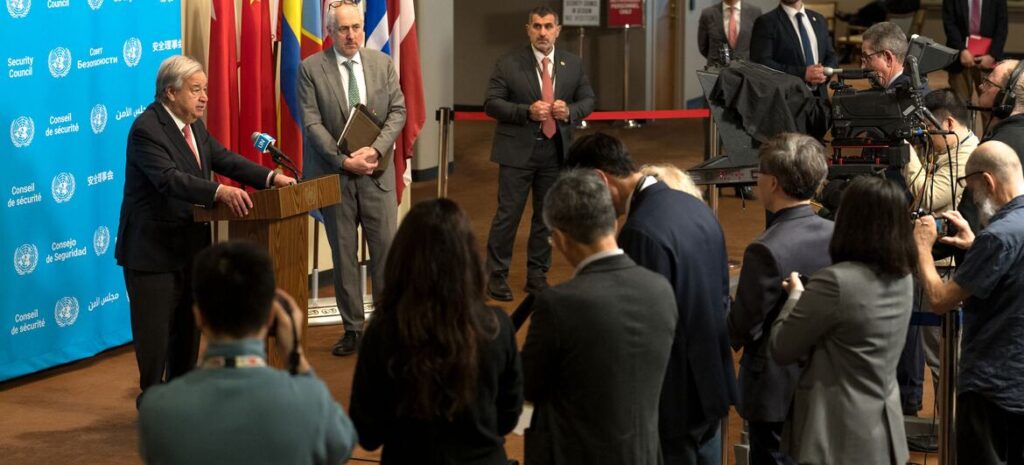
UN Chief Guterres Issues Stark Warning as Middle East Crisis Escalates
The world is holding its breath as a dangerous and widening conflict in the Middle East enters its second month. With tensions at a boiling point and the specter of a full-scale regional war looming, United Nations Secretary-General António Guterres has delivered a dire and urgent plea to all involved parties. His message is unambiguous: step back from the brink.
This crisis, which has seen a devastating cycle of attack and counter-attack, threatens to unravel decades of precarious stability. The UN chief’s warning underscores a fundamental fear gripping the international community—that what began as a localized conflict could spiral into a conflagration with catastrophic humanitarian and geopolitical consequences.
A Dire Plea from the United Nations
In a powerful statement marking one month of escalating violence, Secretary-General Guterres did not mince words. He painted a grim picture of the current situation, emphasizing that the region and the world cannot afford a major confrontation.
“The Middle East is on a precipice,” Guterres stated. He highlighted the immediate dangers, including:
- The horrific suffering of civilian populations caught in the crossfire.
- The severe strain on humanitarian aid systems, which are at a breaking point.
- The real and present risk of miscalculation or a single incident triggering an uncontrollable chain reaction.
His appeal was directed at all actors with influence, urging them to exercise maximum restraint and prioritize diplomatic channels over military action. The core of his warning is that there are no winners in a wider war, only losers—and the primary loser would be innocent life.
The Human Cost: A Crisis Within a Crisis
Beyond the geopolitical maneuvering lies a profound human tragedy. As the conflict widens, the toll on civilians escalates daily. Reports from affected areas describe:
- Critical shortages of food, clean water, and medical supplies.
- Infrastructure, including hospitals and schools, damaged or destroyed.
- Mass displacement, with families forced to flee their homes with no safe haven in sight.
The United Nations and its aid partners are facing monumental challenges in delivering life-saving assistance. Access is constrained, funding is insufficient, and the safety of humanitarian workers is under constant threat. Guterres stressed that international humanitarian law must be respected, and the protection of civilians is a non-negotiable obligation for all parties.
Why the Risk of a Wider War is So High
The conflict’s potential to spread is not hypothetical; it is a clear and present danger. The region is a complex web of state and non-state actors, alliances, and long-standing grievances. The current hostilities have already seen involvement from multiple fronts, raising the alarming prospect of a domino effect.
Several key factors are fueling this expansion risk:
- Entrenched Proxy Dynamics: The region has long been a theater for proxy conflicts, where regional powers support allied groups. An escalation can quickly pull these sponsors into direct confrontation.
- Strategic Maritime Chokepoints: Threats to vital shipping lanes, like the Strait of Hormuz, have global economic implications and could draw in international naval forces.
- The Psychological “Red Line”: Nations have declared certain actions as unacceptable “red lines.” A perceived crossing of one of these lines could be used as a justification for a severe military response, creating a rapid escalation loop.
Guterres’s warning is a direct response to these interconnected flashpoints. He is calling for an immediate de-escalation to break this dangerous cycle before it passes the point of no return.
The Path Away from the Brink: Diplomacy and Dialogue
In his statement, the UN Secretary-General was clear that there is no military solution to the underlying issues fueling the crisis. The only sustainable path forward is a return to serious, good-faith diplomacy.
“The logic of war is a logic of failure,” he asserted. His call to action includes:
- An immediate humanitarian ceasefire to allow aid in and provide a window for negotiation.
- Unconditional support for all diplomatic initiatives, both regional and international, aimed at calming tensions.
- A renewed and genuine commitment to addressing the root causes of the conflict, which have festered for too long.
This requires courageous leadership from within the region and unwavering, unified pressure from the international community, including the UN Security Council. The alternative—a protracted regional war—would have devastating consequences far beyond the Middle East, destabilizing global energy markets, triggering massive new refugee flows, and creating a vortex of violence that could consume a generation.
A Moment of Global Reckoning
As the Middle East conflict enters its second month, António Guterres’s stark warning serves as a critical alarm bell for the world. We are at an inflection point. The choices made by leaders in the coming days and weeks will determine whether the region descends into an abyss or begins a painstaking climb toward stability.
The Secretary-General’s message is ultimately a call for shared humanity and rational statecraft. It is a reminder that in the face of escalating violence, the hardest but most necessary step is the first step back. The international community must rally around this plea for peace before the window for dialogue closes completely. The cost of inaction is a price the world cannot afford to pay.

