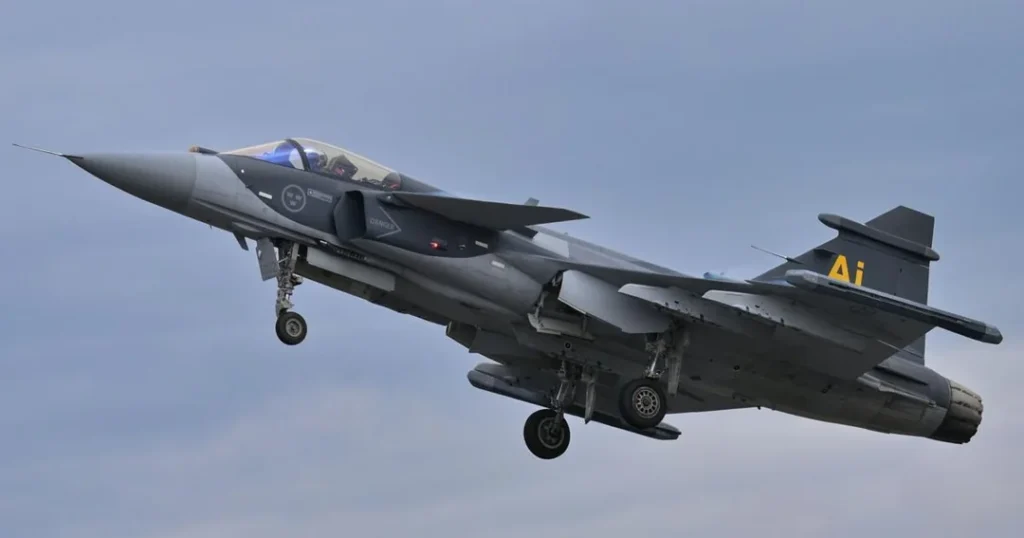
Canada’s Fighter Jet Choice: Why the Gripen Beats the F-35
For over a decade, the debate over Canada’s next fighter jet has been a saga of delays, political wrangling, and heated public discourse. The government’s selection of the American-made F-35 seemed to close the chapter. However, a compelling case remains that Canada may have chosen the wrong aircraft. When examining long-term sovereignty, cost, and operational practicality, Sweden’s Saab Gripen E emerges not just as an alternative, but as the superior strategic choice for Canada’s unique needs.
The $13,000 Per Hour Question: A Staggering Cost Disparity
The most glaring advantage of the Gripen is its life-cycle cost, a figure that should give every taxpayer pause. While the upfront purchase price of jets grabs headlines, the true financial burden lies in decades of operation, maintenance, and upgrades.
Operating the F-35 is estimated to cost a staggering $13,000 more per flight hour than the Gripen E. This isn’t a marginal difference; it’s a chasm. Over a 30-40 year service life encompassing thousands of flight hours per aircraft, this disparity translates into tens of billions of dollars in saved public funds. These are resources that could be reinvested into other critical areas of the Canadian Armed Forces, from naval ships to cyber defense.
Beyond the Price Tag: The Gripen’s Strategic Advantages
Cost savings alone are compelling, but the Gripen’s benefits extend far into strategic sovereignty and operational flexibility.
- Unmatched Operational Independence: The Gripen is designed to operate from short, austere runways—highways, damaged main bases, or forward Arctic strips—with minimal support. This “dispersed operations” capability is a perfect fit for Canada’s vast geography and Arctic sovereignty mission. The F-35, by contrast, requires extensive, fixed-base infrastructure and a long, vulnerable logistics tail, much of which is controlled by the U.S. government and subject to its regulations (like the International Traffic in Arms Regulations, or ITAR).
- Technological Sovereignty: Choosing the Gripen would allow Canada to own the source code and data of its frontline fighter. This means Canadian companies could perform maintenance, upgrades, and integration of new weapons without perpetual U.S. approval. With the F-35, Canada remains a permanent customer in a U.S.-controlled program, unable to modify or fully understand its own aircraft’s software.
- Industrial Benefits Tailored for Canada: Saab’s offer included a guaranteed, transformative industrial package. It promised to build a complete aerospace ecosystem in Canada, centered on a new “Gripen Fighter System Centre.” This would have created a sovereign Canadian capability to design, test, manufacture, and sustain advanced fighter systems for generations, with ownership of the intellectual property. The F-35 program offers work packages, but not the foundational technology transfer or ecosystem control.
The F-35: A Capable Jet with Compromises for Canada
There is no denying the F-35 is a technologically marvelous aircraft. Its stealth capabilities and sensor fusion are unparalleled. However, these advantages come with significant compromises for a country like Canada.
Stealth is a diminishing advantage in an era of advanced low-frequency radars and networked sensor systems. Furthermore, the F-35’s stealth is most effective when the aircraft is in a “clean” configuration without external weapons or fuel tanks. For many missions—like Arctic patrols or air-to-air combat—jets carry external ordnance, rendering their stealth coating largely irrelevant and negating a key cost driver.
The F-35 is also a single-engine aircraft, a point of contention for a country whose pilots routinely fly over remote, unforgiving terrain. The Gripen E, while also single-engine, is built with this reality in mind, designed for exceptional reliability and survivability. More critically, the F-35 program continues to face well-documented issues with availability rates, maintenance complexity, and upgrade timelines, casting doubt on its long-term reliability and cost predictability.
The Sovereignty Test: Who Controls Your Defense?
This is the core of the debate. National defense is the ultimate expression of sovereignty. Can a nation be truly sovereign if the keys to its primary defensive capability are held by another?
- With the Gripen: Canada controls the software, the supply chain, the upgrades, and the basing strategy. It can deploy and maintain the jet anywhere, under any conditions, without foreign veto.
- With the F-35: Canada is integrated into a U.S.-led alliance structure, which is beneficial for interoperability but means operational decisions, software updates, and even the integration of non-U.S. weapons require permission. In a geopolitical crisis where U.S. and Canadian interests might not perfectly align, this could pose a serious constraint.
Conclusion: A Choice for the Future
The selection of the F-35 was framed as choosing the most advanced, interoperable jet for NORAD and NATO. But this view is short-sighted. It confuses tactical interoperability with strategic dependency.
The Saab Gripen E represents a different vision: one of sovereign capability, fiscal responsibility, and practical resilience. It is the jet designed for a country that values control over its own assets, efficiency in its operations, and the ability to defend its vast territory independently. The $13,000 per hour savings is not just a line item; it is a symbol of the ongoing, avoidable cost of forfeiting that sovereignty.
For Canada, a G7 nation with the world’s second-largest landmass and a leading role in Arctic stewardship, the fighter jet decision was about more than replacing old planes. It was a definitive statement about what kind of military—and what kind of nation—Canada wants to be for the next half-century. The evidence suggests that for true sovereignty, long-term affordability, and a made-in-Canada defense industry, the wiser, more strategic choice was waiting in Sweden.