The Hidden Cost of University Budget Cuts on Students
For students stepping onto campus this fall, the university experience promises a world of opportunity—a chance to learn, grow, and build a future. But beneath the surface of this promise, a quiet crisis is unfolding. Across Canada, universities are grappling with severe financial pressures, leading to deep budget cuts that are fundamentally reshaping campus life. While tuition hikes often grab the headlines, the real, hidden costs are being borne by students in ways that extend far beyond their bank accounts. This isn’t just about finances; it’s about the erosion of the very support systems and opportunities that make a university education valuable.
Beyond Tuition: The Unseen Erosion of Student Support
When budgets are slashed, the first casualties are often the non-academic yet vital services that form the backbone of student well-being and success. These are the resources that help students navigate the immense pressures of higher education, and their reduction creates a ripple effect of negative consequences.
The Mental Health Support Gap
Perhaps the most alarming impact is on mental health services. Demand for counselling and psychological support on campuses has been skyrocketing for years. However, budget constraints are forcing many institutions to scale back just when students need help the most. The result is often:
This creates a dangerous scenario where students in distress are left without timely, adequate care, potentially exacerbating their struggles and impacting their academic performance and personal health.
Career Services and Academic Advising Stretched Thin
The pathway from graduation to a career is rarely straightforward. Students rely heavily on career centres for resume reviews, interview coaching, and connections to potential employers. Similarly, academic advisors are crucial for navigating degree requirements and making informed course selections. Budget cuts are crippling these departments, leading to:
This lack of guidance can leave students feeling lost, potentially delaying their graduation or putting them at a disadvantage in the competitive job market.
The Disappearing Campus: Cuts to Facilities and Community
A university is more than a collection of classrooms; it’s a community. Budget cuts are directly diminishing the spaces and activities that foster this sense of belonging, turning a vibrant campus into a mere commuter school.
Shuttered Libraries and Limited Lab Access
The library is often the heart of academic life, but reduced operating hours are becoming the norm. Students who work part-time jobs or simply study better in the evening are finding their access to quiet study spaces, physical books, and research librarians severely limited. In sciences and engineering, cuts to laboratory funding and technician hours mean less hands-on experience with crucial equipment, diluting the practical quality of their education.
The Slow Death of Student Life and Extracurriculars
From sports teams and clubs to student newspapers and cultural events, extracurricular activities are where students develop soft skills, leadership, and lifelong friendships. These programs are often funded through ancillary fees or university subsidies, both of which are vulnerable to cuts. The consequences include:
This erosion of campus life not only makes the university experience less enriching but also impacts student retention and the overall reputation of the institution.
The Academic Squeeze: Larger Classes and Fewer Course Options
The impact on the core academic mission of the university is equally profound. While students are paying more, they are often receiving less in terms of direct instructional quality and choice.
Overcrowded Lectures and Less Professor Interaction
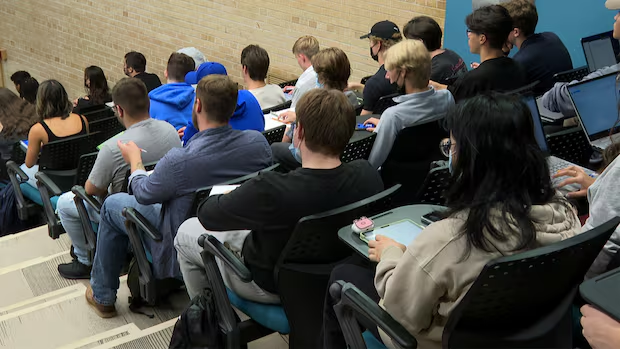
A common cost-saving measure is to not fill vacant faculty positions. This leads to larger class sizes, especially in introductory courses. In a lecture hall with 500 students, the opportunity for individual attention from a professor vanishes. The learning environment becomes impersonal, and students can feel like anonymous numbers rather than scholars. This model prioritizes efficiency over the quality of education.
Reliance on Sessional Instructors and Program Cuts
To manage teaching loads, universities are increasingly relying on sessional instructors. While many are excellent educators, they are often overworked, underpaid, and on short-term contracts with little job security. This high turnover can disrupt program continuity and limit the availability of professors for long-term mentorship and research opportunities. In more drastic scenarios, entire programs, particularly in the humanities and arts, are being cut or consolidated, narrowing the educational landscape and limiting student choice.
The Long-Term Consequences: A Weakened Degree and a Diminished Future
The cumulative effect of these cuts is a devaluation of the university degree itself. When the campus experience is stripped of its support systems, community, and academic depth, the credential becomes less meaningful. Students are graduating with more debt and a less robust educational foundation, potentially putting them at a disadvantage as they enter the workforce. They may have missed out on the critical networking, mentorship, and practical experiences that often lead to career success.
Furthermore, a weakened university system has broader implications for society. Universities are engines of innovation, critical thought, and cultural development. When they are forced to operate in a perpetual state of financial triage, their ability to fulfill this vital role is compromised.
What Can Be Done? A Call for Sustainable Solutions
The situation is dire, but it is not hopeless. Addressing this crisis requires a multi-faceted approach and a collective voice.
The hidden cost of university budget cuts is a bill that today’s students, and society as a whole, will be paying for years to come. It’s a cost measured in mental health struggles, missed opportunities, and a diluted education. Protecting the integrity of higher education is not just about balancing books; it’s about investing in the future of an entire generation.