
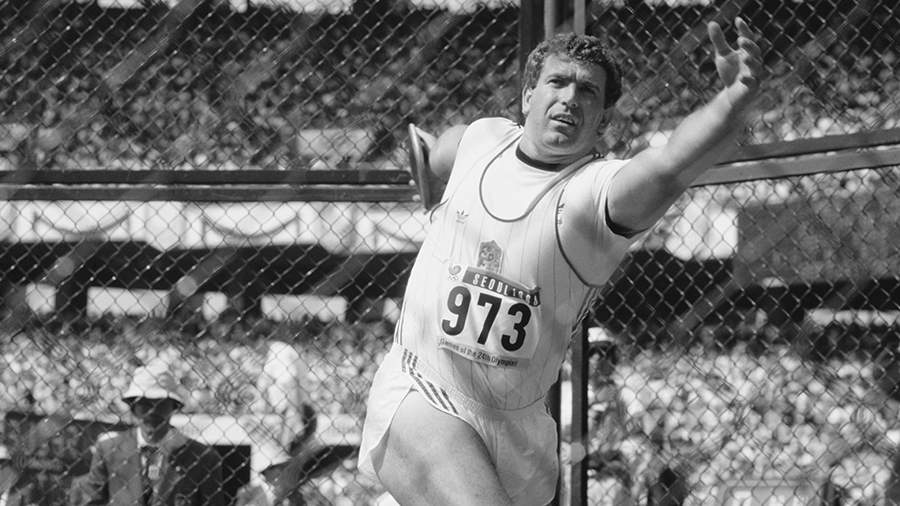
Remembering Imrich Bugár: A Discus Legend’s Legacy and Olympic Journey
The world of athletics has lost a giant. Imrich Bugár, the Czechoslovak-born discus thrower whose name became synonymous with grace, power, and longevity in the throwing circle, has passed away. For over two decades, Bugár was not just a competitor; he was a constant, a master technician whose career arc traced the tumultuous political changes of 20th-century Europe. His story is one of remarkable consistency, Olympic heartbreak and triumph, and an enduring legacy that inspired a generation of throwers.
From Humble Beginnings to World-Class Technique
Born in 1955 in the former Czechoslovakia, Imrich Bugár’s journey to discus immortality was not preordained. He discovered the sport relatively late, but what he may have lacked in early specialization, he more than made up for with a relentless work ethic and an almost scholarly approach to his craft.
Bugár was celebrated for his flawless technique. While many of his rivals relied on raw power, he was the artist in the circle. His spins were a model of controlled, explosive efficiency. Coaches and analysts often pointed to his perfect balance, his precise footwork, and the seamless transfer of energy from his core to his fingertips. This technical mastery was the bedrock of his career, allowing him to compete at the highest level well into his late 30s—a rarity in such a physically demanding event.
Building a Legacy: Major Championship Performances
Bugár’s career was defined by his performances on the biggest stages. He was a championship thrower, consistently delivering when it mattered most.
- Olympic Silver in Moscow (1980): In his first Games, Bugár announced himself to the world by winning the silver medal. It was a breakthrough performance that set the stage for his future battles.
- World Champion in Helsinki (1983): At the inaugural World Athletics Championships, Bugár reached the pinnacle. With a throw of 67.72 meters, he defeated the mighty Soviet throwers on their home turf to claim the gold medal and the title of the world’s best.
- Olympic Silver in Seoul (1988): In one of the most dramatic Olympic finals, Bugár threw a massive personal best of 68.58m. Yet, he was narrowly defeated by Jürgen Schult of East Germany, who set a world record that still stands today. This “silver lining” was a testament to his incredible level at age 33.
- European Champion in Split (1990): Proving his enduring class, he added the European title to his collection, showcasing his dominance across all major championships.
The Unfulfilled Dream: The Elusive Olympic Gold
If there is a central narrative to Imrich Bugár’s competitive story, it is his quest for the Olympic gold medal. He came agonizingly close on multiple occasions, a fact that often defines how the public remembers an athlete. Yet, to focus solely on the missing gold is to overlook the sheer magnitude of his Olympic consistency.
He competed in four consecutive Olympic Games (1980, 1984, 1988, 1992), a feat in itself. The 1984 Los Angeles Games, which he missed due to the Eastern Bloc boycott, likely cost him his best chance at the top podium. His sport’s history is punctuated by such political interruptions, and Bugár was one of its most notable affected champions.
His final Olympic appearance in Barcelona 1992, competing for the newly formed Czech Republic, was a poignant capstone. Though he didn’t medal, his presence was a powerful symbol of perseverance and the unifying spirit of sport beyond national borders.
A Champion for Changing Times
Bugár’s personal story mirrored the geopolitical shifts of his era. He began his career representing communist Czechoslovakia, lived through the Velvet Revolution, and ended it as a standard-bearer for the democratic Czech Republic. Through it all, he remained a quiet, dignified ambassador for his homeland(s) and his event.
His longevity was unprecedented. In an era before advanced sports science and recovery protocols were commonplace, Bugár’s ability to maintain world-class form for over 12 years stands as a testament to his intelligent training, technical perfection, and deep passion for the discus.
The Lasting Impact of a Quiet Legend
Imrich Bugár’s legacy extends far beyond his medal collection. He redefined what was possible for a discus thrower in terms of career span. He proved that technical purity could rival and often outlast brute strength.
- The Technician’s Blueprint: For aspiring throwers and coaches, film of Bugár’s technique remains essential viewing. His style is still taught as a model of efficiency.
- Perseverance Personified: His journey through boycotts, political upheaval, and near-misses on sport’s biggest stage is a masterclass in resilience and dedication to craft.
- A Bridge Between Eras: He was a champion of the amateur age who successfully transitioned into the early professional era, mentoring younger athletes and maintaining his competitive fire.
In the Czech Republic and Slovakia, he is remembered as one of the greatest athletes of the 20th century. His 1983 world title was a moment of immense national pride, and his dignified demeanor made him a beloved figure.
Farewell to a Master of the Circle
The passing of Imrich Bugár marks the end of an era in track and field. He was a thrower’s thrower—a purist who found beauty in the spin and physics of the discus. While the Olympic gold medal remained just out of reach, his career was a golden standard of excellence, consistency, and sportsmanship.
He leaves behind a legacy not of what might have been, but of what was: a world championship, multiple Olympic medals, a European title, and the profound respect of everyone who witnessed the artist at work in the circle. The discus world has lost its master technician, but the echoes of his throws—and the lessons of his journey—will resonate for generations to come.

