
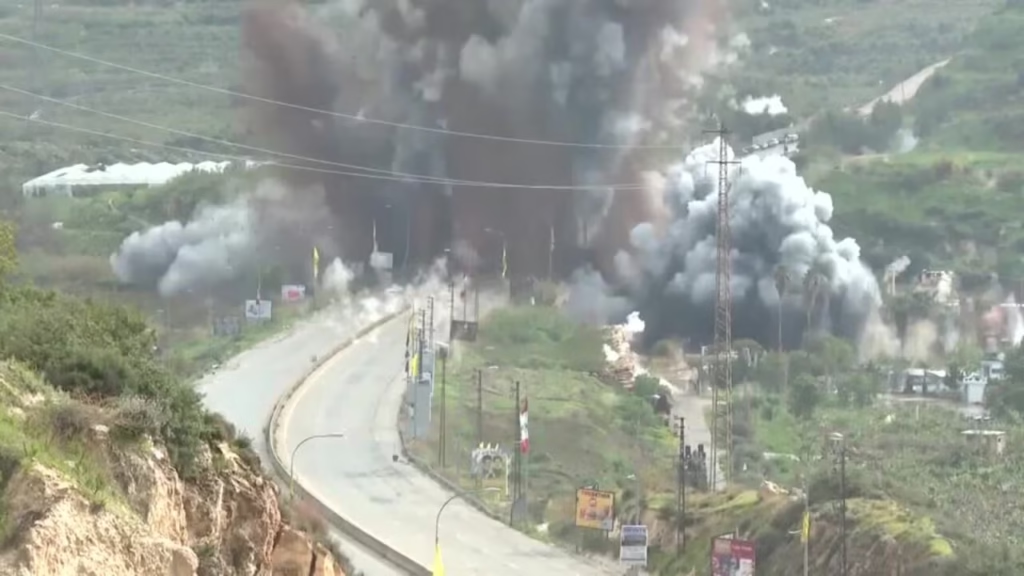
Escalating Israel-Iran Conflict Sparks Regional Tensions and Strikes
The long-simmering shadow war between Israel and Iran has erupted into the open, marking a dangerous and unprecedented escalation that threatens to engulf the entire Middle East in a wider conflict. For decades, hostilities played out through proxies and covert operations. Now, a cycle of direct strikes and retaliations has shattered that paradigm, raising the specter of a regional war with global implications. This article breaks down the recent explosive events, the strategic stakes for both nations, and the precarious position of the international community.
From Shadow War to Open Confrontation: A Timeline of Escalation
The current crisis did not emerge in a vacuum. It is the direct result of a tit-for-tat exchange that began with a strike on an Iranian diplomatic compound in Damascus, widely attributed to Israel.
The Damascus Attack: A Crossed Red Line
On April 1st, an airstrike leveled the Iranian consulate in Syria’s capital, killing several members of Iran’s Islamic Revolutionary Guard Corps (IRGC), including two senior generals. Iran and Syria accused Israel, which typically neither confirms nor denies such actions. For Tehran, this was a profound provocation—an attack on what it considered its sovereign territory. This strike was perceived as crossing a red line, mandating a direct response from Iran itself, rather than through its allied militias like Hezbollah.
Iran’s Retaliation: A Historic Direct Strike
On the night of April 13th, Iran launched its promised response. In a major escalation, it fired over 300 drones and missiles directly from its own territory toward Israel. This marked the first-ever direct Iranian military attack on Israeli soil. The Israeli military, with assistance from the United States, United Kingdom, France, Jordan, and others, reported intercepting 99% of the projectiles, causing minimal damage. Despite its limited military effect, the attack was a monumental shift in strategy, moving the conflict from the shadows into the light.
Israel’s Counter-Strike: A Calculated Response
Israel vowed to respond. After days of deliberation and under significant international pressure to de-escalate, Israel conducted a limited strike inside Iran in the early hours of April 19th. Reports indicate the strike targeted an air defense radar site near a major nuclear facility in Isfahan, signaling Israel’s capability to penetrate Iranian airspace. The strike was deliberately calibrated to be limited in scope but clear in message: Israel will retaliate against direct attacks, yet it showed restraint to avoid spiraling the situation further out of control.
The Core of the Conflict: What Are Israel and Iran Fighting For?
At its heart, this is a multifaceted struggle for regional dominance, security, and ideology.
* Iran’s “Axis of Resistance”: Iran seeks to cement its role as the leader of the Shia Muslim world and a counterweight to American and Israeli influence. It has built a network of proxy forces across the region—including Hezbollah in Lebanon, the Houthis in Yemen, and various militias in Iraq and Syria. This network allows it to project power and pressure Israel without engaging in full-scale war.
* Israel’s Existential Security Doctrine: Israel views a nuclear-capable Iran as an existential threat. Its core security policy is to prevent Iran from establishing permanent military footholds in Syria (on Israel’s northern border) and from acquiring nuclear weapons. It conducts a continuous campaign, known as the “war between wars,” to disrupt weapons transfers to Hezbollah and degrade Iranian military assets in Syria.
* The Nuclear Question: The stalled Iran nuclear deal (JCPOA) looms over all hostilities. Israel vehemently opposed the original agreement and is determined to prevent Iran from developing a nuclear weapon by any means necessary, including military action.
Regional Fallout: A Tinderbox Ready to Ignite
The direct Israel-Iran exchanges have sent shockwaves through an already volatile region, activating multiple flashpoints.
Proxy Forces on High Alert
Iran’s network of allied groups has been engaged in low-level conflict with Israel and its allies for months:
* Hezbollah and Israel have been trading near-daily fire across the Lebanese-Israeli border since the Gaza war began, in their most serious clashes since 2006.
* Yemen’s Houthis have been attacking international shipping in the Red Sea, claiming solidarity with Palestinians in Gaza.
* Iraqi militias have launched drones and rockets at U.S. forces stationed in Iraq and Syria.
A full-scale war between Israel and Iran would almost certainly trigger these groups to unleash their full arsenals, opening multiple devastating fronts.
The Gaza War Connection
The current escalation is inextricably linked to the ongoing war in Gaza between Israel and Hamas (which is supported by Iran). The Gaza conflict provided the backdrop and the impetus for heightened activity by Iran’s proxies, which in turn set the stage for the Damascus strike and the subsequent cycle of retaliation. Any regional de-escalation is deeply tied to finding a resolution to the crisis in Gaza.
The Global Stakes and the Path Forward
The international community watches with grave concern. A regional war would disrupt global oil supplies, trigger massive humanitarian disasters, and potentially draw in major powers.
* The U.S. Dilemma: The United States is firmly allied with Israel but desperately seeks to avoid an all-out war that could entangle American troops. It walks a tightrope, supporting Israel’s defense while urging extreme restraint in its offensive actions.
* Diplomatic Efforts: Nations around the world are calling for de-escalation. The G7, Arab states, and the UN are all engaged in frantic diplomacy to lower temperatures and establish communication channels to prevent miscalculation.
* A Precarious Calm: For now, the cycle of direct strikes appears to have paused. Both sides have signaled a desire to step back from the brink after their demonstrations of capability. However, the underlying conflict remains entirely unresolved. The paradigm has permanently shifted to one where direct attacks are now a tool in the arsenal.
Conclusion: A New and Dangerous Normal
The Middle East has entered a new and perilous phase. The unwritten rules of the Israel-Iran conflict have been rewritten. The era of predictable proxy warfare has given way to a reality where the two arch-foes are willing to strike each other’s territory directly. While the immediate fire may be dampened, the embers are glowing hotter than ever. The region now exists in a fragile state of deterrence, where one miscalculation, one misread signal, could ignite a conflict that everyone claims they do not want. The world holds its breath, hoping diplomacy can build a wall against the rising tide of war.

