
Japan’s Strategic Shift: Deploying Long-Range Missiles to Counter Regional Threats
For decades, Japan’s defense posture was defined by its pacifist constitution, emphasizing self-defense within its own territory. However, a rapidly shifting security landscape in East Asia is prompting a historic and decisive transformation. In a move that signals a new era for Japanese security policy, the nation is now actively deploying long-range, precision-guided missiles capable of striking targets in foreign territory. This strategic pivot is a direct response to the growing military capabilities and assertive actions of its neighbors, primarily China and North Korea, and is fundamentally reshaping the balance of power in the Indo-Pacific.
A Historic Departure from Post-War Pacifism
Japan’s post-World War II identity has been deeply intertwined with Article 9 of its constitution, which renounces war and the threat or use of force as a means of settling international disputes. For years, this was interpreted to mean that Japan could only maintain forces for the exclusive purpose of defending its homeland from a direct attack. The concept of possessing “counterstrike capabilities”—the ability to hit launch sites and command centers in an adversary’s territory—was considered a political and constitutional red line.
That line has now been crossed. The driving force behind this change is a palpable sense of vulnerability. China’s sweeping military modernization, its increased pressure on Taiwan, and frequent incursions around the Japanese-administered Senkaku Islands (claimed by China as the Diaoyus) have created a persistent threat. Simultaneously, North Korea’s relentless ballistic missile tests, including those that overfly Japanese territory, present a clear and present danger. Faced with adversaries who can strike from afar, Japan’s leadership concluded that a purely defensive shield was no longer sufficient; a deterrent sword was also necessary.
The Capabilities: Tomahawks and Type 12s
Japan’s new long-range arsenal is a blend of proven foreign systems and enhanced domestic technology.
Key systems include:
- U.S.-made Tomahawk cruise missiles: Acquired from the United States, these sea-launched missiles are a battle-proven weapon with a range exceeding 1,000 kilometers (620 miles). Their deployment on Japan’s advanced destroyers gives the Maritime Self-Defense Force a powerful, long-range precision strike capability from versatile naval platforms.
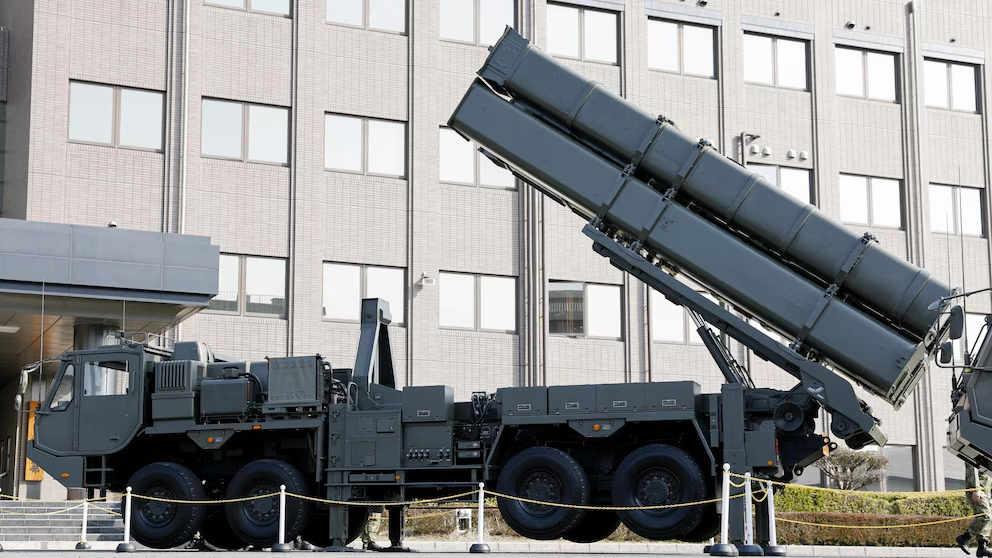
- Upgraded Type 12 Surface-to-Ship Missiles (SSMs): This is the cornerstone of Japan’s indigenous effort. Originally a truck-mounted anti-ship missile with a range of roughly 200 km, the Type 12 is undergoing a massive upgrade. The new version will have a staggering range of over 1,000 kilometers and will be deployable from ships and aircraft, transforming it from a coastal defense weapon into a long-range land-attack cruise missile.
- Development of Hypersonic Weapons: Looking to the future, Japan is also investing in research for hypersonic glide vehicles, which would travel at speeds exceeding Mach 5, making them extremely difficult to intercept.
This combination ensures Japan can hold critical assets at risk deep within an adversary’s territory, complicating enemy planning and raising the cost of aggression.
The Strategic Rationale: Deterrence and Alliance Integration
Japan’s move is not about militarism but about credible deterrence. The core logic is to make any potential aggressor believe that an attack on Japan or its interests would trigger a devastating response. By being able to threaten command nodes, logistics hubs, and missile launch sites, Japan aims to “deter by denial,” convincing rivals that a successful first strike is impossible, and a conflict would be too costly to initiate.
Crucially, this shift is deeply integrated with Japan’s alliance with the United States. For years, the U.S. provided the “offensive” strike capability while Japan focused on “defensive” roles like anti-submarine warfare and missile defense. This new capability allows Japan to take on a more balanced role within the alliance. It enables deeper operational planning and more effective joint responses to regional crises, particularly a contingency in the Taiwan Strait. A Japan that can contribute long-range firepower is a stronger and more capable partner, which ultimately strengthens the U.S.-led security network in Asia.
Regional Reactions and the Stability Dilemma
Unsurprisingly, Japan’s decision has drawn sharp criticism from Beijing and Pyongyang. China has accused Japan of “abandoning its pacifist commitments” and “hyping up regional tensions.” It views the deployment of long-range missiles, especially on islands closer to Taiwan, as a direct threat to its sovereignty and security. North Korea has condemned the move as part of a dangerous arms build-up.
This highlights the classic “security dilemma,” where one nation’s efforts to increase its own security are perceived as a threat by others, potentially triggering an arms race. Japan argues that its actions are reactive and defensive in nature, a necessary response to an already deteriorating environment. However, the risk of miscalculation and escalation in a crisis has undoubtedly increased. The region is now home to multiple powers with advanced, long-range strike capabilities in close proximity, raising the stakes of any military incident.
The Road Ahead: Challenges and Implications
Deploying these systems is only the first step. Japan faces significant challenges in operationalizing its new strategy.
Critical implementation hurdles include:
- Targeting and Intelligence: Effective use of long-range missiles requires exquisite, real-time intelligence, surveillance, and reconnaissance (ISR) to identify targets and assess damage. Japan will need to heavily rely on and integrate with U.S. ISR assets while bolstering its own.
- Stockpiling and Sustainability: A sustained conflict would require a large inventory of expensive missiles. Japan must navigate budgetary constraints to build a stockpile large enough to be a credible deterrent.
- Political and Public Consensus: While there is growing public acceptance of a stronger defense, the move remains controversial domestically. Sustaining political will and public support for this expensive, offensive-leaning strategy over the long term will be crucial.
A New Normal for Japanese Security
The deployment of long-range missiles marks a point of no return for Japan. It is the most tangible manifestation of a broader shift towards a more proactive and integrated defense posture, as outlined in its recent National Security Strategy documents. Japan is no longer content to sit behind a purely defensive shield.
This transformation is reshaping the geopolitical map of East Asia. It signals Japan’s determination to be a primary security actor in its own right, capable of defending its interests and contributing decisively to regional stability alongside the United States. While the risks of an intensified security dilemma are real, Japan’s calculation is that a robust and credible deterrent, built on a foundation of strong alliances, is the best way to prevent conflict and maintain a free and open Indo-Pacific in an increasingly contested and dangerous world. The era of post-war pacifism, as it was once known, has unequivocally ended.

