
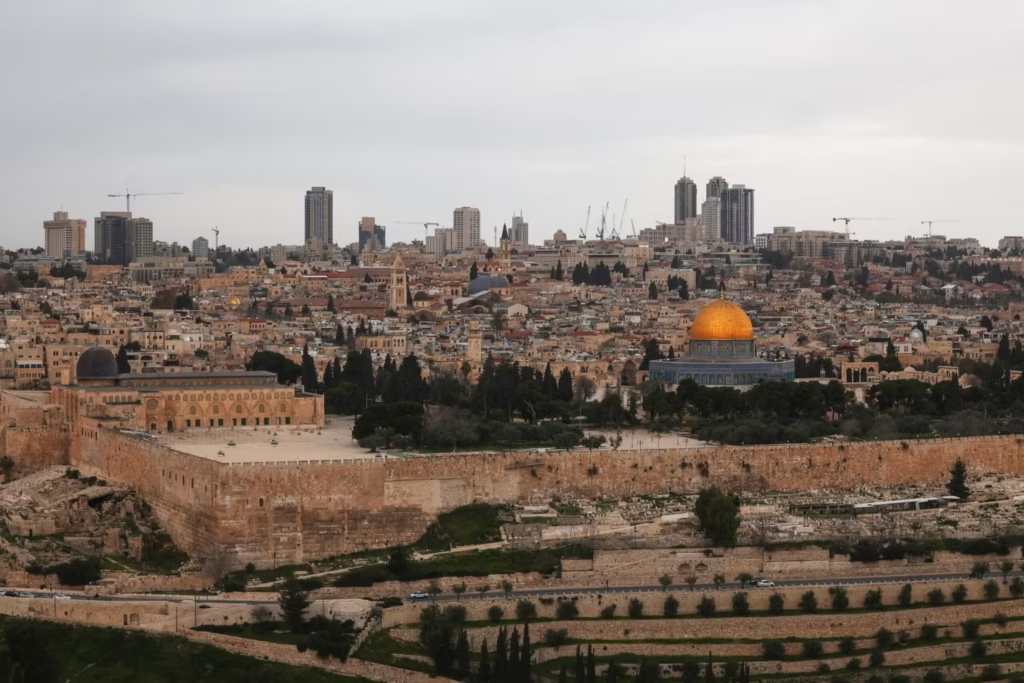
Iran Launches Unprecedented Missile Attack on Jerusalem, Israel
The night sky over Jerusalem, a city sacred to billions, was violently illuminated on Sunday as sirens wailed and explosions echoed through its ancient streets. In an unprecedented and direct assault, the Islamic Republic of Iran launched a massive barrage of drones and missiles towards Israeli territory, marking a dangerous and historic escalation in the long-running shadow war between the two nations. For the first time, Iran claimed responsibility for a direct strike from its own soil, shattering decades of precedent and bringing the Middle East to a new precipice.
A Night of Alarms and Unprecedented Escalation
The attack was not a surprise in its timing but was staggering in its scale and origin. Israeli and U.S. officials had been warning of an imminent Iranian response for days, following a suspected Israeli airstrike on an Iranian diplomatic compound in Damascus, Syria, on April 1st. That strike, which killed senior commanders of Iran’s Islamic Revolutionary Guard Corps (IRRC), including two generals, was seen by Tehran as a crossing of a red line.
In retaliation, Iran launched an operation it dubbed “True Promise.” The assault involved:
- Hundreds of drones: A first wave of slow-flying unmanned aerial vehicles (UAVs), likely Shahed-136 “suicide drones,” were launched hours before the missile strike, requiring extended flight time to reach Israel.
- Ballistic missiles: This was the core of the attack, with Iran firing dozens of medium-range ballistic missiles from its own territory, a direct-state-on-state action it had previously avoided.
- Cruise missiles: Reports indicated cruise missiles were also part of the complex, coordinated barrage, designed to overwhelm Israeli defenses from multiple vectors and altitudes.
The sounds of interceptions by Israel’s multi-layered air defense systems, primarily the Arrow system for ballistic missiles and David’s Sling, were heard across central Israel, including in Jerusalem.
Jerusalem on Alert: A City Under the Shield
Residents of Jerusalem and other Israeli cities were instructed to move to protected spaces as sirens blared. The sight and sound of defenses engaging incoming threats over one of the world’s most historically significant cities created a scene of surreal tension. Social media filled with videos of bright flashes and loud booms in the night sky as Israeli air defenses worked to neutralize the threat.
While the psychological impact was profound, the physical damage within Israel appears to have been remarkably limited. This was largely due to two critical factors:
- Advanced Allied Defenses: Israel’s Iron Dome, David’s Sling, and Arrow systems, supported by U.S., British, French, and Jordanian forces, formed a highly effective defensive coalition. Jordan’s reported engagement of projectiles over its airspace was a particularly notable regional dynamic.
- Extended Warning Time: The slow travel of the initial drone wave provided a crucial window for Israel and its allies to prepare and coordinate the defensive response.
Initial reports indicated a minor injury to a young girl and some light damage to an Israeli military base. The Nevatim Airbase, a key strategic site, was reportedly struck but remained operational.
The Global Reaction and the Stakes of Retaliation
The international response was swift and largely unified in condemning Iran’s actions while urging restraint to prevent a wider war.
United States: President Joe Biden reaffirmed America’s “ironclad” commitment to Israel’s security. U.S. forces in the region actively assisted in shooting down Iranian drones. However, in a crucial phone call with Israeli Prime Minister Benjamin Netanyahu, Biden reportedly advised that Israel should consider its successful defense a “win” and implied the U.S. would not support a retaliatory strike.
United Nations: The UN Security Council held an emergency meeting, with Secretary-General António Guterres stating, “The Middle East is on the brink.” He pleaded for all parties to avoid actions that could lead to major military confrontations.
Regional Actors: Reactions were mixed. Several Arab nations, while privately relieved at Israel’s defensive success, publicly expressed deep concern over the escalation. The attack complicated delicate regional diplomacy and normalization efforts.
Analyzing Iran’s Calculated Gambit
Why would Iran launch such a direct and risky attack? Security analysts point to a complex calculus of domestic and regional pressures:
- Compelled Response: The Damascus consulate strike was a severe blow to the IRGC’s prestige. Failure to respond directly could have been seen as weakness both domestically and by its proxy network across the region.
- Signaling Strength, Limiting Escalation: The attack was telegraphed, allowing for a defensive response. This suggests Iran may have intended to demonstrate capability and restore deterrence without necessarily seeking a full-scale war that would risk its own regime.
- Testing Defenses: The barrage provided Iran with valuable real-world data on the coordination and effectiveness of Israeli and allied air defense systems.
The Precarious Road Ahead for Israel and the Region
The immediate question now hangs over the Israeli war cabinet: How will Israel respond? The options range from a symbolic but contained strike to a much more significant military action against Iranian territory or its assets. The decision is fraught with risk.
Arguments for a Strong Response: Proponents argue that allowing a direct missile attack on Jerusalem to go unanswered sets a dangerous new precedent. It could embolden Iran and its proxies, eroding Israel’s long-standing policy of punishing direct attacks from enemy states.
Arguments for Strategic Restraint: Others contend that Israel, with allied help, achieved a major defensive victory. A large-scale counterstrike could trigger an uncontrollable regional war, destabilize global oil markets, and divert critical resources from other strategic priorities, including the ongoing conflict in Gaza.
The world now watches to see if this unprecedented attack becomes a isolated, dramatic event or the opening chapter of a much broader and more dangerous regional conflict. The sirens in Jerusalem have stopped, but the echo of their warning continues to reverberate, defining a new and more volatile chapter in the Middle East. The delicate balance between restoring deterrence and avoiding all-out war has never been more challenging for the leaders involved.

