
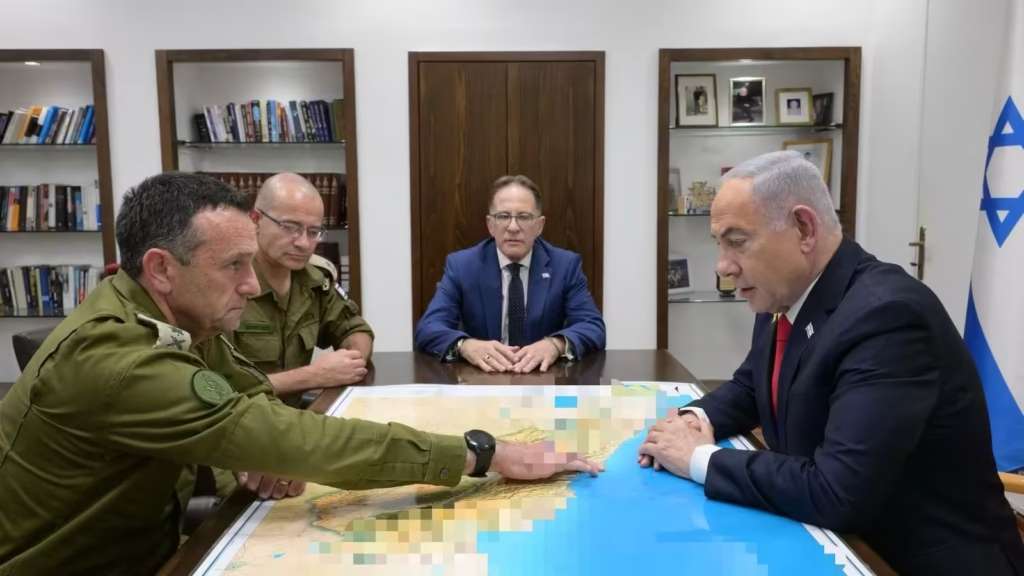
Netanyahu’s Lebanon Talks Could Catalyze Middle East Ceasefire
In a significant and potentially transformative diplomatic move, Israeli Prime Minister Benjamin Netanyahu has authorized direct negotiations with Lebanon. This decision, emerging from a period of intense cross-border conflict, is being viewed by international observers as a critical step that could unlock a wider regional de-escalation. The talks, focused squarely on resolving a longstanding maritime border dispute, represent a rare channel of communication between two nations technically at war. The hope resonating from Washington to Brussels is that success in this focused arena could create the necessary momentum and framework for a more durable ceasefire along the Israel-Lebanon frontier.
The Core Issue: Untangling the Maritime Border
At the heart of these authorized talks lies a complex dispute over approximately 860 square kilometers of the Mediterranean Sea. This area is rich in natural gas reserves, a potential economic lifeline for both countries, particularly for Lebanon which is mired in a profound financial crisis.
The key points of contention have been:
- Line 23: Lebanon’s current official claim, which extends its maritime territory further south.
- The Hof Line: Israel’s claim, based on a boundary registered with the UN in 2011.
- Line 29: An even more expansive claim previously discussed within Lebanese political circles, though not the current official stance.
For years, this disagreement has blocked both nations from exploring and exploiting the energy resources in the contested zone. The U.S. has acted as a primary mediator, shuttling between the parties with proposed maps and solutions. Netanyahu’s direct authorization for his team to engage is a signal that Israel sees a pathway to a deal, likely based on a compromise where Lebanon would gain sovereignty over the disputed area while Israel would receive guarantees or compensation for potential gas reserves in its equivalent economic zone.
From Energy Deal to Ceasefire Catalyst
While the talks are technically about maritime borders, their implications stretch far beyond underwater gas fields. The northern Israeli border with Lebanon has been a tinderbox for months, with the Iranian-backed militant group Hezbollah engaging in near-daily exchanges of fire with the Israeli Defense Forces (IDF) in solidarity with Hamas in Gaza. This has led to widespread destruction in southern Lebanon and northern Israel, displacing tens of thousands of civilians on both sides.
How could a maritime agreement impact security?
The theory is one of creating a virtuous cycle of de-escalation. A successful negotiation, brokered with strong U.S. backing, would achieve several things:
- Establish a Precedent for Diplomacy: It would prove that direct, interest-based talks between Israel and a Lebanese government that includes Hezbollah are possible and can yield tangible results.
- Empower the Lebanese State: A major economic win for the official Lebanese government, in the form of gas revenue, could marginally strengthen state institutions relative to Hezbollah, which positions itself as the defender of Lebanese interests.
- Provide a Face-Saving Off-Ramp: For Hezbollah, a nationally celebrated victory on maritime resources could provide the political cover to scale back military operations, claiming it secured a national achievement where the state failed for over a decade.
- Separate the Fronts: The international community, led by the U.S., hopes to compartmentalize conflicts. A Lebanon-Israel deal could help “unlink” the northern front from the war in Gaza, creating a localized incentive for calm.
In essence, the maritime deal is seen as a confidence-building measure on a grand scale. It would not directly mandate Hezbollah to stand down, but it would alter the political and economic landscape in a way that makes continued conflict less tenable and a negotiated security arrangement more likely.
Significant Hurdles and Risks Remain
Despite the cautious optimism, the path to a final deal—and certainly to a resulting ceasefire—is fraught with challenges.
Domestic Politics in Israel: Netanyahu faces pressure from his right-wing coalition partners, who oppose making concessions to Lebanon, which they view as controlled by Hezbollah. Any deal will be scrutinized for being too lenient.
Hezbollah’s Ultimate Agenda: The militant group’s actions are heavily influenced by Iran. While it may accept a maritime deal that benefits Lebanon, its military posture is also tied to the Gaza war and its regional resistance axis. Tehran may not wish to see tension fully defused on Israel’s northern border.
Implementation and Trust: Even with a signed maritime agreement, translating it into quiet on the ground would require separate, intricate security talks. The process of demarcating the sea border and beginning gas exploration would also need to proceed without security incidents.
The Shadow of Gaza: A major escalation in Gaza could still shatter any progress made on the Lebanese track. The conflicts, while diplomats try to separate them, remain deeply interconnected in reality.
A Potential Turning Point for Regional Stability
The authorization of direct Israel-Lebanon talks is a pivotal development. It shifts the dynamic from pure military confrontation to a parallel track of diplomatic engagement, however narrow its initial scope. The United States is betting that economic and diplomatic gains can be leveraged to achieve security stability.
If successful, this process could offer a blueprint for conflict management in the Middle East: identifying a mutual economic interest, using it to build a sliver of trust, and then expanding that dialogue to address more entrenched security dilemmas.
The world will be watching closely. A deal would not only unlock vital energy resources but could also begin the painstaking work of lowering the temperature on one of the world’s most volatile borders. The hope is that by starting with a dispute over lines on a map in the sea, the foundations for a more stable peace on land can finally be laid. The coming weeks of negotiation will reveal whether this potential catalyst for a broader ceasefire can withstand the immense pressures of Middle Eastern politics and conflict.

