
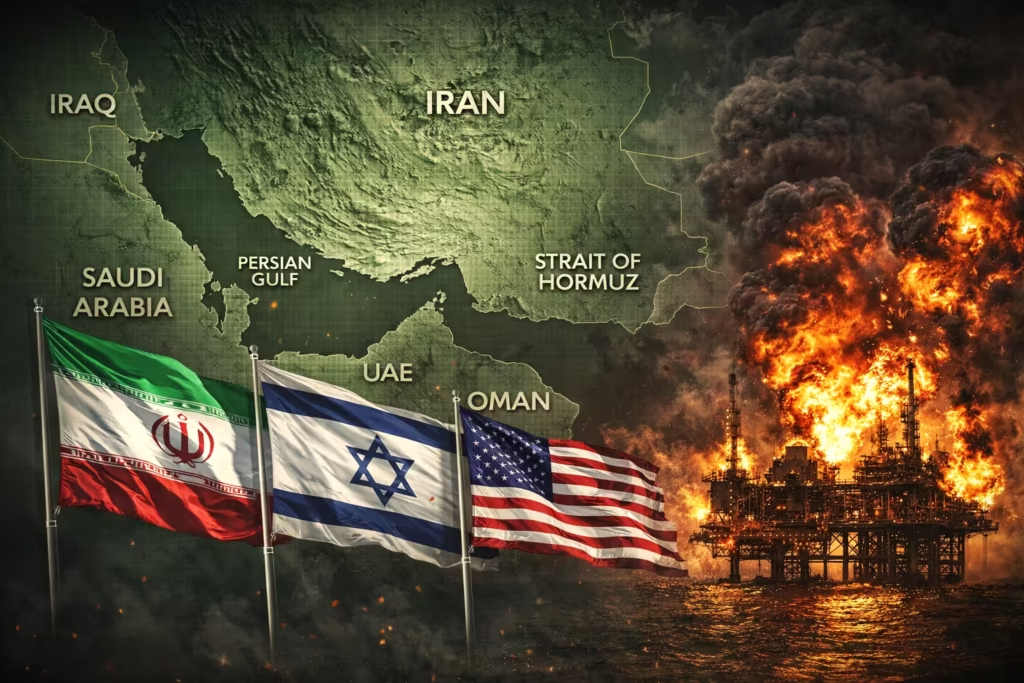
Iran’s Expanding Shadow War: A Global Threat Beyond the Strait of Hormuz
For decades, the world’s primary concern with Iran’s military strategy has centered on a narrow but vital waterway: the Strait of Hormuz. The threat to block this artery, through which a fifth of the world’s oil passes, has been a potent geopolitical lever. However, recent intelligence and a series of alarming global incidents reveal a far more dangerous and expansive reality. Iran is no longer confining its asymmetric warfare to its immediate neighborhood; it is prosecuting a sophisticated, global “shadow war,” targeting adversaries on multiple continents and threatening international security at an unprecedented scale.
From Regional Bully to Global Disruptor
The traditional model of Iranian power projection relied on regional proxies like Hezbollah in Lebanon, the Houthis in Yemen, and various militias in Iraq and Syria. This network allowed Tehran to exert influence while maintaining plausible deniability. Today, that model has evolved into a more direct and brazen campaign of international aggression. Western intelligence agencies now warn that Iran’s Islamic Revolutionary Guard Corps (IRGC) and its elite Quds Force are orchestrating plots far beyond the Middle East.
The European Front: Assassinations and Intimidation
European capitals have become active battlegrounds in this shadow war. Recent foiled plots to assassinate former US officials, Iranian dissidents, and even journalists on European soil point to a strategy of intimidation and retaliation. The chilling message is clear: no critic of the Iranian regime is safe, anywhere. This campaign aims to silence opposition, destabilize diaspora communities, and test the resolve and security capabilities of Western nations. It represents a fundamental violation of national sovereignty and international norms.
Maritime Mayhem: The New Frontier of Hybrid Warfare
While the Strait of Hormuz remains a focal point, Iran’s maritime aggression has gone global. The IRGC Navy’s harassment of commercial vessels is now mirrored by its proxy forces thousands of miles away. The Houthis’ relentless attacks on shipping in the Red Sea, using Iranian-supplied drones and missiles, have disrupted a critical lane of global trade, forcing reroutes that spike costs and inflation worldwide. This is not merely regional support; it is an export of chaos designed to exert economic pressure on Iran’s enemies and demonstrate its ability to project power into vital international waterways.
The Unfolding Crisis: A Network of Threats
The scope of Iran’s shadow war is multifaceted, creating a complex web of threats that challenges a unified international response.
- Cyber Operations: Iran maintains a highly capable cyber army, responsible for disruptive attacks on critical infrastructure, ransomware campaigns against private companies, and sophisticated espionage. These low-cost, high-impact tools allow for continuous harassment and intelligence gathering.
- Drone and Missile Proliferation: Iran has become a drone superpower, supplying advanced unmanned aerial vehicles (UAVs) to Russia for its war in Ukraine and to proxies across the region. This proliferation erodes regional military balances and puts advanced weaponry in the hands of non-state actors.
- Political Manipulation: Through its proxy networks, Iran seeks to influence political outcomes in fragile states, fueling sectarian tensions and undermining governments that oppose its agenda, from Yemen to Iraq and Lebanon.
The International Response: A Call for Coherent Strategy
The diffuse nature of Iran’s shadow war has left the international community struggling to mount an effective counter-strategy. Traditional military deterrence and economic sanctions, while still necessary, are insufficient against a campaign of deniable plots, cyberattacks, and proxy warfare. Recent high-level discussions, including warnings from leaders like Ukraine’s Volodymyr Zelenskyy about Iranian drones and calls from figures like Germany’s Friedrich Merz for a firmer European stance, highlight the growing alarm.
The Path Forward: Deterrence in the Shadows
To counter an unconventional war, the West must adopt unconventional tactics. This requires a paradigm shift in several key areas:
- Enhanced Intelligence Sharing: A seamless flow of intelligence between allies—from the Five Eyes to European agencies—is paramount to preempting terror plots and cyberattacks before they occur.
- Coordinated Law Enforcement: Treating Iranian assassination plots as major international crimes and dedicating cross-border police and judicial resources to prosecute perpetrators and their handlers.
- Public and Private Sector Cyber Defense: Fortifying critical national infrastructure and key industries against state-sponsored cyber intrusions through mandatory standards and active defense measures.
- Economic Pressure on the IRGC: Moving beyond broad national sanctions to systematically dismantle the IRGC’s international financial and smuggling networks that fund its global operations.
- Diplomatic Isolation: Holding Iran accountable in international forums for its violations of sovereignty and working to diplomatically constrain its ability to arm proxies, particularly through stringent enforcement of arms embargoes.
Conclusion: A Defining Challenge for Global Security
The threat posed by Iran is no longer contained to a map of the Middle East. Its shadow war—a blend of terrorism, cyber warfare, proxy conflict, and political subversion—now reaches into the heart of Europe, the waters of the Red Sea, and the digital infrastructure of the West. The assassination plots on European streets and the drones over Ukrainian cities are two fronts of the same campaign. Ignoring this expansion, or responding with disjointed and incremental measures, only emboldens the regime.
The world stands at a crossroads. Either it develops a new, coherent, and resilient strategy to confront this era of asymmetric conflict, or it risks accepting a new normal where a rogue state can wage war globally with impunity. The stakes extend far beyond the Strait of Hormuz; they involve the very principles of sovereignty, security, and stable global order upon which the modern world depends.

