
Unconfirmed Report: US Pilot Ejects Over Southwest Iran
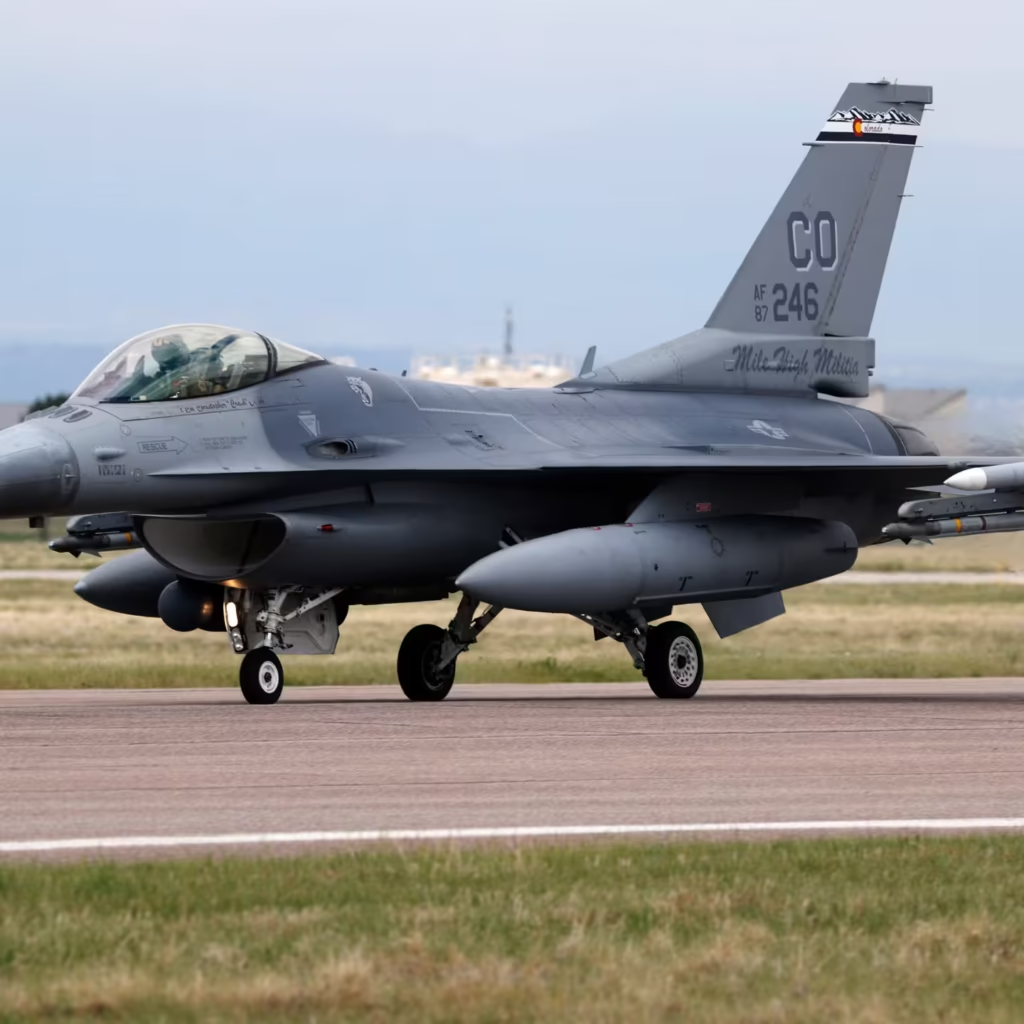
A surprising and unverified claim has emerged from Iranian state-affiliated media, injecting fresh tension into an already volatile region. According to a report from the Tasnim news agency, an affiliate of Iranian state television, a U.S. military pilot was forced to eject from their aircraft over southwestern Iran. The incident, which allegedly occurred near the city of Dezful in Khuzestan province, has been met with immediate skepticism and official denial from U.S. authorities, raising more questions than answers about the true events of the day.
The Initial Claim and Its Immediate Aftermath
The story broke via Tasnim News Agency, a media outlet known for its close ties to Iran’s Islamic Revolutionary Guard Corps (IRGC). Their report stated that a “U.S. pilot” had ejected over Iranian territory and that the individual had subsequently been “arrested” by Iranian security forces. The location was specified as the vicinity of Dezful, a city with a major Iranian airbase. The agency provided no visual evidence, such as photographs or video of a crash site, pilot, or aircraft wreckage, to substantiate the claim.
The U.S. response was swift and categorical. A spokesperson for the U.S. military’s Central Command (CENTCOM), which oversees operations in the Middle East, flatly denied the report. “We are aware of the reports but can confirm that no U.S. aircraft have operated over Iranian airspace. All U.S. personnel are accounted for,” the statement read. This definitive denial from official channels casts immediate and serious doubt on the Iranian affiliate’s narrative.
Context: A Region on a Knife’s Edge
To understand the gravity of such a report, one must consider the current geopolitical climate. Relations between the United States and Iran have been fraught for decades, marked by deep-seated distrust, economic sanctions, and proxy conflicts across the Middle East. The strategic Strait of Hormuz, a critical global oil shipping lane, lies just south of Iran’s coastline, making any military incident in the area a potential international crisis.
Recent months have seen a dangerous escalation in tit-for-tat actions:
- Iran-backed militant groups have launched attacks on U.S. forces stationed in Iraq and Syria.
- The U.S. has conducted retaliatory airstrikes on IRGC-linked facilities in Syria.
- Ongoing tensions persist over Iran’s nuclear program and its military support for regional actors.
In this environment, an incident involving a downed U.S. pilot over Iranian soil would represent a dramatic and dangerous escalation, potentially triggering a direct military confrontation. The lack of immediate, verifiable evidence from the Iranian side, coupled with the firm U.S. denial, suggests this may not be a factual account of a military incident, but rather something else entirely.
Analyzing the Motives Behind the Report
Given the absence of proof and the strong U.S. counter-statement, analysts are looking at potential reasons why Iranian state-linked media would broadcast such an unverified claim. Several theories have emerged:
- Propaganda and Psychological Operations: This could be an attempt to project strength and capability to a domestic audience. Claiming to have captured a U.S. pilot serves as a powerful nationalist narrative, portraying Iran as successfully standing up to a global superpower.
- Testing Reactions and Spreading Disinformation: Releasing such a report allows Iranian intelligence to gauge international and domestic reaction patterns. It also sows confusion and uncertainty, a classic tactic in information warfare.
- Misinterpretation of a Real, Unrelated Event: There is a remote possibility that a genuine aviation incident occurred—perhaps involving a civilian, commercial, or even an Iranian military aircraft—and was misinterpreted or deliberately misrepresented as involving the U.S.
The Critical Importance of Verification
This incident underscores the critical challenge of navigating information in conflict zones. In the age of instant digital news, unverified claims can spread globally within minutes, influencing public opinion and raising diplomatic temperatures before the facts are known. Key questions remain unanswered that would be essential to verifying the Tasnim report:
- Where is the crash site or aircraft debris?
- Where is the alleged pilot, and can neutral parties confirm their identity and status?
- What type of aircraft was allegedly involved? U.S. aircraft are not known to operate in Iranian airspace.
- Why has no other international agency or government corroborated the story?
Until such evidence is presented, the report must be treated with extreme caution. The history of state-sponsored media in conflict regions is replete with examples of fabricated or exaggerated stories used for strategic advantage.
Potential for Miscalculation and Escalation
The most dangerous aspect of this unconfirmed report is its potential to spark a real crisis. In a region saturated with military assets and high alert levels, misinformation can directly lead to miscalculation. If either side were to act precipitously based on an untrue report—by mobilizing forces or launching a pre-emptive strike—the consequences could be catastrophic. This event highlights the urgent need for reliable, direct communication channels between adversaries to quickly deconflict and debunk false narratives before they spiral out of control.
Conclusion: A Story Defined by Its Lack of Evidence
As it stands, the claim of a downed U.S. pilot in southwestern Iran remains an unsubstantiated report from a single, highly partisan source, directly contradicted by official U.S. military authorities. The absence of tangible proof, the fraught geopolitical context, and the clear motives for disinformation all point toward this being a fabricated or wildly misrepresented event.
The takeaway for observers and news consumers is a renewed lesson in media literacy, especially regarding international conflicts. In moments of high tension, the first report is rarely the full or accurate story. This incident serves as a stark reminder to seek multiple, credible sources, demand evidence, and consider the source’s potential agenda before drawing conclusions. While the skies over Southwest Iran may have been quiet in terms of U.S. aircraft ejections, the information battlefield remains as active and contested as ever.

