US Reopens Venezuela Embassy, Signaling Major Diplomatic Shift
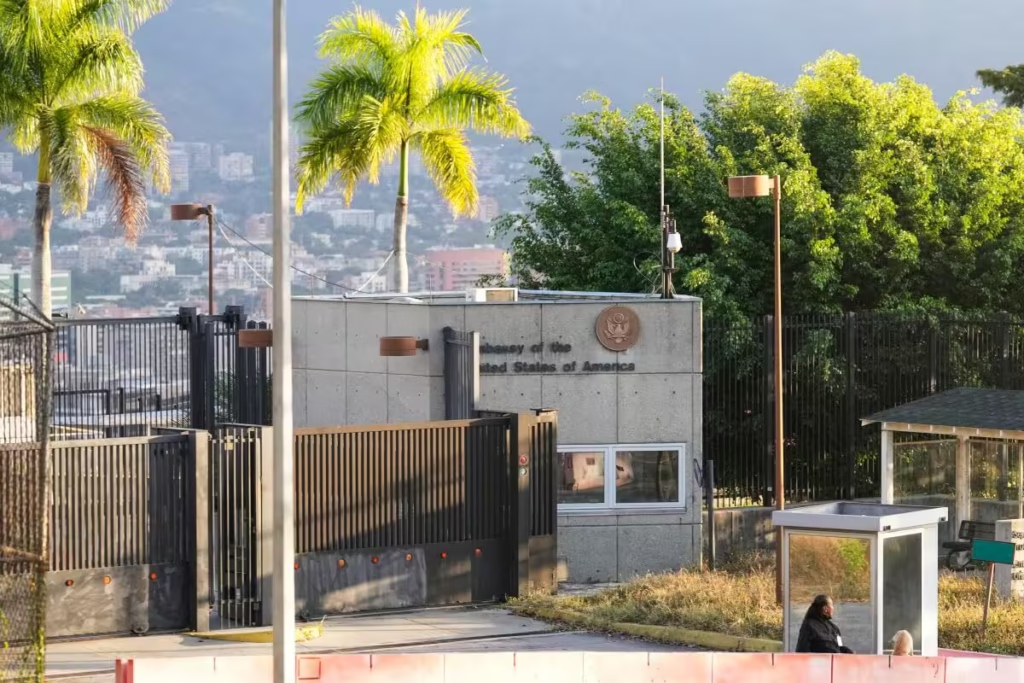
In a move that marks a significant recalibration of its foreign policy in the hemisphere, the United States has officially reopened its embassy in Caracas, Venezuela. This decision comes just months after a high-stakes, and ultimately unsuccessful, military operation aimed at forcibly removing President Nicolás Maduro from power. The reopening signals a profound shift from a strategy of maximum pressure and isolation to one of cautious, pragmatic engagement, acknowledging the complex political realities on the ground.
From “Maximum Pressure” to Measured Engagement
For years, the U.S. approach to Venezuela was defined by the doctrine of “maximum pressure.” This involved:
- Recognizing opposition leader Juan Guaidó as the legitimate interim president.
- Imposing crippling economic sanctions on Venezuela’s oil sector and government officials.
- Leading a global diplomatic campaign to isolate the Maduro regime.
- Supporting, both rhetorically and logistically, efforts to challenge Maduro’s hold on power.
The apex of this strategy was the failed military incursion in early 2023, a covert operation that aimed to capture Maduro but ended in disaster, embarrassing Washington and strengthening the Venezuelan government’s narrative of resisting foreign intervention. This event appears to have been a turning point, forcing a sober reassessment of a policy that had yielded little in terms of democratic transition but had exacerbated a humanitarian crisis affecting millions.
The Calculus Behind the Diplomatic Pivot
Several key factors are driving this unexpected diplomatic thaw:
Global Energy Realities: The war in Ukraine and subsequent sanctions on Russian oil have reshaped global energy markets. The U.S., while promoting energy independence, has a pragmatic interest in diversifying global oil supplies. Venezuela sits on the world’s largest proven oil reserves, and engaging with Caracas, however cautiously, opens a potential channel for future energy discussions, albeit under a complex web of sanctions.
The Stalemate in Caracas: The U.S. has tacitly acknowledged that the policy of regime change has stalled. The Maduro government, backed by a loyal military and key international allies like Russia, China, and Cuba, has consolidated control. The opposition is fractured and demoralized. With no clear path to ousting Maduro, engagement becomes a tool to address other pressing issues.
Addressing the Migration Crisis: Venezuela’s economic collapse has triggered one of the largest displacement crises in the world, with over 7 million people fleeing the country. Many have undertaken perilous journeys to the U.S. southern border. The Biden administration hopes that diplomatic presence and dialogue can create conditions to address root causes of migration and improve coordination on repatriation flights.
Humanitarian and Consular Imperatives: With a U.S. embassy shuttered, providing consular services to American citizens and facilitating the delivery of humanitarian aid became extremely difficult. Reopening the embassy allows for better protection of U.S. nationals and a more structured channel for aid distribution, a critical need in a country suffering from severe shortages.
What Embassy Reopening Means for Venezuela’s Political Future
The reopening of the embassy is not a recognition of the Maduro government’s legitimacy in the eyes of the U.S. Instead, it represents a shift to state-to-state engagement over partisan alignment with the opposition. The U.S. is likely to use its diplomatic presence to push for a return to credible negotiations between the government and the opposition, possibly under the auspices of Mexico-led talks that have been stalled.
Key Objectives for U.S. Diplomacy
- Pressing for Free and Fair Elections: The U.S. will almost certainly use its renewed dialogue to advocate for international electoral observation and guarantees for the 2024 presidential election, though expectations for a fully democratic process remain low.
- Securing the Release of Wrongfully Detained Americans: Several U.S. citizens and permanent residents are detained in Venezuela. Their release will be a top-tier priority for embassy officials.
- Conditional Sanctions Relief: The U.S. has shown a willingness to offer limited, reversible sanctions relief in exchange for concrete steps from Maduro, such as progress in negotiations with the opposition. The embassy will be central to monitoring any such agreements.
The move is not without its fierce critics. Hardliners within the U.S. and segments of the Venezuelan opposition view it as a capitulation that legitimizes a dictatorship. They argue it removes leverage and rewards Maduro for his intransigence. The administration counters that a sterile policy of isolation has failed and that having diplomats on the ground provides better intelligence, more influence, and the ability to directly advocate for democratic principles and human rights.
A New Chapter of Pragmatism in U.S.-Venezuela Relations
The decision to reopen the U.S. embassy in Caracas closes a chapter defined by overt hostility and regime change ambitions. It opens a new, uncertain chapter of pragmatic and transactional diplomacy. The U.S. is stepping back from its role as the chief architect of Venezuela’s political transition and adopting a more traditional diplomatic posture focused on managing a difficult bilateral relationship and protecting core national interests.
The success of this pivot will be measured not by dramatic overthrows, but by incremental gains: the safe return of detained Americans, improved humanitarian access, a lessening of the migration flow, and perhaps, eventually, creating the conditions for a genuine democratic opening. The embassy flag flying over Caracas once again is a powerful symbol, but it is only the beginning of a long and intricate diplomatic dance between two adversaries learning to engage once more. The world will be watching to see if this calculated shift can yield results where maximum pressure could not.