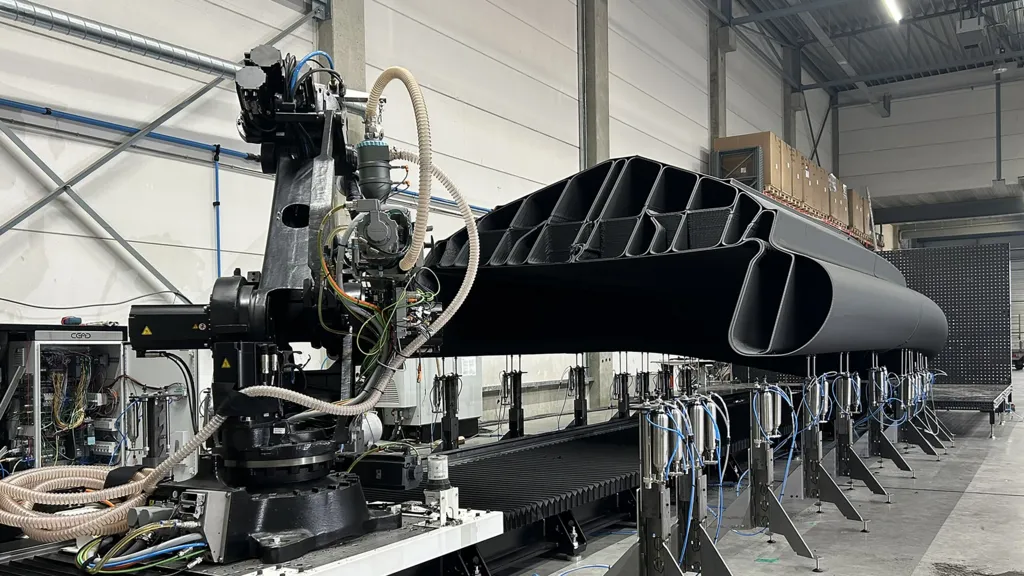
3D Printing’s Next Frontier: Revolutionizing Marine Manufacturing
For decades, the process of building ships and marine equipment has been a monumental task, dominated by traditional methods like welding and casting. These processes are often time-consuming, expensive, and generate significant material waste. But on the horizon, a powerful new wave of technology is emerging, poised to reshape the very foundations of how we build for the sea. That technology is 3D printing, also known as additive manufacturing, and its application in the marine industry is set to revolutionize everything from small component production to the creation of entire vessels.
This isn’t about printing small plastic trinkets; this is about large-scale, industrial-grade manufacturing using advanced polymers, composite materials, and even metals. The potential for customization, rapid prototyping, and on-demand part creation is unlocking unprecedented possibilities for naval architects, shipbuilders, and marine engineers worldwide.
From Prototyping to Production: The Tidal Shift
Initially, 3D printing’s role in marine manufacturing was confined to creating detailed scale models and prototypes for design validation. This alone was a significant step forward, allowing designers to spot flaws and test concepts without committing to costly full-scale production. However, the technology has rapidly evolved, moving from a tool for visualization to a legitimate method for producing end-use, marine-grade parts.
The advantages of this shift are profound:
Real-World Waves: Case Studies in Maritime 3D Printing
The theory is compelling, but the real proof is in the water. Several pioneering projects are demonstrating the practical viability of 3D printing in marine applications.
The US Navy’s On-Demand Parts Program
The US Navy is aggressively pursuing 3D printing to increase the self-sufficiency of its fleet. Instead of waiting weeks or months for a replacement part to be shipped to a vessel in a remote location, sailors can now print the required component on board or at a nearby port facility. This drastically reduces downtime and increases operational readiness. They have successfully printed and certified parts ranging from drain sleeves and valve handles to more complex drone components, proving the technology’s reliability in the harshest conditions.
WAAMpeller: The World’s First 3D Printed Ship Propeller
A landmark project, known as the WAAMpeller, saw the creation of a full-sized ship propeller using Wire Arc Additive Manufacturing (WAAM). This technique is a form of 3D printing that uses an electric arc to melt metal wire. The resulting propeller was not only a technical marvel but also demonstrated excellent performance characteristics. This project opened the industry’s eyes to the possibility of printing large, critical marine components on demand.
Customized Tools and Jigs
Beyond critical components, shipyards are using 3D printing to produce custom tools, jigs, and fixtures. These are the unsung heroes of the manufacturing process, used to hold parts in place during assembly. Printing these items is faster and cheaper than machining them, and it allows for perfect, ergonomic designs that improve worker safety and efficiency.
Navigating the Challenges: Durability, Scale, and Regulation
Despite the exciting progress, the widespread adoption of marine 3D printing is not without its hurdles. The industry must navigate several key challenges before the technology becomes standard practice.
The Future is Printed: What’s on the Horizon?
Looking ahead, the convergence of 3D printing with other advanced technologies promises an even more transformative impact on marine manufacturing.
Distributed Digital Shipyards could become a reality, where a design file is sent to a port anywhere in the world for local printing, slashing logistics costs and lead times. The use of generative design software, powered by artificial intelligence, will create parts that are perfectly optimized for their specific load and function, resulting in vessels that are lighter, stronger, and more fuel-efficient than ever before. Furthermore, the ability to incorporate embedded sensors directly into a 3D-printed part will enable smart components that can monitor their own health and performance, paving the way for predictive maintenance and enhanced safety.
Conclusion: Riding the New Wave
3D printing is no longer a futuristic fantasy for the marine industry; it is a present-day tool delivering tangible benefits. By enabling complex designs, reducing waste, shortening supply chains, and allowing for unprecedented customization, additive manufacturing is steadily charting a new course for how we build and maintain marine assets. The challenges of certification and scale are significant, but the direction is clear. As the technology continues to mature and overcome these hurdles, 3D printing is poised to become a cornerstone of marine manufacturing, driving innovation, sustainability, and efficiency across the global maritime sector. The next great wave of naval architecture is being built, one layer at a time.