
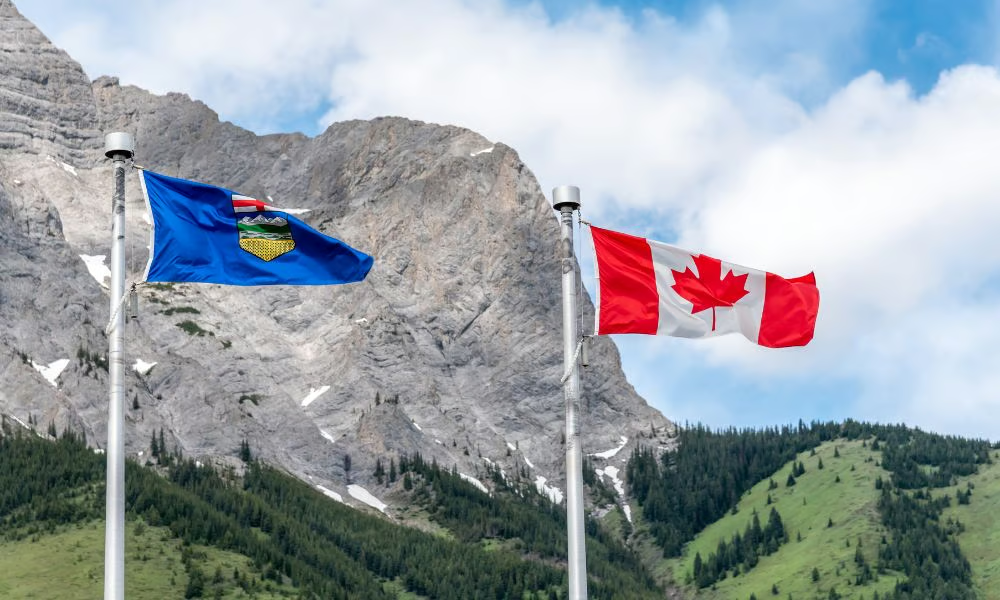
How Alberta’s Referendum Could Reshape Canada’s Investment Landscape
The political and economic fabric of Canada is facing a potential seismic shift, one that could ripple far beyond provincial borders. At the heart of this shift is Alberta, a province long defined by its resource wealth and its complex relationship with federal authority. A looming referendum on equalization and broader fiscal autonomy is not just a local political maneuver; it is a signal flare to global investors, raising profound questions about stability, predictability, and the future of capital flows into the nation. As former Bank of Canada Governor Mark Carney and other financial luminaries weigh in, the conversation is shifting from provincial politics to national economic confidence.
The Referendum Question: More Than a Provincial Issue
While framed around the specific mechanism of equalization payments, Alberta’s referendum is fundamentally a vote on fiscal federalism. The question taps into a deep-seated sentiment within the province that its economic contributions are not met with commensurate benefits or respect within Confederation. This isn’t a new narrative, but the decision to formalize it through a referendum elevates the stakes significantly.
For investors, political and fiscal stability are non-negotiable pillars of a healthy investment climate. A province openly challenging a cornerstone of Canada’s federal structure introduces a new variable into the risk equation. It signals potential for prolonged constitutional discord, legal battles, and policy uncertainty—factors that can cause capital to hesitate or look elsewhere. The referendum, therefore, transcends its wording; it becomes a proxy for assessing Canada’s internal cohesion.
The Carney Warning: A Voice from Global Finance
The intervention by Mark Carney, a figure with unparalleled credibility in both Canadian and international financial circles, cannot be overstated. His warning that the referendum could “spook” investors is a direct message about perception and reality in global markets.
Why Carney’s Words Carry Weight
- Global Credibility: As former head of the Bank of Canada and the Bank of England, Carney’s analysis is seen through a lens of global financial stability.
- Investor Psychology: He highlighted that investors seek “stability, certainty, and fair rules of the game.” A public, divisive debate on dismantling key federal policies undermines all three.
- The Domino Effect: The concern isn’t just about Alberta. It’s that instability in one of Canada’s economic engines could tarnish the country’s overall brand as a safe, predictable place to invest.
Carney’s point is clear: symbolic political gestures can have very real economic consequences. When a former central bank governor speaks of “spooking” markets, institutional investors, pension funds, and multinational corporations take note.
Potential Impacts on the Canadian Investment Landscape
The ramifications of this political moment could unfold across several key sectors and investment themes.
1. Energy and Natural Resources
Alberta’s core industry is at a crossroads, balancing traditional strength in oil and gas with the urgent global shift toward energy transition. This sector requires massive, long-term capital investments—precisely the kind that are sensitive to political risk.
- Negative Impact: Prolonged constitutional uncertainty could divert investment to other stable, resource-rich jurisdictions (e.g., the United States, Norway). Projects with decades-long horizons need to know the regulatory and fiscal framework won’t be upended.
- Potential Opportunity: Some argue that greater provincial autonomy could allow Alberta to more aggressively court investment with tailored incentives. However, this potential benefit is heavily contingent on avoiding a chaotic and adversarial separation from federal systems.
2. Technology and Diversification
Alberta has made significant strides in diversifying its economy, particularly in tech, fintech, and agri-science. These sectors thrive on talent mobility, federal research grants, and a stable business environment.
A perception of Alberta being “at odds” with the federation could make it harder to attract the skilled talent and venture capital that are often concentrated in more politically stable regions like Ontario, British Columbia, or the United States.
3. National Unity and Sovereign Risk
Internationally, Canada is prized for its political stability and rule of law. A serious and sustained dispute between a wealthy province and the federal government begins to chip away at that premium.
- Credit rating agencies could begin to factor in political risk into their assessments of both Alberta and Canada.
- Foreign direct investment (FDI) decisions often consider nationwide stability. Turmoil in one region can negatively impact the country’s overall scorecard.
The Path Forward: Navigating Uncertainty
The referendum itself is unlikely to immediately change the equalization formula, which is enshrined in the Constitution. However, it is a powerful opening move in a larger negotiation. The path Alberta and Canada take from here will define the investment impact.
A collaborative, negotiation-focused approach following the vote, where legitimate grievances are addressed through dialogue and compromise, could ultimately strengthen the federation. It could lead to modernized fiscal arrangements that provide Alberta with greater flexibility while maintaining national cohesion. This outcome could, in the long run, boost investor confidence by demonstrating Canada’s capacity for adaptive and resilient governance.
A confrontational, legally fraught path, marked by continuous threats of separation or unilateral action, would validate the worst fears of investors. It would create a cloud of uncertainty that hangs over not only Alberta but all provinces considering similar actions.
Conclusion: A Pivotal Moment for Confederation and Capital
Alberta’s referendum is more than a provincial ballot question. It is a stress test for Canadian federalism and a live case study for global investors watching how mature democracies manage internal economic dissent. The warnings from figures like Mark Carney are a sobering reminder that capital is a coward—it flees confusion and conflict.
The ultimate impact on Canada’s investment landscape will not be determined by the “Yes” or “No” vote alone, but by the tone, strategy, and diplomacy that follow. Will this moment be a catalyst for constructive renewal of the fiscal federation, or the first step into a period of destabilizing discord? The answer will resonate in boardrooms and trading floors worldwide, shaping Canada’s economic destiny for years to come. The province and the nation stand at a crossroads, where political choices will directly write the next chapter of their economic story.

