
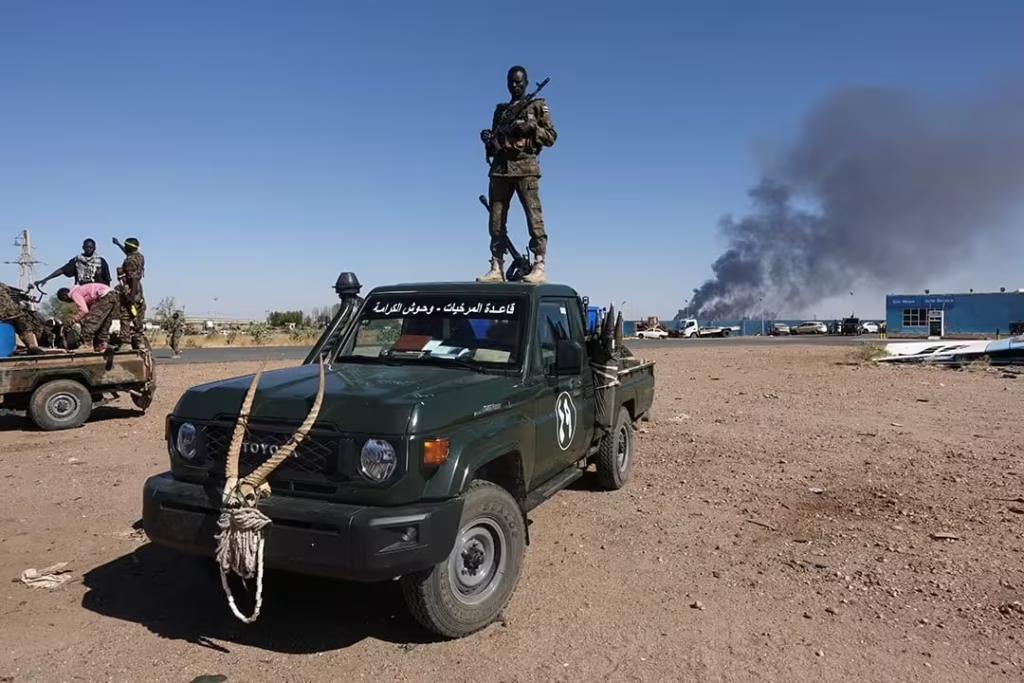
Sudan’s Deadly Conflict Escalates with Central State Massacre
The brutal war tearing Sudan apart has taken another horrific turn, with a paramilitary assault in the country’s central heartland claiming at least 14 lives. This latest massacre underscores the conflict’s terrifying expansion beyond the capital, Khartoum, and the western Darfur region, signaling a dangerous new phase of nationwide violence and humanitarian collapse.
A New Front in a Relentless War
For over a year, the Sudanese Armed Forces (SAF), led by General Abdel Fattah al-Burhan, and the paramilitary Rapid Support Forces (RSF), commanded by General Mohamed Hamdan Dagalo, have been locked in a vicious power struggle. What began in Khartoum has spiraled into a nationwide catastrophe, with the RSF gaining significant ground. The recent attack in the central state of Al Jazirah marks a strategic and bloody push into a region once considered a relative safe haven.
Local resistance committees and eyewitnesses report that RSF fighters targeted the village of Wad Al-Noura, unleashing heavy artillery and gunfire. The assault, which lasted for hours, left a trail of destruction, killing at least 14 civilians and injuring many more. This violence in Al Jazirah, Sudan’s traditional agricultural breadbasket, is not just an attack on people but a direct strike at the nation’s food security and internal stability.
The Human Cost: Beyond the Death Toll
While the number of fatalities is devastating, the true scale of suffering extends far beyond the initial attack. The massacre has triggered a fresh wave of displacement, adding to the nearly 9 million people already forced from their homes—the largest displacement crisis in the world.
- Families are fleeing with nothing: Survivors from Wad Al-Noura describe fleeing into the countryside or attempting perilous journeys to other states, often on foot and without food or water.
- The healthcare system is obliterated: Hospitals that are still standing lack supplies, electricity, and staff, making treatment for the wounded nearly impossible.
- A generation in trauma: Children are witnessing unspeakable violence, creating a profound psychological crisis that will impact Sudan for decades.
The International Community’s Failing Response
The global reaction to Sudan’s war has been widely criticized as woefully inadequate. Despite the staggering scale of human suffering, the conflict remains, for many, “forgotten.”
Diplomatic efforts have repeatedly stalled. Multiple ceasefire agreements, brokered in Saudi Arabia and elsewhere, have collapsed within hours or days. Both warring parties have shown little genuine commitment to peace, prioritizing military gains over the lives of Sudanese civilians. Sanctions and condemnations have proven ineffective against generals who are heavily invested in a fight to the finish.
Aid Blockades and Famine as a Weapon
Perhaps the most sinister development is the weaponization of humanitarian aid. Both sides have been accused of systematically blocking and looting life-saving supplies. The World Food Programme has warned that Sudan is facing the worst hunger crisis on the planet, with 18 million people facing acute food insecurity.
The attack on Al Jazirah is catastrophic in this context. The state’s fertile land is crucial for feeding the population. Displacing farmers and destroying agricultural cycles ensures that hunger will be used as a tool of war, starving civilians into submission regardless of the battlefield’s outcome.
Understanding the RSF’s Strategy
The paramilitary’s push into central Sudan is a calculated move. Analysts suggest several strategic objectives:
- Resource Control: Securing Al Jazirah means controlling vital agricultural revenue and supply routes.
- Encircling the SAF: Expanding territorial control isolates the Sudanese army in its remaining strongholds and stretches its defensive lines.
- Ethnic Dimensions: In regions like Darfur and now beyond, RSF attacks have taken on a severe ethnic character, targeting specific non-Arab communities. This raises the grim specter of further atrocities and genocide.
The RSF, born from the Janjaweed militias of the Darfur genocide, operates with a level of brutality that has characterized this conflict. Their tactics consistently show a blatant disregard for international law, targeting civilians, occupying homes, and committing widespread sexual violence.
Is There Any Path to Peace for Sudan?
The road to stopping this war is fraught, but not impossible. It requires a fundamental shift in approach from the international actors who hold leverage.
- Targeted and Enforced Sanctions: Global powers must move beyond rhetoric to impose concrete, painful financial sanctions on the warring factions and their external enablers, tracking and freezing illicit financial networks.
- Unified Diplomatic Pressure: Regional powers with influence over the SAF and RSF, including Egypt, the UAE, and Saudi Arabia, must align their efforts to force the generals to the negotiating table for a sustained ceasefire.
- Unimpeded Humanitarian Access:The UN and aid agencies must be granted guaranteed, safe corridors to deliver aid across front lines. The world must treat the blocking of aid as the war crime it is.
- Amplifying Civilian Voices: Sudan’s grassroots resistance committees, professional unions, and women’s groups have been organizing aid and calling for peace since day one. Any future political solution must center these democratic civilian forces, not just the generals.
A Nation Hangs in the Balance
The massacre in central Sudan is a dire warning. The war is escalating, not winding down. Each day of inaction allows the conflict to deepen, the state to disintegrate further, and the death toll to climb. Sudan stands on the precipice of a full-scale fragmentation that would destabilize the entire Horn of Africa.
The world cannot afford to look away. The stories from Wad Al-Noura are a testament to the resilience of the Sudanese people and a chilling indictment of the global failure to protect them. Without immediate, coordinated, and forceful action to halt the violence and ensure humanitarian relief, the term “massacre” will soon be insufficient to describe the horror unfolding in the heart of Sudan.

