
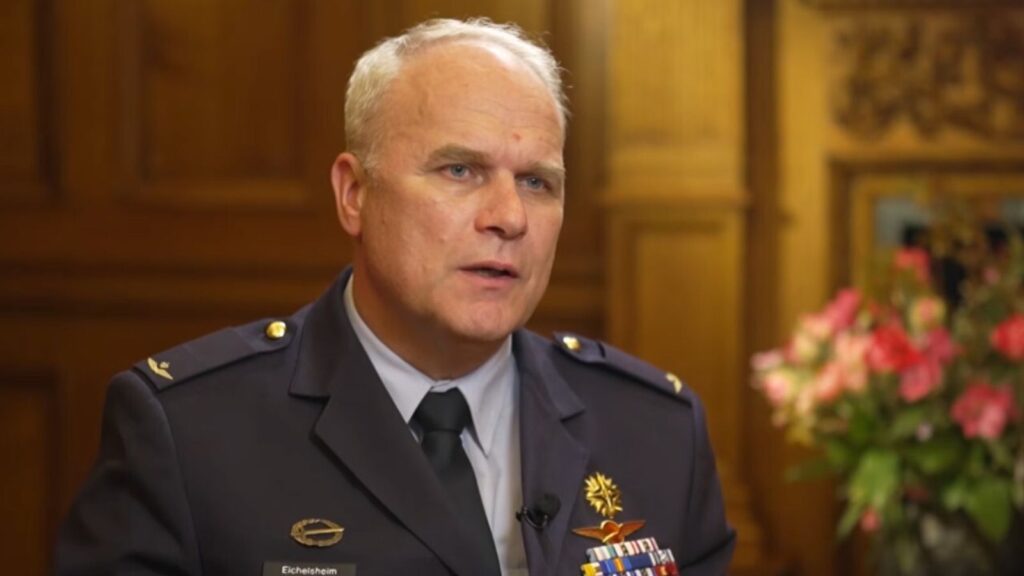
Dutch Military Leader Criticizes Trump’s NATO Remarks as Unwise
The recent comments by former U.S. President Donald Trump regarding NATO have sent a shockwave through the alliance, prompting a rare and direct public rebuke from a senior European military figure. The Chief of Defence of the Netherlands, General Onno Eichelsheim, has labeled Trump’s suggestion that the U.S. might not protect allies failing to meet spending targets as “unwise” and detrimental to the security of all member states. This stark criticism from a key NATO nation underscores the profound anxiety rippling across Europe about the future of its primary defense guarantee.
A Stark Warning from The Hague
Speaking candidly, General Eichelsheim did not mince words. He argued that public statements which cast doubt on the fundamental Article 5 collective defense principle—the bedrock of NATO that an attack on one is an attack on all—are inherently dangerous. “It is unwise to make this public,” Eichelsheim stated, emphasizing that such rhetoric only serves to embolden adversaries like Russia.
The Dutch military leader’s core concern is that this public questioning of mutual commitment erodes the very deterrent power of the alliance. For decades, the unambiguous promise of a unified response has been the primary shield preventing conflict in Europe. By introducing public conditionality, that shield appears—in the eyes of both allies and potential aggressors—to be cracking.
The Context: Trump’s Controversial NATO Comments
The incident that sparked this diplomatic firestorm occurred at a campaign rally, where the former and potential future President recounted a conversation he claimed to have with the leader of a “big country.” Trump stated he would “encourage” Russia to do “whatever the hell they want” to nations that are “delinquent” in their financial contributions to the alliance. While framed around the long-standing issue of defense spending, the language represented a significant escalation, moving from a critique of burden-sharing to an explicit suggestion of abandoning allies to their fate.
The Persistent Burden-Sharing Debate
General Eichelsheim’s criticism, while sharp, does not dismiss the underlying issue Trump’s comments highlighted. The debate over fair burden-sharing within NATO is not new. For years, U.S. administrations, both Democratic and Republican, have urged European allies to increase their defense expenditures toward the alliance’s agreed target of 2% of GDP.
The key distinction lies in the approach:
- Private Diplomacy vs. Public Brinkmanship: Previous U.S. leaders have applied pressure through diplomatic channels and summit meetings.
- Conditioning Security: Trump’s public method explicitly and controversially links the U.S. security guarantee to a cash-for-protection formula.
Eichelsheim acknowledged the validity of the spending push, noting it has actually been successful. “He has a point,” the General said of Trump’s focus on financial commitments, pointing out that the pressure has led more European nations to meet the 2% threshold. However, he fundamentally disagrees with using the alliance’s core security promise as a public bargaining chip.
The European Response: Urgency and Investment
In the wake of Russia’s full-scale invasion of Ukraine, Europe’s strategic calculus has shifted dramatically. The war on the continent’s doorstep has acted as a powerful catalyst for increased defense spending. Countries like the Netherlands, Germany, and Poland have announced massive, multi-year reinvestment plans into their militaries.
The European effort now includes:
- Significant increases in national defense budgets.
- Joint procurement initiatives for ammunition and air defense systems.
- A renewed focus on the defense of European soil and eastern flank stability.
This shift demonstrates that European nations are taking their security more seriously than at any point since the end of the Cold War. The Dutch criticism, therefore, comes from a position of a partner who is actively stepping up, not one shirking its responsibilities.
Why This Criticism Matters: A Strategic Perspective
The public nature of General Eichelsheim’s comments is as significant as their content. It signals a growing willingness among European leaders to openly challenge narratives they believe jeopardize their security, even when they come from a powerful ally. This reflects a broader European strategic awakening.
The core strategic risks highlighted by the Dutch military chief are clear:
- Empowering Adversaries: Public division is a gift to Moscow, which has long sought to fracture NATO unity.
- Undermining Deterrence: The strength of deterrence lies in its certainty. Any doubt introduced is a strategic vulnerability.
- Creating Political Instability: It forces European governments to answer difficult questions at home about the reliability of their most important ally, potentially scrambling long-term defense planning.
Looking Ahead: NATO at a Crossroads
This episode places NATO at a critical juncture as it prepares for its upcoming summit and a potential U.S. election that could see Donald Trump return to power. The alliance is grappling with two simultaneous challenges: supporting Ukraine for the long haul and ensuring its own internal cohesion and credibility.
The path forward requires navigating a delicate balance. European allies must continue, and accelerate, their increased defense investments to demonstrate commitment and capability. Simultaneously, the message from leaders like General Eichelsheim is that the transatlantic bond must be framed as an indispensable partnership, not a transactional client relationship. The security of the Euro-Atlantic area, they argue, is indivisible. Weakening the promise of collective defense in one region inherently weakens it for all, including the United States.
The unwise remark from The Hague is more than a critique; it is a plea for strategic sanity. It underscores that in an era of renewed great-power competition, the greatest asset the West possesses is its unity. Allowing that unity to be publicly questioned, regardless of the domestic political context, is a risk that military leaders charged with actual defense see as one not worth taking. The coming months will test whether the political leaders on both sides of the Atlantic agree.

