
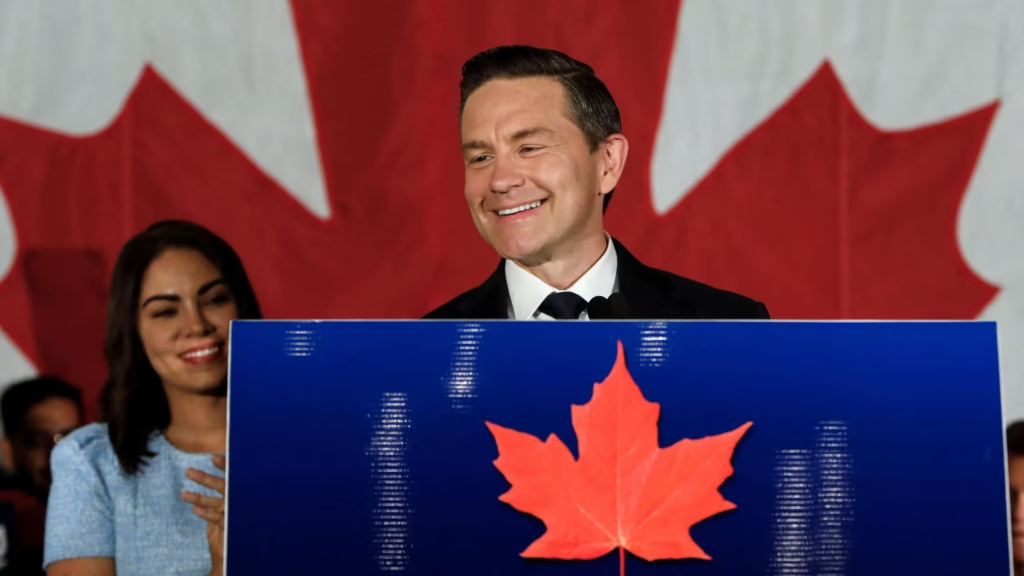
Poilievre Vows to Steadfastly Lead Conservatives Despite Byelection Setbacks
In the wake of a disappointing night for the Conservative Party of Canada, Leader Pierre Poilievre is sending a clear message: he is digging in. Following double-digit losses in two critical federal byelections, Poilievre has emphatically declared his intention to stay at the helm, framing the results not as a rebuke of his leadership but as a call to intensify his fight against the governing Liberals. The outcomes in Toronto—St. Paul’s and Durham have ignited a fresh wave of political analysis, revealing both the persistent challenges for the Official Opposition and the vulnerabilities of a government facing widespread public fatigue.
Breaking Down the Byelection Blow: Toronto—St. Paul’s and Durham
The June 24th byelections served as a high-stakes temperature check on the national political mood. All eyes were particularly on **Toronto—St. Paul’s**, a riding held by the Liberals for over three decades. Recent national polls suggesting deep dissatisfaction with Prime Minister Justin Trudeau had fueled Conservative hopes of a potential upset. However, Liberal candidate Leslie Church narrowly retained the seat, dealing a psychological blow to Poilievre’s momentum.
In **Durham**, a riding with a stronger Conservative history, the party also fell short by a significant margin, failing to capitalize on what many saw as a more favourable battleground. The double defeat underscores a critical hurdle for Poilievre: translating broad national discontent into concrete votes in specific, diverse constituencies.
Key Takeaways from the Vote:
- A failure to flip a quintessential Liberal urban stronghold despite perceived government weakness.
- Continued difficulty for Conservatives in making decisive inroads in key metropolitan areas.
- A sign that voter dissatisfaction does not automatically equate to a direct transfer of support to the Conservatives.
Poilievre’s Defiant Stance: “I’m Not Going Anywhere”
Facing immediate questions about his strategy and leadership, Pierre Poilievre’s response was characterized by defiance rather than introspection. He swiftly dismissed any notion of stepping aside, stating unequivocally, “I’m not going anywhere.” Instead of a post-mortem on campaign tactics, he doubled down on his core political narrative.
Poilievre attributed the losses to what he termed a “coalition” between the Liberals and the NDP, arguing that this alliance muddies the waters for voters seeking change. He immediately pivoted back to the issues that form the bedrock of his public persona:
- Affordability and Inflation: Highlighting the ongoing struggle with the cost of living.
- Housing Unaffordability: Positioning the Conservatives as the party with solutions to the crisis.
- Carbon Tax Impact: Reiterating his pledge to “axe the tax” and blame it for rising costs.
This reflexive return to familiar messaging suggests a belief within Poilievre’s camp that a relentless, focused critique of the government will ultimately prevail, regardless of short-term electoral setbacks.
Internal Pressure and Strategic Crossroads
While Poilievre’s position as leader is not currently under immediate threat, the byelection results have undoubtedly amplified murmurs of concern. Some party insiders and political observers are quietly questioning whether his combative, narrowly focused style has a ceiling, particularly in the urban and suburban ridings essential for forming government. The pressure is now on to demonstrate that the Conservative message can be adapted and broadened without diluting its core principles.
What the Losses Reveal About Canada’s Political Landscape
The byelection outcomes offer a nuanced snapshot that complicates the simplistic story told by national polling aggregates. They reveal several important dynamics at play.
A Government on the Defensive, But Not Defeated: The fact that Toronto—St. Paul’s was even close is a stark warning for the Liberals. It signifies profound voter frustration and suggests Trudeau’s party is clinging to support rather than commanding it. However, the Liberal ability to hold the seat also demonstrates a residual base of support and an effective ground game in critical moments.
The Conservative Urban Challenge: This remains Poilievre’s most significant strategic dilemma. To win a general election, the Conservatives must break through in metropolitan areas like Toronto, Vancouver, and Montreal. The failure in Toronto—St. Paul’s indicates that the party’s current brand and policy mix have not yet found a winning formula in these crucial electoral battlegrounds. The path to 24 Sussex Drive runs directly through ridings just like it.
The Limits of Negative Partisanship: While anger at the incumbent government can drive a protest vote, it may not be sufficient to build a durable, positive coalition for the alternative. The results suggest that some voters unhappy with Trudeau are not yet sold on Poilievre as the answer, potentially viewing the choice as unpalatable or seeking other options.
The Road Ahead for Pierre Poilievre and the Conservative Party
These byelections have crystallized the tasks facing the Conservative leader as the next federal election draws nearer. The period of simple opposition—hammering the government on daily controversies—must now evolve into a more complex phase of demonstrated electability.
Strategic Recalibration Required: The party will need to conduct a sober analysis of why its message failed to resonate decisively. This may involve:
- Refining policy announcements to address specific urban concerns beyond broad-brush tax and affordability talk.
- Considering whether Poilievre’s tone and presentation require modulation to appeal to a wider, more moderate demographic.
- Investing heavily in constituency-level organization and candidate development in non-traditional Conservative ridings.
Building a Bridge to Victory: Poilievre’s immediate challenge is to build a bridge from a base of solid support to the additional voters needed for a majority. The byelections show that bridge is not yet complete. He must find a way to maintain the energized support of his core followers while simultaneously crafting an inviting message for skeptical centrists and struggling urban voters who may agree with him on affordability but have other reservations.
The coming months will be critical. Every policy announcement, parliamentary performance, and public appearance will be scrutinized through the lens of these losses. Poilievre has vowed to stay and fight. The unanswered question is whether his fight will change in ways that can turn narrow defeats into future victories. The Toronto—St. Paul’s and Durham results are not a death knell for his leadership, but they are a flashing warning light: the course to power may require a strategic adjustment he has so far been unwilling to make.

