Fragile Lebanon Truce Holds as Displaced Families Return Home
A tentative, U.S.-brokered ceasefire along Lebanon’s southern border is holding, offering a fragile respite from months of intense cross-border fire. The truce, which took effect in the early hours of Wednesday, has allowed the first wave of displaced families to begin the arduous journey back to their villages, many of which lie in ruins. While the calm is tenuous and the underlying political tensions remain unresolved, the lull in fighting represents the most significant diplomatic breakthrough in the region since the wider conflict began.
A Cautious Return to Shattered Homes
For weeks, towns and villages within a several-kilometer radius of the Israeli-Lebanese border have been virtual ghost towns. An estimated 90,000 people fled north to the relative safety of cities like Tyre, Sidon, and Beirut, sheltering in schools, with relatives, or in makeshift camps. The sound of artillery and drones became a constant, terrifying backdrop, making life in the fertile border region impossible.
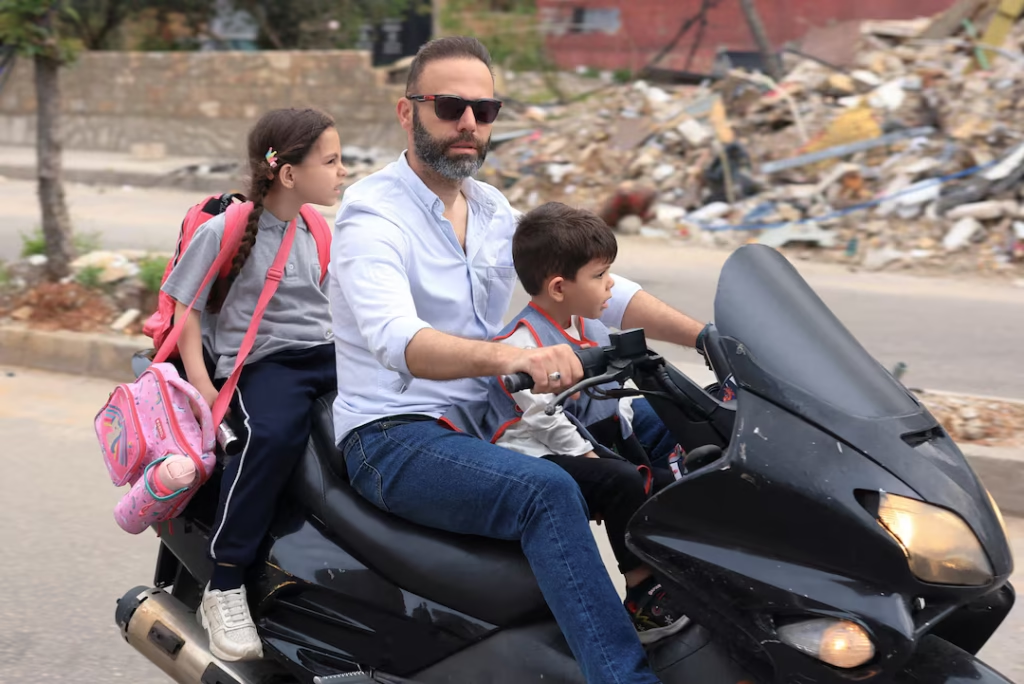
With the ceasefire now in its third day, a cautious trickle of residents is returning. Packed into cars with whatever belongings they could carry, families are navigating cratered roads and military checkpoints to assess the damage. The scenes they are encountering are devastating.
Initial reports from returning civilians and aid organizations paint a picture of widespread destruction:
- Critical infrastructure, including power stations, water towers, and telecommunications networks, has been heavily damaged or completely destroyed.
- Residential neighborhoods bear the scars of direct hits, with homes reduced to piles of rubble and twisted metal.
- Agricultural lands, the lifeblood of the South’s economy, are scarred by fire and unexploded ordnance, rendering this year’s harvest a total loss.
“We left with nothing, and we are coming back to nothing,” said one elderly resident of the border town of Aita al-Shaab, surveying what was left of his family home. “But it is still our land. We had to see it for ourselves.”
The Mechanics of a Delicate Truce
The agreement, mediated through intense U.S. diplomatic channels with Qatari and Egyptian support, is not a formal treaty but a series of mutual, reciprocal commitments. Its primary goals are an immediate cessation of all hostile military actions and the creation of conditions for a more lasting de-escalation.
The key pillars of the understanding include:
- A complete halt to cross-border strikes by both Hezbollah and the Israeli Defense Forces (IDF), including rockets, drones, and airstrikes.
- The repositioning of Hezbollah’s elite Radwan forces to positions north of the Litani River, a key demand from Israel aimed at creating a security buffer.
- A commitment from the Lebanese government, bolstered by UNIFIL peacekeepers, to assert greater control and prevent militant activity in the border zone.
- An unofficial timeline for parallel, indirect negotiations to address the core border disputes, particularly concerning 14 contested points along the “Blue Line” demarcated by the UN.
Critically, the truce is explicitly linked to the ceasefire holding in Gaza. All parties have acknowledged that a major flare-up there could instantly unravel the calm in Lebanon, a vulnerability that hangs over every interaction.
Hezbollah’s Calculated Pause
For Hezbollah, the decision to accept the truce is a strategic one. The group has framed its months of fighting as a “support front” for Hamas in Gaza. With negotiations for a Gaza ceasefire gaining momentum, Hezbollah leadership can claim its military pressure was effective and now pause without losing face among its support base. The group also faces significant internal pressure from a Lebanese public weary of a war that has displaced hundreds of thousands and brought the country’s crumbling economy to the brink of total collapse.
Israel’s Security Calculus
The Israeli government, under immense domestic pressure to secure the return of tens of thousands of its own displaced citizens from northern towns, has described the truce as a “necessary test.” The IDF claims its military campaign has significantly degraded Hezbollah’s capabilities near the border. The withdrawal of Radwan forces, if verifiable, would be a tangible security win for Jerusalem. However, Israeli officials remain deeply skeptical of Hezbollah’s long-term intentions and the Lebanese army’s ability to enforce the border zone.
The Daunting Road to Recovery and Lasting Peace
While the guns have fallen silent for now, the path forward is strewn with obstacles. The ceasefire is fragile, and a single incident or misinterpretation could trigger a rapid escalation. Beyond the immediate security concerns, the humanitarian and reconstruction challenges are staggering.
The immediate priorities for the international community and Lebanese authorities are:
- Humanitarian Corridors: Ensuring safe, sustained access for aid agencies to deliver food, water, medical supplies, and temporary shelter to returning populations.
- Explosive Ordnance Disposal (EOD): A massive, urgent operation to clear homes, fields, and roads of unexploded cluster munitions and other remnants of war before more civilians are killed or maimed.
- Basic Service Restoration: Repairing water and electricity networks is essential to prevent a public health crisis and make areas minimally habitable.
Long-term, a political solution is the only guarantee of stability. This would require finally implementing long-ignored UN Security Council resolutions, particularly Resolution 1701 from 2006, which called for Hezbollah’s disarmament and full Lebanese government control over the south. It also necessitates a definitive settlement of the Blue Line disputes. Given the deep-seated distrust between all actors and the volatile regional landscape, such a comprehensive deal remains a distant prospect.
A Nation Holds Its Breath
For now, Lebanon is in a state of exhausted, anxious limbo. The returning families, facing the monumental task of rebuilding from ashes, represent a nation desperate for peace but all too familiar with broken promises. The shops in Beirut may be a little busier, and the roads south a little more crowded, but the mood is far from celebratory.
The U.S.-brokered truce has provided a critical window—a chance to breathe, to bury the dead, and to house the homeless. Whether this window becomes a door to a more stable future or slams shut with the next round of violence depends on the willingness of regional and international powers to address the root causes of a conflict that has kept Lebanon on the brink for decades. The calm is holding, but for how long, no one can say.