
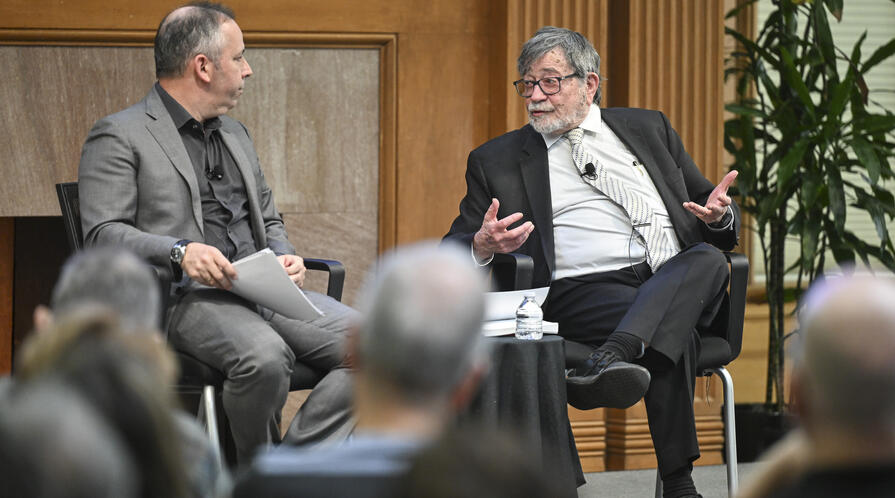
A Leading Genocide Scholar Analyzes the Evolution of Zionism
The conversation surrounding Israel, its founding ideology, and its current actions in Gaza has reached a fever pitch, with the term “genocide” being invoked in international courts and global protests. To understand the gravity of these accusations, one must look beyond the headlines to the historical and ideological roots of the conflict. A pivotal perspective comes from within the Israeli academic establishment itself, from a scholar whose life’s work has been the study of genocide. His analysis provides a challenging, nuanced examination of how Zionist thought has transformed over decades, leading to what he describes as a present-day reality of “genocidal discourse.”
From Scholar of the Past to Interpreter of the Present
Omer Bartov, a renowned Israeli-born historian at Brown University, built his career meticulously documenting the horrors of the Holocaust, particularly the role of ordinary people in perpetrating atrocities. For decades, he applied this lens to events far from his native country. However, the events following October 7th, 2023, forced a profound and personal shift. The rhetoric emanating from Israeli leaders, the widespread destruction in Gaza, and the mass displacement of its population presented him with a chilling case study that felt tragically familiar. Bartov found himself applying the framework of his lifelong research to the actions of his own nation, asking whether the ideology that once promised refuge for Jews was now facilitating a campaign of destruction against Palestinians.
The Foundational Shift: From Defense to Supremacy
Bartov’s analysis hinges on a critical evolution in Zionist thought. He identifies a fundamental transformation from a defensive, victim-based nationalism to an exclusionary, supremacist ideology. Early Zionism, born from the ashes of European persecution, was primarily concerned with creating a safe homeland. While this project inherently marginalized the indigenous Palestinian population, Bartov argues the contemporary strain of Zionism, empowered by decades of occupation and military dominance, has shed its defensive posture.
Key elements of this evolved ideology include:
- A belief in the exclusive right of Jews to the entirety of the land between the river and the sea.
- The framing of Palestinians not as a people with national rights, but as a “demographic threat” to be managed or removed.
- The use of religious scripture to justify territorial expansion and political control, merging nationalist ambitions with messianic fervor.
This shift, Bartov contends, has created a political environment where dehumanizing language against Palestinians becomes mainstream and where policies of displacement are not seen as tragic necessities but as righteous fulfillment of a divine or historical mandate.
The Language of Erasure: When Words Precede Actions
A core component of Bartov’s warning is his focus on language. As a genocide scholar, he knows that mass violence is almost always preceded by a sustained campaign of dehumanization. He points to the statements of Israeli ministers who have openly called for the forced transfer of Gazans or referred to Palestinians in animalistic terms. This rhetoric, amplified by media and echoed by parts of the public, creates a permission structure for extreme violence.
It is not merely the words of fringe figures, Bartov emphasizes, but statements from the highest levels of government that frame the war in Gaza in absolute, civilizational terms. When an entire population is labeled as “terrorists” or “human animals,” the moral calculus for warfare changes. The staggering civilian death toll and humanitarian catastrophe then become, in this logic, an unavoidable byproduct of eradicating an existential evil—a chilling echo of historical genocidal rationalizations.
The Gaza War as a Case Study
For Bartov, the Israeli military campaign in Gaza following the Hamas attacks presents several alarming indicators that align with patterns studied in other contexts of mass atrocity. He highlights:
- Scale of Destruction: The systematic leveling of civilian infrastructure—homes, hospitals, universities, and cultural archives—which appears to exceed any immediate military necessity.
- Humanitarian Strangulation: The siege conditions that have brought famine and disease, affecting the most vulnerable in the population.
- Displacement and the Question of Return: The forced and permanent displacement of over a million people, with senior officials openly questioning whether they should or will be allowed to return.
Bartov is careful to distinguish intent from outcome. His argument is not necessarily that there is a single, documented blueprint for genocide. Rather, he asserts that the convergence of genocidal rhetoric, a supremacist ideology, and military actions that knowingly cause mass civilian death and displacement creates a reality that fits within the analytical framework of genocide studies. The outcome, regardless of stated intent, is what he calls “genocide in effect.”
Confronting the Unthinkable Within
Perhaps the most powerful aspect of Bartov’s analysis is its source. This is not a critique from a distant observer, but a painful internal reckoning by a son of Holocaust survivors, a former Israeli soldier, and a scholar dedicated to memory. He represents a profound intellectual and moral consistency: the tools used to understand the crimes of others must be turned inward when one’s own society shows similar warning signs.
His work challenges the instrumentalization of Jewish history. He warns against using the Holocaust as a shield to deflect all criticism or as a justification for unlimited force. Instead, he argues that the lessons of that very history impose a unique moral responsibility to recognize and halt processes of dehumanization and collective punishment, no matter who the perpetrator is.
A Warning for the Future
Omer Bartov’s analysis is ultimately a dire warning about the trajectory of Israeli society and the fate of the Palestinian people. By tracing the evolution of Zionism from a liberation movement for Jews to an exclusionary force, he provides a crucial framework for understanding the current crisis. His scholarship underscores that genocide is not an event but a process, one that begins with words and ideas long before the full horror unfolds.
The importance of his voice lies in its refusal to simplify. He forces a confrontation with uncomfortable questions about identity, power, and moral responsibility. In doing so, he issues a call not just to the international community, but first and foremost to his fellow Israelis and Jews worldwide: to recognize the grave path their nation is on and to reclaim a future defined by justice and shared humanity, rather than by supremacy and ruin. The evolution of an ideology, as Bartov makes devastatingly clear, carries with it the fate of millions.

