
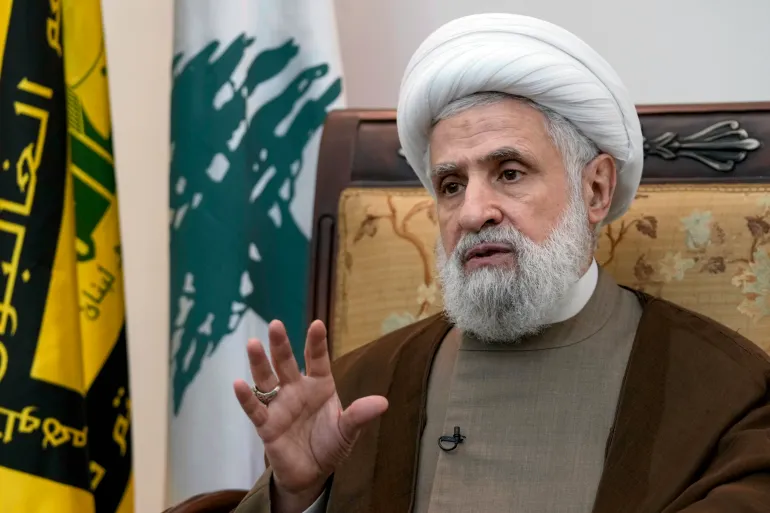
Hezbollah’s Ultimatum: Why Lebanon Must Abandon US-Israel Talks or Face Chaos
The geopolitical tectonic plates of the Middle East have shifted once again. In a move that threatens to upend the fragile diplomatic momentum between Lebanon and Israel, Hezbollah’s Secretary-General has issued a stark ultimatum: pull the Lebanese delegation out of the indirect talks currently taking place in Washington. This isn’t a mere political opinion—it is a calculated power play from an organization that holds both military supremacy and profound political influence within Lebanon. For the Lebanese government, this demand presents an impossible choice: placate a militia that controls much of the country, or risk being branded a traitor to the resistance cause.
As an analyst monitoring Levantine politics for over a decade, I can tell you this is not a routine diplomatic spat. This is a direct challenge to the sovereignty of the Lebanese state and a test of whether Beirut can conduct foreign policy independently of its most powerful non-state actor. Let’s break down exactly what Hezbollah is demanding, why it matters, and what happens next.
The Core Demand: A Walkout from Washington
Hezbollah’s leader publicly urged the Lebanese government to withdraw its delegation immediately from the US-mediated indirect talks with Israel. The negotiations—ostensibly focused on maritime border demarcation and de-escalation mechanisms—are being framed by Hezbollah as capitulation to the enemy. In a televised address, the Secretary-General argued that any form of direct discussion, even through a mediator, legitimizes what he calls “Israeli aggression and occupation.”
This demand is not coming from a fringe faction. Hezbollah is the most heavily armed non-state actor in the world, with a rocket arsenal estimated at over 150,000 projectiles. It holds seats in Lebanon’s parliament and has effective veto power over major government decisions. When the Secretary-General speaks, the Lebanese Armed Forces and the political elite in Beirut listen—even if they publicly resist.
What Hezbollah Is Actually Saying
Let’s parse the rhetoric. The leader’s statement explicitly calls the talks “a gift to Israel” and warns that they undermine the “resistance project.” For Hezbollah, the entire raison d’être is armed confrontation with Israel. Any diplomatic normalization—even indirect talks over maritime rights—erodes the ideological foundation on which the organization was built. By demanding a withdrawal, Hezbollah is:
- Reinforcing its narrative that only armed resistance, not diplomacy, has ever secured Lebanese interests. They point to the 2000 Israeli withdrawal from South Lebanon and the 2006 war as proof.
- Testing Lebanon’s sovereignty by forcing the government to choose between international legitimacy (via US-mediated talks) and internal political stability (by keeping Hezbollah placated).
- Digging in against normalization in a region still reeling from the Abraham Accords. Hezbollah sees any Israeli-Lebanese engagement—even over economic zones—as a slippery slope toward full normalization.
Why This Is a High-Stakes Move
To understand the gravity of this demand, you have to appreciate the context. Lebanon is in the throes of a catastrophic economic collapse, with the Lebanese pound losing over 95% of its value since 2019. The government is barely functional. The army is underfunded. The people are desperate for any relief. In that environment, the Washington talks represented a rare diplomatic opening—a chance to unlock offshore gas reserves in disputed waters and potentially ease tensions with Israel.
But Hezbollah sees this as a trap. The organization’s leadership believes that the United States is using economic incentives to weaken the resistance axis. By demanding a walkout, Hezbollah is effectively holding Lebanon’s economic future hostage to its ideological purity. This is not irrational from a strategic perspective—Hezbollah’s survival depends on maintaining a state of low-level conflict with Israel. Peace would render its massive arsenal irrelevant.
The Regional Ramifications
This is not just a Lebanese domestic issue. Iran, Hezbollah’s primary patron, is watching closely. A Lebanese withdrawal from the talks would be a major victory for Tehran, demonstrating that the Axis of Resistance can still disrupt US-brokered diplomacy. Conversely, if Lebanon stays, it sends a signal that Hezbollah’s veto power has limits—a development that would embolden other Arab states to pursue normalization with Israel.
The Abraham Accords have already reshaped the region. Hezbollah’s demand is a rear-guard action to prevent Lebanon from becoming the next domino. The group’s leader explicitly linked the Washington talks to what he called “the normalization train” and warned that “no one has the right to give up Palestinian and Lebanese rights at the negotiating table.”
The Balancing Act for Lebanon
Lebanon’s government is caught between a rock and a hard place—or more accurately, between a US administration and a heavily armed militia. The delegation in Washington is there to negotiate the maritime border and potentially unlock energy wealth. Walking out would isolate Lebanon from potential US economic support and undermine any hope of a future peace framework. Staying, however, risks internal unrest and possibly even violent retaliation from Hezbollah’s supporters.
The Government’s Dilemma
Prime Minister Najib Mikati’s caretaker government has limited room to maneuver. On one hand, the cabinet includes Hezbollah-affiliated ministers who will push for withdrawal. On the other hand, the head of the delegation—Deputy Speaker Elias Bou Saab—has indicated that talks are proceeding on a technical level, not a political one. But Hezbollah doesn’t buy that distinction. For them, any engagement with Israel, at any level, is unacceptable.
The Lebanese military also finds itself in a bind. The army is a respected institution that operates largely independently of Hezbollah, but it relies on the group’s tacit approval to maintain stability in Shia-majority areas. A direct confrontation between the state and Hezbollah over this issue could fracture the fragile Lebanese security apparatus.
What Happens Next?
As of this writing, the Lebanese delegation remains in Washington. But the clock is ticking. Hezbollah has not yet threatened violence, but the rhetoric is escalating. The organization is known for its patience—it will likely give the government a week or two to comply before taking more assertive measures, such as large-scale street protests or a boycott of cabinet sessions.
If the government caves to Hezbollah’s demand, it would be a clear signal that Lebanese foreign policy is effectively held hostage by a non-state actor. That would have immediate repercussions: the United States may rethink its economic and military aid to Lebanon, and Israel would likely view any future negotiations as futile.
If the government stands firm, we could see a direct confrontation. Hezbollah controls key supply routes along the Syrian border and maintains a heavily fortified zone in the Bekaa Valley. A political crisis could quickly turn into a security crisis. The Lebanese Armed Forces have no appetite for a fight with Hezbollah, and the public is exhausted by years of instability.
The Bottom Line
The real story here is not about a diplomatic withdrawal. It is about who truly governs Lebanon. Is the state capable of making independent decisions on matters of war and peace? Or is it merely a façade behind which Hezbollah pulls the strings? The Washington talks have become a litmus test. How Lebanon’s leaders respond will define the country’s trajectory for the next decade.
Stay tuned. The road to peace in the Levant just got a lot bumpier—and the next move from Hezbollah could reshape the entire regional chessboard.

