
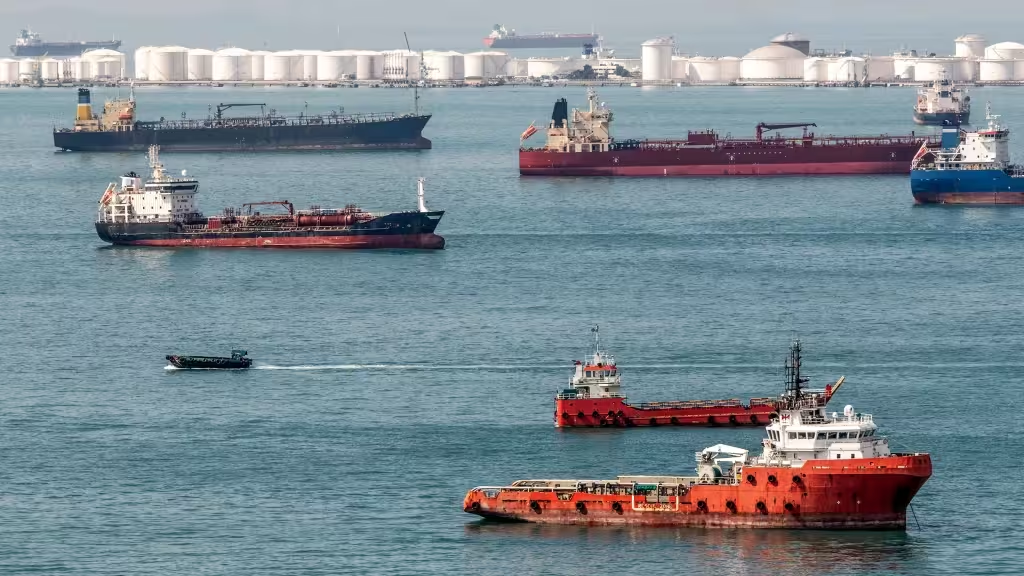
Hormuz Crisis Shifts Global Energy Focus to the Strait of Malacca: A New Strategic Flashpoint
The world has long understood that the Strait of Hormuz is the most volatile energy chokepoint on the planet. When tensions in the Persian Gulf escalate, global oil markets jolt, insurance premiums spike, and naval forces brace for confrontation. But as the latest Hormuz crisis unfolds—with Iran’s aggressive maritime posture and the shadow of mine threats returning to the region—strategic analysts are looking further east. They are warning that the real, long-term vulnerability may lie not in the Arabian Sea, but in the steamy, narrow channel between Sumatra and the Malay Peninsula.
The Strait of Malacca is suddenly at the center of a recalibrated geopolitical calculus. While the immediate crisis in the Middle East captures headlines, the strait of Malacca threat is quietly emerging as the more consequential vulnerability for global trade and energy security. Here is why this shift matters—and why policymakers in Washington, Beijing, New Delhi, and Jakarta are racing to adjust their strategies.
The Immediate Risk in the Persian Gulf
Before we examine the Malacca dimension, it is essential to understand what is happening in Hormuz right now. The recent escalation—stemming from heightened tensions between Iran and the U.S. over nuclear negotiations and regional strikes—has put approximately 20 million barrels per day of crude oil and liquefied natural gas (LNG) at risk. That is roughly one-fifth of the world’s daily oil consumption passing through a waterway that is just 21 miles wide at its narrowest point.
Iran has historically threatened to close the strait in response to sanctions or military pressure. While a full closure remains a high-risk move that would devastate Iran’s own economy, the ability to harass shipping, deploy mines, and use fast-attack craft creates a sufficient disruption to spike global prices. The International Energy Agency (IEA) has already warned that a prolonged disruption in Hormuz could send oil above $140 per barrel.
Yet here is the uncomfortable truth: the world has had decades to prepare for a Hormuz crisis. Strategic petroleum reserves have been built. Alternate pipeline routes exist, though limited. The naval presence of the U.S. Fifth Fleet and allied forces is robust. The crisis is dangerous, but it is also anticipated.
The Strait of Malacca is a different story entirely.
Why the Strait of Malacca is Suddenly the Next Flashpoint
The Unmatched Volume of Transiting Trade
The Malacca Strait carries an estimated 16 million barrels per day of crude oil and refined products—nearly as much as Hormuz. But where Hormuz primarily serves Western markets and China via the long sea route, Malacca is the absolute lifeline for the Asian economies. More than 60 percent of global liquefied natural gas (LNG) trade transits this waterway. China, Japan, South Korea, and India are all critically dependent on Malacca for energy imports that fuel their industrial economies.
But volume is only part of the story. The structural vulnerabilities are far more concerning.
The Physical Geography of Vulnerability
The Malacca Strait narrows to just 1.5 nautical miles at the Phillips Channel, near Singapore. This is not a theoretical chokepoint—it is a physical reality. Massive Very Large Crude Carriers (VLCCs) and container ships must navigate with extreme caution, often reducing speed to avoid grounding. A single stranded vessel or a well-placed mine could block the entire channel for days or weeks.
Unlike the open waters of the Persian Gulf, the Malacca Strait is flanked by Indonesia, Malaysia, and Singapore—three sovereign nations with complex jurisdictional claims and varying naval capabilities. The water depth averages only 82 feet in many sections, making submarine operations risky but also making the strait highly susceptible to asymmetric threats like small boat attacks, underwater explosives, and fast-attack craft swarms.
The Piracy and Non-State Threat Factor
The historical record is sobering. The Malacca Strait was once the most pirate-infested waterway in the world. While coordinated patrols by Indonesia, Malaysia, Singapore, and Thailand dramatically reduced incidents between 2005 and 2015, the threat has never disappeared. Recent reports from the Regional Cooperation Agreement on Combating Piracy and Armed Robbery (ReCAAP) indicate a resurgence of armed robbery in the strait, particularly targeting slow-moving tankers and bulk carriers.
Now, combine that baseline criminal activity with a state-level or state-sponsored threat. If the Hormuz crisis spills over into a broader geopolitical confrontation—particularly one involving China or the United States—the Malacca Strait becomes the most tempting target for disruption.
The South China Sea Dynamic
You cannot discuss the Malacca threat without addressing the South China Sea. China has long referred to the “Malacca Dilemma”—a term coined by President Xi Jinping in 2003—describing Beijing’s vulnerability to any power that can block the strait. China imports the vast majority of its oil and gas through this passage, and the People’s Liberation Army Navy (PLAN) has spent two decades building a blue-water capability specifically to address this weakness.
The crisis in Hormuz accelerates this dilemma. If Iran or its proxies threaten Hormuz, China faces a double threat: a reduction in Middle Eastern supply combined with the need to protect its tanker fleet through both chokepoints. The strategic calculus shifts. Beijing is now compelled to increase naval patrols in the Indian Ocean, deploy anti-piracy escorts through Malacca, and accelerate construction of infrastructure at Gwadar in Pakistan and Kyaukphyu in Myanmar to bypass the strait entirely.
The Risk of Escalation Cascade
Here is what keeps naval strategists awake at night. A single miscalculation in Hormuz—a mine striking a Chinese tanker, for example—could trigger a retaliatory chain that pulls the U.S., China, and regional powers into a confrontation that extends far beyond the Persian Gulf. In that scenario, the Malacca Strait would not just be a secondary front; it would become the primary arena for great power competition.
The U.S. Navy’s Seventh Fleet and the Singapore-based Logistics Group Western Pacific would be immediately tasked with ensuring freedom of navigation. China would mobilize its South Sea Fleet and potentially deploy submarines to patrol the strait. The risk of accidental escalation is extraordinarily high in such a confined waterway, where naval ships and commercial traffic operate within sight of each other.
The Economic Calculus for Asia
The economic impact of a Malacca disruption would dwarf that of a Hormuz closure. While Hormuz primarily affects crude oil supply, Malacca handles finished goods, industrial components, foodstuffs, and raw materials across the global supply chain. Singapore’s port—the world’s second-busiest container port—handles a staggering 37 million TEUs annually. A blockage of even 48 hours would cascade into delays across Southeast Asia, China, and beyond.
For Japan and South Korea, the stakes are existential. Both nations import nearly all of their oil and LNG through Malacca. Their strategic petroleum reserves are measured in months, not years. A prolonged disruption would force industrial shutdowns, rationing, and possibly a humanitarian crisis in winter months when heating fuel demand peaks.
Strategic Responses and Naval Posturing
What the littoral states are doing
Indonesia, Malaysia, and Singapore have intensified their coordinated maritime patrols under the Malacca Strait Patrols (MSP) framework. However, these patrols are designed for counter-piracy and piracy deterrence, not for countering state-level naval threats. None of the three nations possess the submarine capability or anti-mine warfare capacity to keep the strait open against a determined adversary.
The US and allied posture
The United States has long maintained a strong presence in the region through the Singapore-based Commander, Logistics Group Western Pacific and rotational deployments of aircraft carriers and submarines. The recent AUKUS pact (Australia, UK, US) adds nuclear-powered submarine capability that could operate in the region, though the shallow depths of Malacca remain a challenge for submarine operations.
India has also moved to assert its role, leveraging the Andaman and Nicobar Islands—which lie at the entrance to the Malacca Strait—to monitor traffic and project power. The Indian Navy’s increased presence in the region, combined with joint exercises like MALABAR (with the US, Japan, and Australia), signals a concerted effort to keep the chokepoint open.
China’s belt and road bypasses
Beijing is pursuing multiple infrastructure projects to bypass Malacca altogether. The China-Pakistan Economic Corridor (CPEC) provides access to Gwadar port on the Arabian Sea, while the Myanmar-China oil and gas pipelines from Kyaukphyu to Yunnan offer a direct land route that avoids the strait. However, these alternatives are limited in capacity and themselves vulnerable to disruption. The Malacca Dilemma remains unsolved for China, and the current Hormuz crisis only underscores that reality.
Conclusion: The New Normal of Dual Chokepoint Risk
The Hormuz crisis is a fire that demands immediate attention. But for those who track global energy security and maritime strategy, the real story is the emergence of a dual chokepoint threat landscape. The world can no longer focus on one waterway at a time. The interdependence of global energy flows means that a crisis in the Persian Gulf directly amplifies the vulnerability of the Strait of Malacca.
Analysts are now warning that the next major maritime incident may not happen where the world expects it. It may happen in the narrows off Singapore—triggered not by Iranian fast boats, but by a chain reaction that began with a tanker delay in the Gulf. The Strait of Malacca threat is no longer a theoretical scenario. It is the defining strategic challenge for the Asian century.
For now, the navies of the Pacific will continue their watch. But the question no one can answer is whether the patchwork of national patrols, diplomatic agreements, and commercial insurance policies is enough to keep the world’s most vital waterway open when the crisis inevitably comes.

