Poilievre’s Alberta Promise: Every Conservative Will Campaign to Defeat Separation
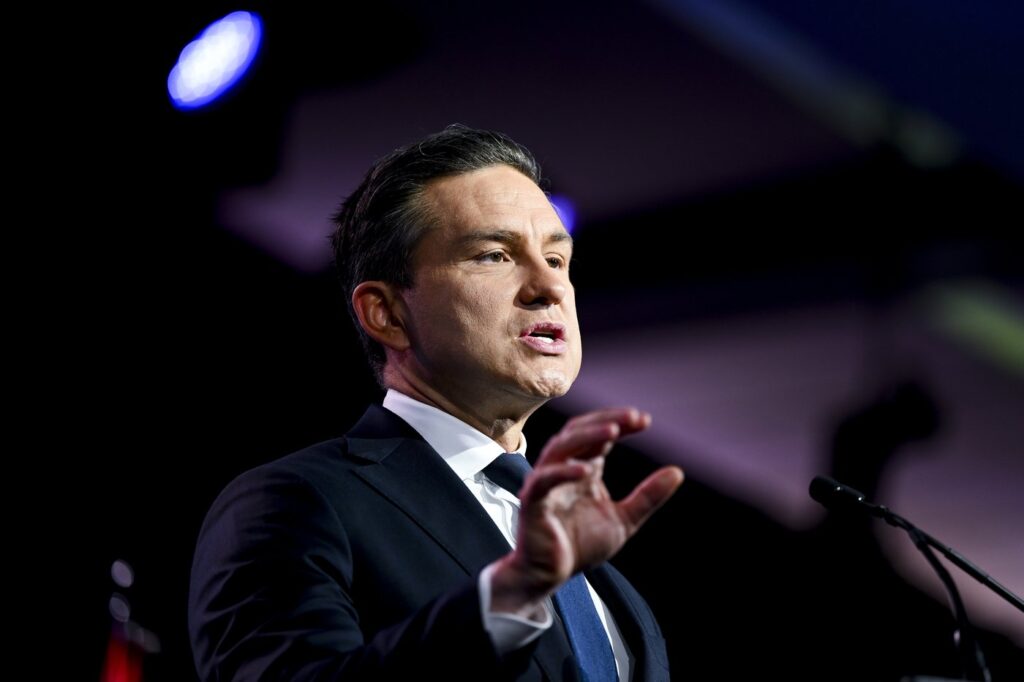
Pierre Poilievre has just issued the most explicit federal unity commitment in a generation. At a recent party gathering, the Conservative leader declared that every single one of his MPs, senators, candidates, and riding associations—from the oil sands to the fishing wharves of Atlantic Canada—will be mobilized to campaign for Alberta to remain a full partner in Confederation. It is a pre-emptive strike against a separatist sentiment that has moved from the province’s political fringes to its legislative floor, and it instantly reshapes how national parties must now talk about Western alienation.
The pledge arrives as Albertans have been steadily warming to the idea of going it alone. The provincial government’s Alberta Sovereignty within a United Canada Act already arms the legislature with a tool to push back against federal laws. Polling over the past two years has shown a stubborn uptick in residents willing to entertain “Wexit,” and fury over equalization payments, pipeline cancellations, and perceived Ottawa-knows-best environmental policy has calcified into a broad-based regional frustration. Poilievre’s response is not a polite acknowledgment of these grievances; it is a declaration of electoral war on the very notion of separation.
The Rising Temperature of Western Alienation
Western alienation is neither new nor simple, but the current wave is sharper and better organized than any since the National Energy Program era. Several accelerants have combined to create a political atmosphere where staying in Canada is no longer treated as an immutable given.
- Equalization payments: Alberta has contributed hundreds of billions more to the federal treasury than it has received. For many Albertans, the formula no longer looks like a equalization tool but a permanent pipeline of wealth out of the province.
- Energy sector paralysis: The cancellation of Keystone XL, the legislative crash of Energy East, the tanker ban on the northern B.C. coast, and Bill C-69’s regulatory hurdles have left the province’s most vital industry trapped behind a wall of federal and interprovincial barriers.
- Perceived institutional imbalance: A Senate that awards 24 seats to the Maritimes while giving six to Alberta, a Supreme Court that has rarely seen a Prairie appointment, and an electoral map that undervalues a fast-growing population all feed a narrative that the federation is structurally tilted against the West.
- The Sovereignty Act: Premier Danielle Smith’s signature legislation, whatever its legal limits, has normalized the language of resistance. It turned pushback into government policy and gave separatist voices a megaphone inside the legislature.
These accelerants have created a political market for secession talk that was unthinkable a decade ago. Poilievre’s camp has clearly concluded that pretending the fire will burn itself out is a losing strategy.
Deconstructing the Pledge: A Full Electoral Mobilization
The magnitude of Poilievre’s promise lies in its specificity. He did not offer a vague statement that Albertans are better off in Canada. He committed the entire federal Conservative apparatus to a hypothetical future campaign where the question on the ballot is separation itself. Every riding association would be expected to organize, every candidate to knock on doors, every senator to lean into a heavily pro-Canada message. It draws a hard red line through the party’s own coalition: you can be furious with Ottawa, but the exit door is permanently closed.
This is a break from standard Conservative positioning. For years, the party has successfully channeled Western grievances into electoral wins while stopping short of framing itself as the Great Canadian Unity Party. Poilievre’s new tone places the loyalty test front and centre. It also implicitly pressures the UCP government in Edmonton: if you escalate the sovereignty agenda far enough to trigger a plebiscite, the federal Conservatives will not sit on their hands—they will become your most formidable opponents.
Walking the Tightrope Between Validation and Unity
The political artistry required here is delicate. Poilievre must avoid the cardinal mistake that previous federal leaders made: dismissing the substance of Western anger as mere whining. His speeches continue to hammer the themes of gatekeepers, a broken equalization formula, and an Ottawa elite that treats energy workers as pariahs. That validation is central to his brand.
Yet simultaneously, the leader must build a persuasive case that life inside Confederation—even in an imperfect one—delivers more prosperity, security, and sovereignty than a small, landlocked petro-state. The arguments he is likely to sharpen include:
- The CPP and intergenerational pension stability: A fractured Canada would throw retirement security into chaos.
- Currency and central bank credibility: An Alberta dollar would carry immense volatility, and the province would lose access to the Bank of Canada’s balance sheet.
- Military and intelligence sharing: Alberta borders an increasingly contested Arctic. Independence would strip it of NORAD, Five Eyes integration, and the Canadian Armed Forces’ logistical spine.
- Trade and interprovincial friction: A newly independent Alberta would face border posts with B.C. for its exports and could lose unfettered access to the rest of the Canadian market, which still absorbs a significant share of its industrial products.
Framing the message this way—not as a scolding but as a sober spreadsheet—allows Conservatives to tell Albertans that their grievances are legitimate but solvable within the federation. It’s an argument built on self-interest, not sentiment.
Alberta as the Conservative Electoral Engine
The bluntest explanation for Poilievre’s urgency is arithmetic. Alberta, along with Saskatchewan, provides the Conservative Party with its deepest well of donors, its most reliable block of seats, and an army of volunteers who routinely flood swing ridings in Ontario during election cycles. If Alberta were to leave Confederation, the Conservative path to a majority government would evaporate overnight. The party would lose roughly 30 safe ridings and the fundraising oxygen that makes national campaigns viable. Poilievre’s electoral calculus and his unity stance are two sides of the same coin.
There is a subtler, longer-term play as well. By positioning himself as the champion of national unity, Poilievre can contrast sharply with Prime Minister Justin Trudeau, whose Western approval ratings have cratered into single digits. Every time Trudeau dismisses the Sovereignty Act as silly or unconstitutional without addressing the underlying rage, Poilievre can respond, “I hear you, and I’ll fight for you—but together.” That framing not only shores up the Prairies but also signals to soft nationalists in Quebec and Atlantic Canada that the Conservative leader is not a regional firebrand but a prime-minister-in-waiting who takes the country’s integrity seriously.
Uncomfortable Contradictions and the Reform Gap
A pledge this muscular is not without its internal friction. Some Western Conservatives will ask how they can simultaneously campaign against a separatist referendum while the party continues to benefit politically from the anger that fuels it. Poilievre’s team will need to translate tough talk on equalization and pipelines into concrete, realizable policy platforms that actually change how federalism works—otherwise the promise to “fix” the federation risks sounding hollow after a decade of Conservative federal governments whose record on Senate reform and internal trade liberalization remains incomplete.
Expect the Conservatives to eventually table a detailed “Fair Federalism” package. This could include:
- A legislated national corridor for energy infrastructure that pre-empts provincial vetoes.
- A revised equalization formula with a hard ceiling tied to fiscal capacity.
- An elected Senate with equal provincial representation, reviving the Triple-E concept.
- Binding mutual-recognition clauses for professional credentials and goods to erode internal trade walls.
Until such a package is fleshed out and publicly endorsed, Poilievre’s campaign promise remains a firebreak without a firefighting plan. The separatist movement thrives on the belief that federal reform is impossible. The Conservative leader must prove that reform is not only possible but imminent.
What This Means for the Wider Federation
Poilievre’s proclamation also sends a signal to Quebec. No federalist leader can draw a hard line on Alberta separatism without implicitly reinforcing that the same standard applies to the St. Lawrence. While he will not court that comparison directly, the consistency strengthens the hand of Canadian federalists everywhere. It neutralizes a potential Bloc Québécois narrative that Conservatives are only interested in the West and would quietly tolerate a fragmented country if it benefited them.
At the same time, the pledge raises the stakes for Danielle Smith’s UCP. If the premier were ever to call a referendum, she would immediately be confronted with a federally financed, well-organized, and emotionally resonant “No” campaign fronted by the country’s most polished communicator. That reality changes the domestic political cost-benefit analysis inside Alberta. The Sovereignty Act may remain a pressure valve, but its ultimate