Canada and China Navigate Crucial Talks on Pork Tariffs and Supply Chain Stability
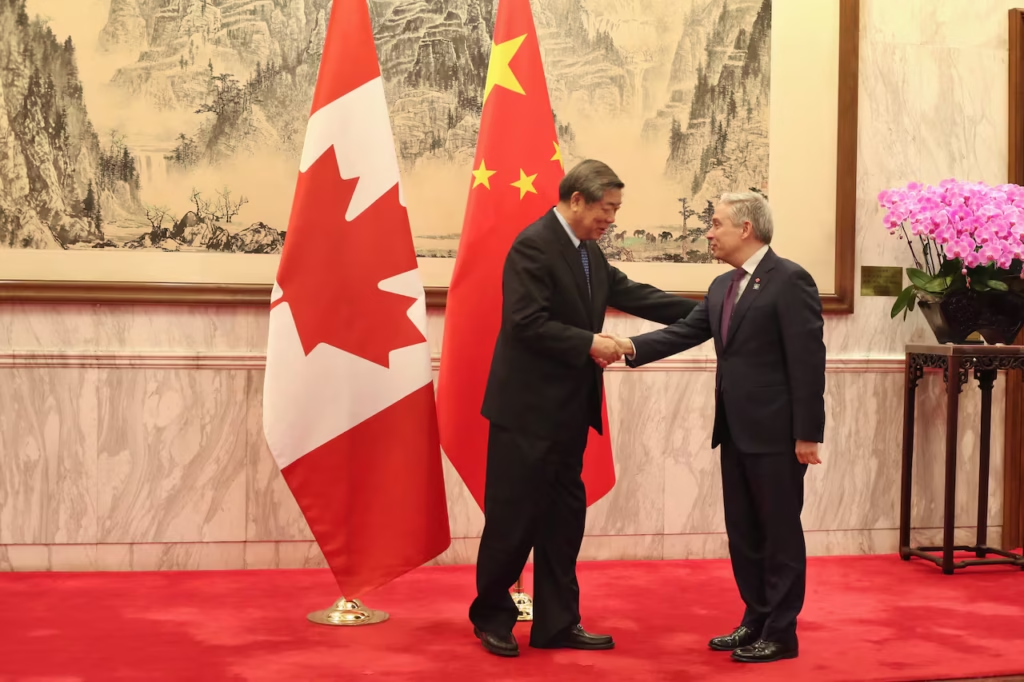
In a significant development for North American agriculture and global trade, high-level discussions are underway between Canada and China. The focus is twofold: resolving long-standing tariff disputes on Canadian pork and establishing a more robust framework for supply chain security. These negotiations represent a critical juncture in the bilateral relationship, with substantial economic implications for farmers, exporters, and consumers in both nations.
The Sticking Point: Lingering Pork Tariffs
The heart of the current trade dialogue centers on tariffs imposed by China on Canadian pork. These measures, initiated several years ago, were linked to concerns over feed additives. While some restrictions were eased in 2022, significant barriers remain, hindering what was once a thriving export market for Canadian pork producers.
For Canada, a major global pork exporter, the Chinese market is indispensable. Prior to the tariffs, China was Canada’s top pork export destination by volume. The restrictions have forced producers to pivot to other markets, often at lower prices, squeezing profitability and creating uncertainty within a vital agricultural sector.
What’s on the Table for Canadian Producers?
Canadian negotiators are pushing for the complete removal of these residual tariffs. Success would mean:
- Regained Market Access: Re-opening the door to one of the world’s largest consumer markets for pork.
- Price Stability: Reducing the supply glut in alternate markets and improving returns for farmers.
- Industry Confidence: Providing the certainty needed for long-term investment and growth in the pork sector.
The Broader Picture: Fortifying Supply Chains
Beyond the immediate issue of pork, the talks are delving into the broader, strategic theme of supply chain security. The pandemic and recent global tensions exposed vulnerabilities in international logistics and trade flows. Both Canada and China, as major trading nations, have a shared interest in ensuring predictability and resilience.
This part of the negotiation is less about removing barriers and more about building frameworks. Key areas of discussion likely include:
- Predictable Regulations: Creating clearer, more consistent rules for agricultural and food product trade to avoid sudden disruptions.
- Sanitary and Phytosanitary (SPS) Cooperation: Enhancing dialogue and scientific collaboration to resolve technical trade issues swiftly.
- Logistics and Transparency: Exploring ways to improve the efficiency and visibility of goods moving between the two countries.
For China, securing a stable and diverse supply of high-quality agricultural products is a key food security priority. Canada, with its vast agricultural resources and reputation for safety, can be a reliable partner in this endeavor.
Why These Negotiations Matter Now
The resumption of high-level economic talks signals a potential thaw in diplomatic relations after a period of significant strain. Finding common ground on pragmatic trade issues like pork and supply chains offers a pathway to stabilize the broader relationship.
Furthermore, the global economic landscape is shifting. Nations are increasingly reevaluating trade dependencies and seeking to “de-risk” supply chains without fully decoupling. These Canada-China talks can be seen as a practical example of this complex balancing act—managing geopolitical tensions while preserving mutually beneficial commercial ties.
Challenges and Opportunities Ahead
Negotiations will not be without hurdles. Geopolitical sensitivities, particularly concerning third parties, will loom in the background. Any agreement will need to be carefully crafted to address the core concerns of both sides without appearing as a concession on broader principles.
However, the opportunities are compelling:
- For Canada: A win would provide a major boost to its agri-food sector, demonstrate its ability to navigate complex trade relationships, and reinforce its role as a trusted supplier in Asia.
- For China: An agreement would help secure a stable protein supply for its population and show its willingness to engage in rule-based trade resolution on specific issues.
- For Global Trade: A successful outcome could serve as a model for how major economies can address discrete trade disputes through dialogue, even amid strategic competition.
The Road Forward for Agri-Trade
The outcome of these negotiations will be closely watched by farmers, exporters, and trade analysts worldwide. A positive resolution on pork tariffs would immediately inject hundreds of millions of dollars in value back into the Canadian economy and reassure other agricultural exporters about market access.
The supply chain discussions, while producing less immediate headlines, may hold even greater long-term significance. Establishing stronger protocols for cooperation can prevent future disputes and create a more predictable trading environment, which is the bedrock of long-term investment and growth.
As the talks progress, the focus will remain on tangible results. The Canadian pork industry is seeking the removal of a specific economic burden, while both governments are working to construct a more resilient trade corridor. In an era of fragmentation, the ability to find practical solutions to complex trade issues is not just good economics—it’s essential diplomacy.
The coming weeks will reveal whether Canada and China can translate this dialogue into a concrete agreement that supports their producers, secures their supply chains, and adds a measure of stability to their important, yet complicated, economic partnership.