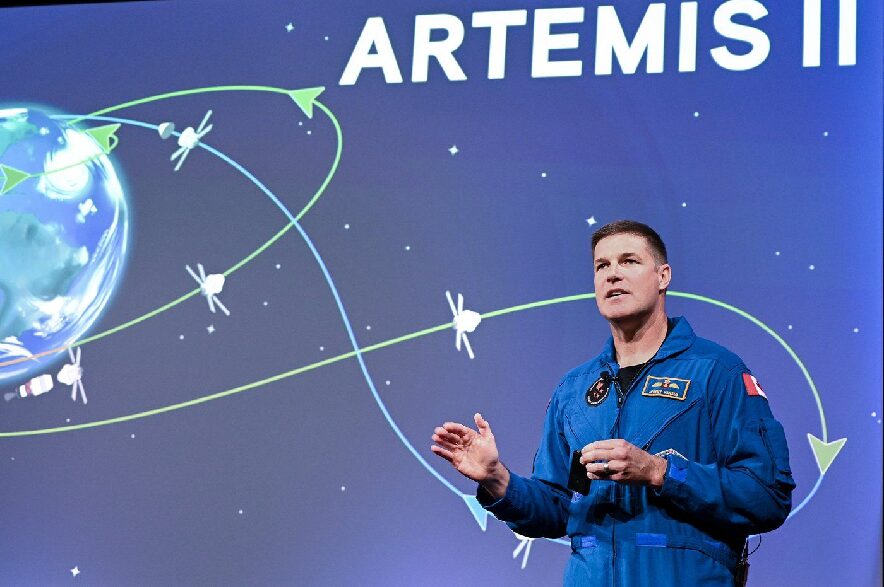
Canadian Astronaut Jeremy Hansen Shares Exclusive Artemis II Moon Mission Reflections
In the wake of one of humanity’s most ambitious space ventures, the world turned its eyes to the stars as the Artemis II mission completed its historic journey around the Moon. Among the crew was Canadian astronaut Jeremy Hansen, whose participation marked a monumental leap for Canada’s space program. In an exclusive post-mission discussion, Hansen sat down with former Bank of Canada governor Mark Carney to reflect on the experience, the challenges, and the future of lunar exploration. This conversation not only highlighted the personal journey of an astronaut but also underscored the collaborative spirit driving modern space exploration.
The Artemis II Mission: Humanity’s Return to Lunar Orbit
Artemis II stands as a pivotal chapter in NASA’s Artemis program, designed to return humans to the Moon and eventually pave the way for Mars. Unlike its predecessor, Artemis I, which was an uncrewed test flight, Artemis II carried a crew of four astronauts on a 10-day mission that ventured around the far side of the Moon. This mission served as a critical test of the Orion spacecraft’s life support systems and operational capabilities with humans on board.
The crew included:
- Commander Reid Wiseman – A seasoned NASA astronaut with extensive spaceflight experience.
- Pilot Victor Glover – The first person of color to embark on a lunar mission.
- Mission Specialist Christina Koch – A record-holder for the longest single spaceflight by a woman.
- Mission Specialist Jeremy Hansen – The first Canadian to travel to the Moon, representing the Canadian Space Agency (CSA).
This diverse team embodied the international cooperation that defines the Artemis program. For Hansen, the mission was not just a personal achievement but a national milestone, as Canada became the second country to send an astronaut to lunar orbit.
Jeremy Hansen: From Ontario to the Orbital Frontier
Jeremy Hansen’s path to the Moon began in London, Ontario, where his fascination with flight led him to join the Royal Canadian Air Force. As a fighter pilot, he honed the skills that would later prove invaluable in space. Selected by the CSA in 2009, Hansen underwent rigorous training, including survival exercises and technical simulations, preparing him for the unknowns of space travel.
His selection for Artemis II in 2023 was a testament to Canada’s contributions to space exploration, particularly through the development of the Canadarm3, a next-generation robotic system destined for the Lunar Gateway. Hansen often emphasizes that his role is a symbol of what can be achieved through perseverance and collaboration. “This mission isn’t just about me; it’s about every engineer, scientist, and dreamer in Canada who pushed the boundaries of what’s possible,” he noted in the interview.
Training for the Unknown: The Grueling Path to Launch
Preparing for Artemis II involved years of intensive training across the globe. Hansen and his crewmates endured simulations of every conceivable scenario, from launch emergencies to lunar orbit operations. Key training elements included:
- Orion Spacecraft Simulations – Practicing manual controls and system failures in high-fidelity mockups.
- Geological Fieldwork – Studying Moon geology in remote locations like Arizona and Iceland to prepare for future surface missions.
- Team-Building Exercises – Building trust and communication skills through activities like caving and underwater training.
Hansen described the training as both physically demanding and mentally exhausting, but essential for fostering the cohesion required in space. “In isolation, you rely on your crew like family. That bond was our greatest asset,” he shared.
The Interview: Candid Reflections with Mark Carney
Sitting down with Mark Carney, now a prominent advocate for sustainable finance, Hansen delved into the emotional and technical aspects of the mission. Carney, known for his insightful dialogues, steered the conversation toward the broader implications of space exploration for humanity.
Hansen recalled the moment Orion slipped behind the Moon, cutting off communication with Earth. “It was a profound silence, a reminder of our vulnerability and our ingenuity. Seeing the lunar surface up close, devoid of human footprints since Apollo, was humbling,” he said. He also discussed the daily life aboard Orion, from managing resources to capturing breathtaking imagery of Earthrise—a view that reinforced the fragility of our planet.
The conversation touched on the psychological impact of space travel. Hansen emphasized the importance of mental resilience, nurtured through mindfulness practices and support from ground teams. “Space teaches you patience and perspective. Every challenge is an opportunity to learn,” he reflected.
Insights on International Collaboration: Canada’s Role in the Artemis Era
Artemis II highlights the power of global partnerships. Canada’s involvement, driven by the CSA, includes providing the Canadarm3 for the Lunar Gateway, a space station that will orbit the Moon and serve as a hub for exploration. Hansen stressed that this collaboration is a model for future endeavors, such as missions to Mars.
Key benefits of international cooperation include:
- Shared costs and resources, making ambitious projects feasible.
- Diverse expertise, enhancing innovation and problem-solving.
- Diplomatic ties, fostering peace and unity through shared goals.
Hansen pointed out that Canada’s role extends beyond robotics; it includes contributions to science experiments and technology demonstrations. “We’re not just passengers; we’re active participants shaping the future of space,” he asserted.
The Future of Space Exploration: Beyond Artemis II
Artemis II sets the stage for Artemis III, which aims to land astronauts on the lunar surface by the late 2020s. Hansen expressed optimism about what comes next, including the establishment of sustainable lunar bases and the utilization of Moon resources. He also highlighted the inspiration factor: “This mission has ignited a passion for STEM in young Canadians. They see that space is within reach.”
Looking ahead, challenges such as funding, technological hurdles, and ethical considerations remain. However, Hansen believes that the lessons from Artemis II—particularly in teamwork and innovation—will guide humanity toward deeper space exploration. The Lunar Gateway, with its Canadian-built robotics, will be instrumental in supporting surface missions and preparing for Mars transit.
Conclusion: A Giant Leap for Canada and the World
Jeremy Hansen’s journey with Artemis II is more than a personal milestone; it’s a beacon of hope and collaboration in an era of global challenges. His reflections with Mark Carney offer a glimpse into the courage and curiosity that drive explorers. As Canada cements its place in the cosmos, this mission reminds us that space exploration unites us in pursuit of knowledge and discovery. The Artemis program is not just about reaching the Moon—it’s about bringing humanity together, one orbit at a time.
For those inspired by Hansen’s story, the message is clear: the sky is not the limit. With determination and partnership, the next generation of astronauts will continue to push boundaries, ensuring that the legacy of Artemis II endures for centuries to come.