
Navigating the Strait of Hormuz: US Military Options and Global Risks
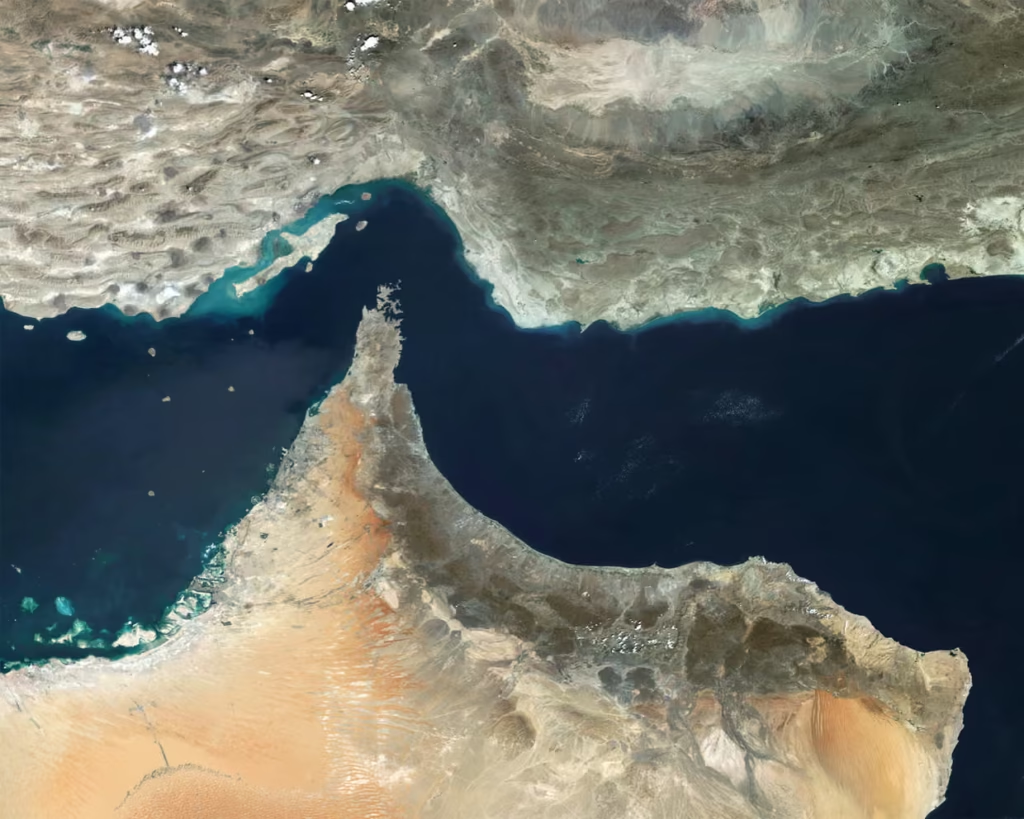
The Strait of Hormuz, a narrow maritime chokepoint between Oman and Iran, is the world’s most critical oil transit corridor. Every day, nearly 20% of the world’s oil supply—about 21 million barrels—flows through its tense waters. For decades, it has been a flashpoint for geopolitical tensions, with Iran repeatedly threatening to close the strait in response to international pressure or conflict. The scenario of a US-led coalition being forced to forcibly reopen the Strait of Hormuz is a complex and dangerous contingency that military planners have long war-gamed. This article examines the potential strategies, immense challenges, and staggering global risks involved in such an operation.
The Strategic Imperative: Why the Strait Cannot Stay Closed
A closure of the Strait of Hormuz is not a regional incident; it is a global economic emergency. The immediate effects would be catastrophic:
- Oil Price Shock: Global oil prices would skyrocket overnight, potentially surpassing historic highs and triggering a worldwide recession.
- Supply Chain Collapse: The cost of transporting all goods would soar, inflating prices for everything from consumer electronics to food.
- Alliance Strain: US allies in Europe and Asia, heavily dependent on Gulf oil, would face immense pressure, testing the cohesion of NATO and other partnerships.
For the United States and its allies, reopening the strait would be a non-negotiable objective. The mission’s core goal would be to establish a secure maritime corridor, allowing tanker traffic to resume and de-escalating the global economic panic.
US Military Options for Reopening the Strait
Any operation to reopen Hormuz would be a multi-domain, high-intensity campaign. It would not be a simple naval exercise but a full-spectrum military engagement likely involving the following phases and assets:
1. Establishing Air and Sea Dominance
The first step would be to neutralize the immediate threats to shipping. This involves:
- Suppression of Enemy Air Defenses (SEAD): US aircraft carriers and land-based air power in the region would launch campaigns to destroy or degrade Iran’s integrated air defense systems, creating “safe” corridors for allied aircraft.
- Anti-Access/Area Denial (A2/AD) Challenge: The US Navy would have to counter Iran’s dense arsenal of coastal defense cruise missiles, using electronic warfare, destroyer-based interceptors, and pre-emptive strikes on launch sites.
2. The Asymmetric Threat: Swarms and Mines
Iran’s most potent tools are its asymmetric, “guerilla warfare at sea” capabilities.
- Small Boat Swarms: Hundreds of Islamic Revolutionary Guard Corps Navy (IRGCN) fast-attack craft, armed with rockets and mines, could harass and attack larger warships. Countering them requires extensive helicopter and close-in weapons system coverage.
- Naval Minefields: Iran possesses thousands of sea mines. A covert mining campaign could quickly render the strait impassable. Mine Countermeasure (MCM) operations—using specialized ships, helicopters, and drones—would be slow, perilous, and essential.
- Submarine and Missile Threat: Iran’s fleet of small submarines and land-based anti-ship missiles (like the Chinese-designed Silkworm variants) add further layers of complexity, requiring constant vigilance from US attack submarines and aerial surveillance.
3. The Escalation Ladder: Striking Iranian Soil
A purely defensive operation in the strait itself may be insufficient. To permanently reopen the passage, the US might feel compelled to escalate by striking command and control centers, missile batteries, naval bases, and mining facilities on Iranian territory. This crosses a significant threshold from a maritime operation to a direct attack on Iran, with severe political and military repercussions.
The Staggering Risks and Potential Consequences
The risks of a forced reopening campaign extend far beyond the tactical military challenges.
Regional War and Proxy Backlash
Iran would not absorb attacks passively. It would likely retaliate across multiple fronts:
- Launching ballistic missiles at US bases across the Middle East, Israel, and Gulf Arab capitals.
- Directing its proxies in Lebanon, Yemen, Iraq, and Syria to unleash rocket and drone attacks on US interests and allies.
- Attempting to disrupt oil infrastructure in Saudi Arabia and the UAE through direct strikes or cyber-attacks.
The conflict could rapidly spiral into a full-scale regional war, drawing in multiple state and non-state actors.
The Global Economic Fallout
Even a successful military operation would occur alongside an economic crisis. Insurance rates for Gulf shipping would become prohibitive. The long-term loss of confidence in the security of global chokepoints could permanently alter energy markets and supply chains, accelerating moves away from Gulf oil but at a devastating short-term cost.
The Diplomatic and Human Cost
Casualties on all sides—military and civilian—would be inevitable. The political fallout would fracture international institutions. The legality of the operation under international law would be fiercely debated. Domestically, the US would face scrutiny over entering another major Middle Eastern conflict.
Conclusion: A Path Fraught With Peril
The question of how the US could forcibly reopen the Strait of Hormuz reveals a sobering reality: while the military possesses the capability, the price of action is astronomically high. The operation would be a bloody, protracted, and escalatory endeavor with no guarantee of a swift return to normalcy. It underscores that deterrence and diplomacy are not just preferable but essential in managing Hormuz tensions.
The true strategy lies in preventing closure through a mix of robust naval presence, clear red lines, and off-ramps for de-escalation. The global economy sails through the Strait of Hormuz; navigating its geopolitical currents requires not just naval power, but immense strategic caution. The world has too much at stake for the strait to become a battlefield.

