
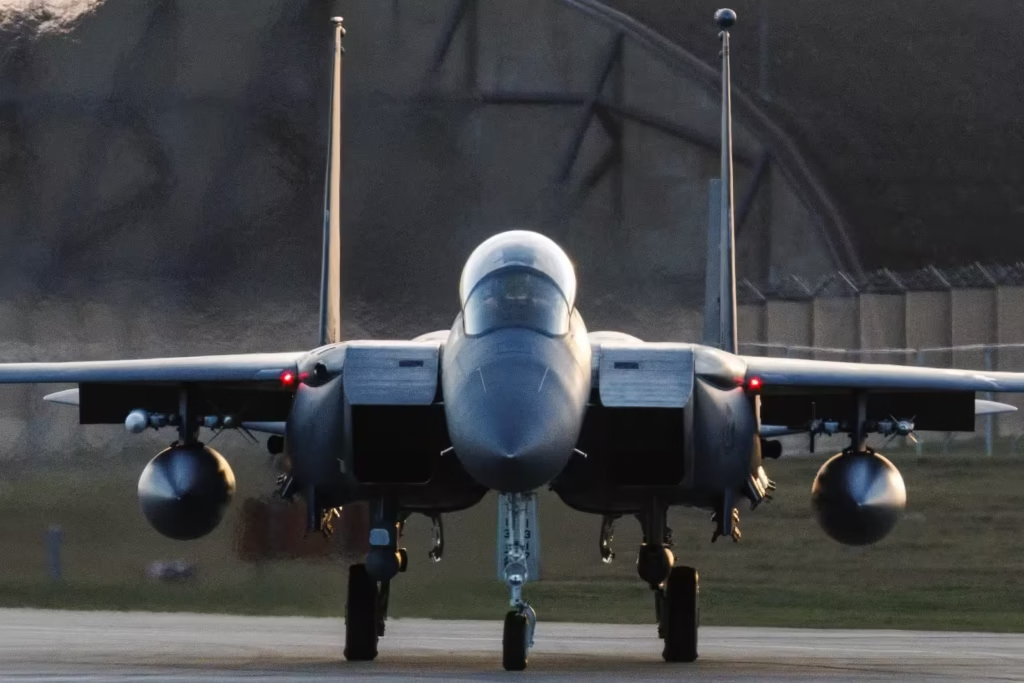
Iran’s Downed F-15 Sends a Stark Warning to the US
The skies over the Middle East, long a theater for tense standoffs and shadow conflicts, witnessed a dramatic and unambiguous escalation. In a stunning display of capability and resolve, Iranian forces successfully engaged and downed a US Air Force F-15 Eagle fighter jet, subsequently capturing its two-man crew. This event is not merely an isolated incident; it is a calculated geopolitical earthquake, a direct message etched in fire and steel to Washington. It signals a fundamental shift in the regional balance of power and serves as a stark reminder that the era of uncontested American aerial dominance in the Persian Gulf is decisively over.
The Incident: A Calculated Demonstration of Force
According to reports, the F-15 was operating near Iranian airspace when it was targeted by an advanced, long-range surface-to-air missile system. The precision of the strike suggests meticulous planning and intelligence, indicating that this was far from a lucky shot. The subsequent rescue and capture of the crew by Iranian Revolutionary Guard Corps (IRGC) forces completed a humiliating sequence for the world’s most powerful military.
Key Details of the Engagement:
- The Target: The F-15 Eagle, a legendary air superiority fighter and backbone of US tactical air power for decades.
- The Method: A sophisticated anti-access/area-denial (A2/AD) missile system, showcasing Iran’s investment in asymmetric warfare capabilities.
- The Outcome: A tangible, undeniable victory for Iran’s military doctrine, resulting in the loss of a premier US asset and the capture of its personnel.
This event transcends the immediate tactical loss. It is a masterclass in propaganda and strategic signaling, demonstrating to domestic and international audiences alike that Iran can directly challenge the US military and win.
Context: The Long Shadow of the Trump Administration
To understand the full weight of this incident, one must look back to the presidency of Donald Trump. His administration’s policy of “maximum pressure” – characterized by the unilateral withdrawal from the Iran nuclear deal (JCPOA) and a campaign of devastating economic sanctions – created a tinderbox. The strategy aimed to cripple the Iranian regime but instead fostered a doctrine of “maximum resistance.”
A Doctrine of Asymmetric Response
Faced with a conventional military it could not match head-on, Iran accelerated the development of capabilities designed to negate American advantages. This meant:
- Expanding its arsenal of drones, cruise missiles, and ballistic missiles.
- Enhancing the range and accuracy of its surface-to-air systems.
- Perfecting tactics of proxy warfare and strategic patience.
The downing of the F-15 is the ultimate fruition of this doctrine. It is Iran’s definitive answer to years of economic warfare and military posturing: a clear demonstration that the cost of confrontation has just been raised exponentially.
The Propaganda Victory: A Narrative Seized
Beyond the military hardware, Iran has won a significant narrative battle. State media has been flooded with images of the captured crew – safe, albeit in custody – and the wreckage of the F-15. This visual proof serves multiple purposes:
Domestic Morale: It bolsters national pride and reinforces the IRGC’s image as the defender of the homeland against an “imperial” aggressor.
Regional Posturing: It sends a powerful message to allies and adversaries in the region about Iran’s reach and capability.
Global Audience: It challenges the perception of American invincibility, potentially altering calculations from Moscow to Beijing.
The rescue operation, framed as an act of “humanitarian” duty by Iranian forces, adds a layer of complicating narrative, making a simple retaliatory strike by the US politically and diplomatically more difficult.
Implications for US Policy and Regional Stability
This event leaves the United States at a critical crossroads. The traditional playbook of overwhelming force is now fraught with unprecedented risk.
Immediate Dilemmas:
- The Crew: Securing their release will require delicate, and likely concessionary, diplomacy, a bitter pill for any administration.
- Retaliation: Any military response risks escalating into a wider regional war, with Iran capable of targeting US assets, allies, and global oil shipping lanes.
- Deterrence Credibility: Failing to respond forcefully could be seen as weakness, emboldening Iran and its proxies further.
Long-Term Strategic Reckoning
The incident forces a painful reassessment of US force posture in the region. Operating advanced aircraft near Iranian airspace can no longer be considered a low-risk activity. It validates the concept of A2/AD “bubbles” and suggests that future US operations may require new technologies, tactics, and a much higher degree of caution.
Furthermore, it exposes the fragility of a policy based solely on coercion without diplomatic off-ramps. The vacuum created by the collapse of the JCPOA has now been filled with a dangerous new reality of direct military confrontation.
Conclusion: A New and Dangerous Chapter
The downing of the F-15 Eagle is a watershed moment. It is Iran’s most brazen and successful direct military action against the United States in decades, marking a transition from proxy conflict to overt, state-on-state challenge. This event is a stark warning written in the clearest possible terms: Iran has developed the capability to hold even the most advanced US assets at risk, and it possesses the will to use it.
The message is not just for Washington, but for the entire world. The Middle East has entered a new and more volatile chapter, where miscalculation can lead to immediate, catastrophic consequences. The rules of engagement have changed, and the United States must now navigate a landscape where its once-unchallenged aerial supremacy is a thing of the past. How it chooses to respond will define the security of the region for a generation. The era of warning shots is over; the first real blow has been landed.

