
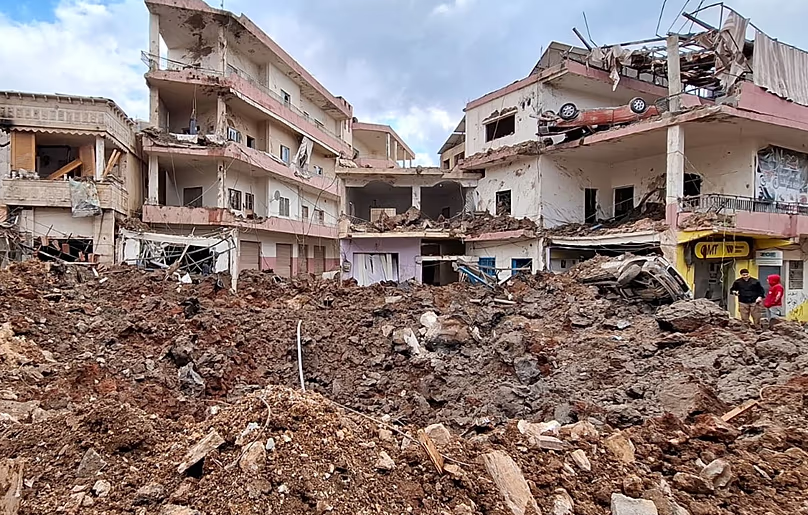
Tensions Soar: Israeli Airstrike Kills Lebanese Forces Amid Hezbollah Clashes
The fragile border between Israel and Lebanon has been plunged into a new crisis, marking one of the most dangerous escalations in months. An Israeli airstrike has tragically killed members of the Lebanese security forces, a state institution, dramatically raising the stakes in the ongoing cross-border conflict with Hezbollah. This deadly incident comes at a critical juncture, casting a long shadow over anticipated diplomatic talks aimed at de-escalation.
A Deadly Strike and a Dangerous Escalation
According to reports from Lebanese officials and international media, the strike targeted a site in southern Lebanon. While Israel has stated its operations are focused on Hezbollah militant infrastructure, this attack resulted in casualties within the Lebanese Internal Security Forces (ISF). The ISF is the national police and security agency of the Lebanese state, distinct from the Iranian-backed Hezbollah.
This distinction is crucial. For months, hostilities have primarily been contained between the Israeli military and Hezbollah fighters, operating in a tense but somewhat defined theater. The killing of state security personnel represents a significant and perilous broadening of the conflict, directly implicating the Lebanese government and risking a more comprehensive interstate confrontation.
The Shadow War Intensifies
This deadly event did not occur in a vacuum. It is the peak of a violent cycle of tit-for-tat exchanges that have raged along the Blue Line—the UN-drawn boundary between the two countries—since October 2023. Daily rocket, missile, and drone attacks have turned communities on both sides into ghost towns, displacing tens of thousands of civilians.
*
- Hezbollah’s Stated Motive: The group frames its attacks as a “support front” for Hamas in Gaza, applying military pressure on Israel’s northern border.
*
- Israel’s Strategic Goal: The Israeli government has vowed to restore security for its northern communities, either through diplomacy or, if necessary, a major military offensive to push Hezbollah away from the border.
The recent strike on Lebanese security forces suggests the lines of this shadow war are blurring, with an increased risk of miscalculation that could spiral out of control.
Diplomacy on the Brink: Talks Amidst the Thunder
Perhaps the most poignant aspect of this tragedy is its timing. The strike occurred just ahead of scheduled, high-stakes talks. International mediators, led by the United States, have been working tirelessly to broker a dual-track resolution:
*
- A ceasefire in Gaza.
*
- A negotiated settlement to the Israel-Hezbollah border conflict.
The objective has been to achieve a diplomatic package that would see Hezbollah’s elite Radwan fighters withdraw north of the Litani River, as mandated by UN Security Council Resolution 1701, in exchange for a cessation of hostilities and the return of Israeli civilians to their homes.
This recent violence throws a wrench into those delicate negotiations. It complicates the position of the Lebanese government, increases public anger, and hardens stances on all sides. Diplomats now face the immense challenge of calming a situation they were meant to be resolving, working against a backdrop of fresh funerals and calls for retaliation.
Regional Implications and the Risk of Wider War
The escalating conflict on the Israel-Lebanon border is a microcosm of the regional instability that has unfolded since the war in Gaza began. It represents a critical flashpoint with the potential to ignite a full-scale regional war, a scenario all parties claim they wish to avoid but are increasingly edging toward.
Key regional risks include:
*
- Direct Israeli Conflict with Lebanon: While Israel views Hezbollah as the primary adversary, sustained attacks on Lebanese state institutions could draw the country into a broader war.
*
- Involvement of Other Iranian-Backed Groups: A major offensive in Lebanon could trigger responses from militias in Iraq, Syria, and Yemen, further stretching Israeli and U.S. defenses.
*
- Humanitarian Catastrophe: A full-scale war in Lebanon would be devastating for a country already mired in a profound economic and political crisis, potentially creating a new wave of displacement and suffering.
The Path Forward: De-escalation or Disaster?
The international community has reacted with grave concern to the latest strike. Calls for maximum restraint have been issued from the United Nations, the United States, and European capitals. The urgent priority is to prevent any further escalation that could render diplomacy irrelevant.
Immediate necessities to avert a wider war include:
*
- A firm recommitment by all parties to the framework of UN Resolution 1701.
*
- Clear, back-channel communication to prevent similar miscalculations that result in state casualties.
*
- Redoubled diplomatic efforts to finally secure a ceasefire in Gaza, which is widely seen as the key to calming the northern front.
The people living on both sides of this border are caught in a relentless cycle of fear. For them, the abstract geopolitics translate into sleepless nights in shelters, abandoned homes, and shattered livelihoods. The strike that killed Lebanese security personnel is a stark reminder that the human cost of this prolonged tension is already far too high and threatens to grow exponentially.
The coming days will be a critical test. Will the shock of this escalation create an opening for a serious de-escalation, or will it become the spark that ignites a broader conflagration? The world watches, hoping that the path of talks can overcome the thunder of trade fire. The alternative is a conflict that neither Israel nor Lebanon can afford.

