
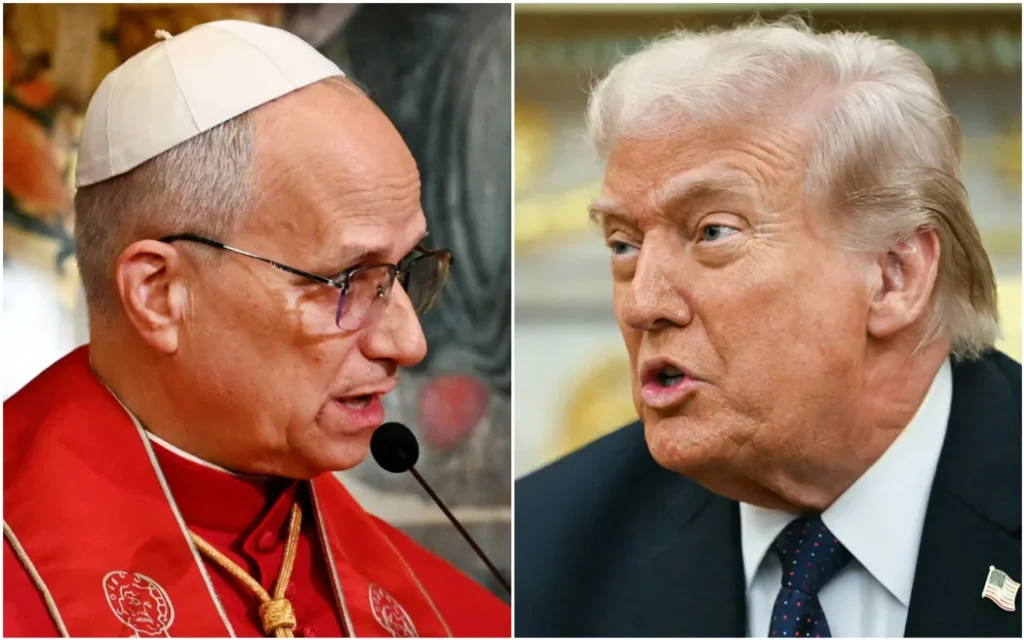
Donald Trump’s Controversial Statement About the Pope Explained
In the whirlwind of a presidential campaign, few moments manage to capture global attention quite like a direct clash between two of the world’s most prominent figures. Recently, former President Donald Trump ignited a firestorm with a pointed and personal critique of Pope Francis. The remarks, made on social media, were not about theological doctrine but were deeply rooted in the heated politics of immigration—a defining issue of the 2024 election. This incident has sparked intense debate, forcing a conversation about the intersection of faith, politics, and the boundaries of diplomatic discourse.
The Catalyst: A Clash Over Immigration Policy
The controversy stems from comments made by Pope Francis during an interview with CBS News’ “60 Minutes.” When asked about the U.S. political debate on immigration, the Pope emphasized a message of compassion and openness. He stated that a country should “welcome everyone” and that while a nation has the right to defend its borders, the fundamental principle should be to “receive with an open heart.”
For Trump, whose political brand is built on strict border enforcement, this was a direct challenge. He responded on his Truth Social platform with a characteristically blunt and provocative post.
Trump’s Direct Accusation
Trump did not engage with the theological or humanitarian aspects of the Pope’s message. Instead, he framed it as a political betrayal and a sign of weakness. His statement included several key accusations:
- He claimed the Pope’s stance was an act of “disgrace” for a religious leader to make.
- He implied it was evidence that the Vatican was being influenced by “the Devil.”
- Most pointedly, he suggested the Pope was “pushing the ridiculous narrative” of open borders to help what he called “corrupt” and “radical left” Democrats win the election.
This framing shifted the discussion from one about policy to one about motive, allegiance, and even spiritual integrity.
Context: A History of Tension
This is not the first time Trump and Pope Francis have found themselves at odds. Their relationship has been notably cool, marked by public disagreements that highlight a fundamental philosophical divide.
- The 2016 Campaign: Then-candidate Trump famously criticized the Pope after Francis suggested that a person focused only on building walls is “not Christian.” Trump at the time called the comments “disgraceful.”
- Climate Change: Pope Francis has been a leading global voice on environmental stewardship, authoring major encyclicals on the topic. Trump, who pulled the U.S. out of the Paris Climate Accord, represents a diametrically opposed view.
- Style and Substance: Beyond policy, their approaches are contrasting. The Pope advocates for a church of service to the poor and marginalized, often speaking in inclusive, pastoral terms. Trump’s political rhetoric is frequently combative, nationalist, and transactional.
This latest exchange is therefore an escalation of a long-standing friction, now supercharged by the high stakes of an election year.
Why This Statement Matters: The Political and Cultural Implications
Trump’s attack on the Pope is significant far beyond the day’s news cycle. It touches on several raw nerves in the American political landscape.
1. The Politicization of Faith
The statement forces a question: What is the proper role of religious leaders in political debates? For Trump’s supporters, the Pope may be overstepping by commenting on sovereign border policy. For many Catholics and observers, the Pope is fulfilling his moral duty to preach on issues of human dignity. Trump’s framing attempts to paint the Pope not as a moral guide, but as a partisan political actor.
2. The Immigration Debate Intensifies
Immigration remains the most potent and divisive issue in U.S. politics. By directly confronting the Pope, Trump is doubling down on his core message and signaling to his base that he will not back down, even when challenged by a globally respected moral authority. It reinforces his image as a fighter willing to take on any establishment figure.
3. Impact on Catholic Voters
The Catholic vote in the United States is not a monolith and is often a crucial swing bloc. This controversy puts Catholic voters, especially those who are conservative but hold the papacy in high esteem, in a difficult position. It creates a tension between political allegiance and religious reverence that could influence voter sentiment in key battleground states.
4. The Erosion of Traditional Diplomatic Norms
Attacking a sitting Pope so personally breaks from decades of diplomatic tradition, where U.S. politicians, regardless of party, have shown public respect for the papacy. It reflects a broader pattern of challenging traditional institutions and norms, a hallmark of Trump’s political strategy.
Reactions and Fallout: A Divided Response
Unsurprisingly, reactions to Trump’s statement have split sharply along partisan lines.
From Trump’s allies and supporters, the statement was seen as a justified pushback against what they view as the Pope meddling in U.S. politics. It was cheered as a defense of national sovereignty.
From the Biden campaign and Democrats, it was condemned as an unpresidential and inflammatory attack on a beloved world religious leader. They framed it as evidence of Trump’s divisiveness and lack of temperament.
Within the Catholic community, reactions were mixed. Some conservative Catholics agreed with Trump’s policy critique while distancing themselves from the personal nature of the attack. More progressive Catholics and clergy saw it as an affront. The Vatican itself has maintained its customary silence on such direct political criticisms, staying above the fray.
Conclusion: More Than Just Words
Donald Trump’s controversial statement about Pope Francis is more than a fleeting social media spat. It is a concentrated reflection of the current political moment: deeply polarized, deeply personal, and unafraid to challenge once-sacrosanct institutions.
It underscores how the issue of immigration has become a cultural and moral battleground, with each side claiming the mantle of righteousness. For Trump, it was a strategic move to solidify his base and dominate the news narrative. For observers, it raises profound questions about the limits of political discourse, the role of faith in public life, and the ongoing transformation of American political norms.
As the 2024 election progresses, this incident will likely be referenced as a key example of the high-stakes, bare-knuckle conflict that defines the race, proving that in today’s politics, no figure—not even the Pope—is immune from becoming a central character in the campaign drama.

