
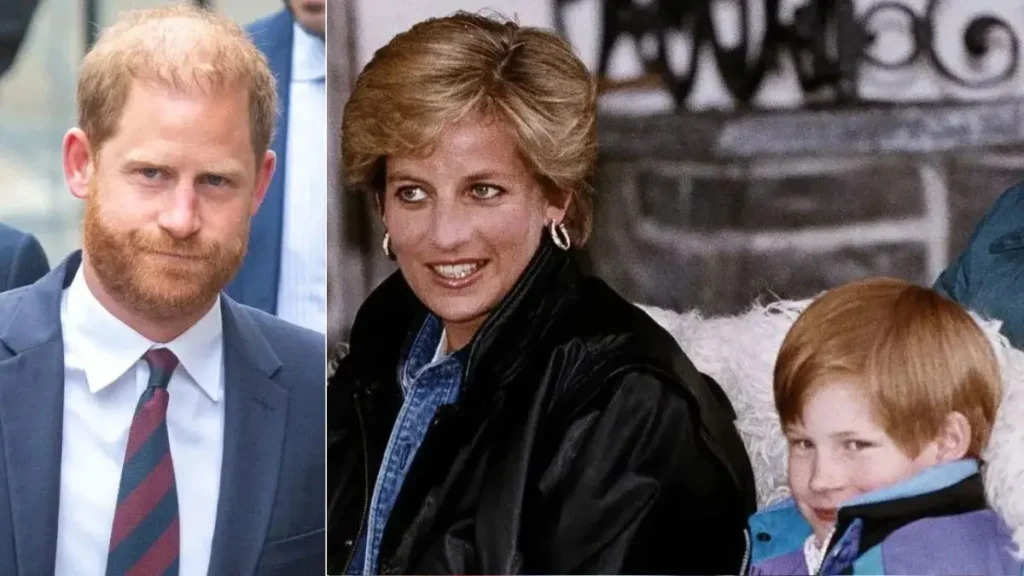
How Princess Diana’s Legacy Forged Prince Harry’s Path Away from the Crown
In a poignant and revealing speech during his recent tour of Australia, Prince Harry, The Duke of Sussex, offered a deeply personal window into the forces that ultimately led to his and Meghan’s seismic departure from royal life. While the headlines have often focused on modern tensions, Harry traced the roots of his decision back to a foundational tragedy: the loss of his mother, Princess Diana. His words painted a picture of a lifelong journey to protect his own family, born from the searing experience of his mother’s absence and the relentless media scrutiny that caused it.
The Unhealed Wound: Diana’s Death and a Lifetime of Scrutiny
Speaking at an event for his charitable organization, Sentebale, Prince Harry did not shy away from connecting the past to the present. He described the death of his mother in 1997 as a wound that never fully closed, a pain that was continuously reopened by the very public nature of his life.
The core of his revelation was this: witnessing history repeat itself was his greatest fear. He saw in the treatment of his wife, Meghan, and later their children, the same patterns of invasive press harassment and sensationalized narratives that had plagued his mother. For Harry, the royal institution’s framework and its often-troubled relationship with the media were not just challenging; they were perilous.
A Vow Forged in Grief: Breaking the Cycle
This fear catalyzed a profound personal vow. Harry articulated a determination to break the cycle—to not passively allow his family to endure what his mother had.
- Protection Over Protocol: His primary duty shifted from royal obligation to familial safeguarding.
- Legacy of Awareness: He credited his mother for giving him the “awareness” that his public role was intertwined with media intrusion, an awareness that shaped his every decision.
- The Final Catalyst: The experience with Meghan made abstract fears concrete, proving the system had not evolved to protect its own.
The decision to step back as senior working royals—popularly dubbed “Megxit”—was thus framed not as a rejection of service, but as the ultimate act of protection learned from his past. It was a choice between the duty to the Crown and the duty to his wife and children, with the ghost of his mother’s experience guiding his hand.
Honouring Diana’s Blueprint: Service on His Own Terms
While stepping away from the institution, Harry is fiercely committed to honouring his mother’s legacy in his own way. His speech in Australia emphasized that his mother’s example remains his true compass.
The Sentebale Connection: A Living Tribute
The setting of his speech was deeply symbolic. Sentebale, the charity he co-founded in memory of Princess Diana, supports children affected by HIV/AIDS in Lesotho and Botswana. His work here is a direct continuation of her humanitarian ethos—a hands-on, globally-focused approach to service that often existed outside traditional royal boundaries.
This highlights a critical distinction in Harry’s path: he seeks the substance of Diana’s work without the suffocating structure of the palace. His philanthropic vision, like his mother’s, is characterized by:
- Emotional connection and physical presence
- Advocacy for stigmatized causes
- A global, rather than purely national, perspective
The Irreconcilable Divide: Personal Peace vs. Public Duty
Harry’s account underscores what appears to be an irreconcilable divide between his need for personal peace and the demands of his birthright. The royal family is an institution built on continuity, tradition, and a complex, centuries-old relationship with the press. Harry’s lived experience, defined by trauma linked to that very relationship, made him incompatible with its unspoken rules.
His narrative positions him not as a rebel, but as a disruptor forced by circumstance. The tools for survival and happiness he needed—privacy, control over his narrative, the right to defend his family—were not readily available within the system. The speech suggested that leaving was less a want and more a psychological necessity, a final step in a grieving process that demanded he safeguard his future to honour his past.
A Legacy of Modernization and Its Cost
In many ways, Prince Harry is the purest product of Princess Diana’s revolutionary influence on the monarchy. She injected modernity, empathy, and public warmth into a stoic institution. Harry inherited all of that, but also the brutal consequences she faced.
The Unanswered Question
His journey forces a difficult question: can the modern monarchy truly accommodate and protect a member whose very identity is shaped by the institution’s most tragic failures? Harry’s exit suggests the answer, for now, is no. He is applying the lessons Diana learned too late, and the cost was his place within the royal fold.
His story is now the most poignant chapter in Diana’s enduring legacy. It is a story of a son using the hardest lessons from his mother’s life to carve out a new one for himself, even if it means walking away from everything she once knew. The grief that once paralyzed a young boy has transformed into the guiding principle for a man determined to write a different ending for his own family. In choosing a life of service on his own terms, away from the spotlight that consumed his mother, Prince Harry is, in his view, finally fulfilling her deepest wish: that her sons would be not just princes, but happy and protected men.

