
Mexico’s President-Elect Considers Sanctions After CIA Deaths in Chihuahua
The already complex and often fraught relationship between Mexico and the United States faces a new, serious test. Following a tragic incident in the northern state of Chihuahua, Mexico’s President-elect, Claudia Sheinbaum, has raised the possibility of imposing sanctions. The controversy stems from a fatal confrontation involving individuals with alleged ties to the U.S. Central Intelligence Agency (CIA), placing bilateral security cooperation under intense scrutiny.
A Fatal Encounter in the Desert State
The incident that sparked this diplomatic firestorm occurred in Chihuahua, a state long plagued by cartel violence and a key transit route for narcotics. According to reports, a confrontation between Mexican security forces and a group of armed individuals resulted in multiple fatalities. What transformed this from a local law enforcement report into an international incident were the identities of the deceased.
Initial investigations and intelligence sources suggest that at least two of the individuals killed were contractors or assets working with the U.S. CIA. The exact nature of their mission on Mexican soil remains officially undisclosed, but the context points towards counter-narcotics or intelligence-gathering operations. The Mexican government has stated its forces were responding to suspicious armed activity and engaged in a firefight after coming under attack, operating without knowledge of the individuals’ purported U.S. affiliations.
Sheinbaum’s Firm Stance on Sovereignty
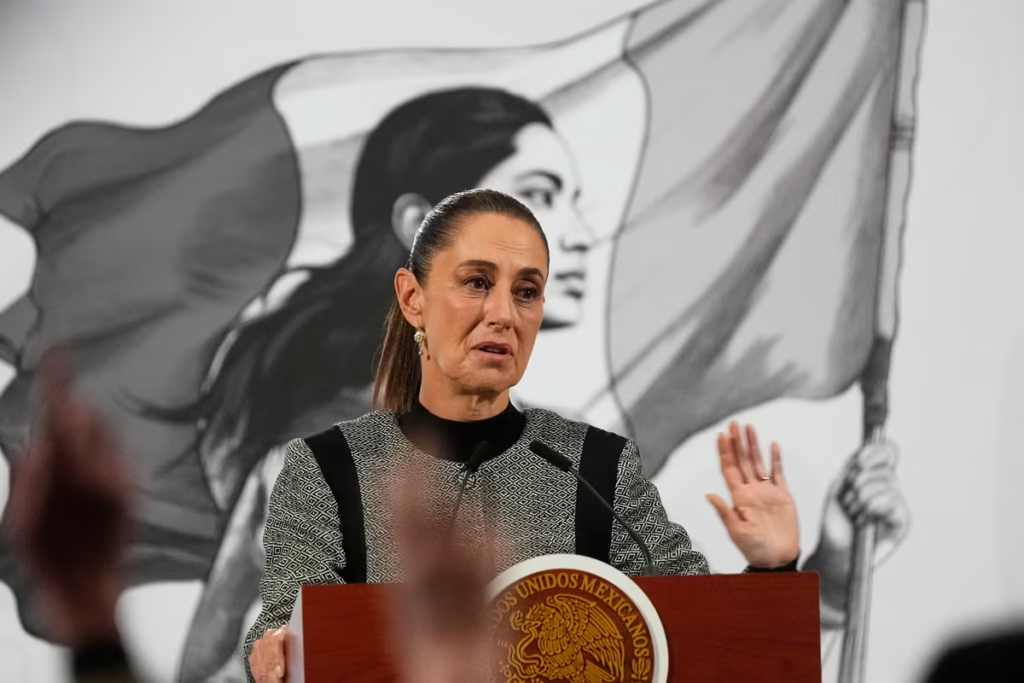
Claudia Sheinbaum, who is set to become Mexico’s first female president in October, has responded with characteristic firmness. A close ally of outgoing President Andrés Manuel López Obrador (AMLO), Sheinbaum has inherited his doctrine of assertive national sovereignty and the principle of “non-intervention.”
In her public statements, Sheinbaum expressed profound concern over the incident, labeling the presence of armed CIA-linked operatives on Mexican soil as a grave violation of Mexican sovereignty and international law. She emphasized that all foreign agents operating in Mexico must do so with full transparency and in strict coordination with Mexican authorities, a protocol that appears to have been breached in this case.
“The integrity of our territory and the safety of our people are not negotiable,” Sheinbaum stated. “We will not tolerate any foreign agency conducting clandestine armed operations within our borders. This incident is unacceptable, and we are evaluating all legal and diplomatic measures at our disposal, including the possibility of targeted sanctions, to ensure it is never repeated.”
What Sanctions Could Entail
While details remain speculative, analysts suggest potential sanctions from Mexico could include:
- Expulsion of certain U.S. diplomatic or intelligence personnel deemed involved or complicit.
- Suspension or severe restriction of joint security initiatives, particularly those involving CIA and DEA operations on the ground.
- Formal complaints and resolutions brought before international bodies like the United Nations.
- Increased scrutiny and delays for U.S. military and surveillance aircraft operating in Mexican airspace.
The Delicate Balance of Security Cooperation
This crisis strikes at the heart of the U.S.-Mexico security relationship, a partnership that is both indispensable and perpetually strained. For decades, the two nations have engaged in intricate cooperation to combat drug trafficking organizations (DTOs) that supply the U.S. market and fuel violence in Mexico.
U.S. agencies, primarily the DEA and CIA, provide critical intelligence, training, and technological support to Mexican counterparts. However, this cooperation has always walked a fine line, with Mexican officials deeply sensitive to any perception of U.S. overreach or violation of their national jurisdiction. Historical incidents of U.S. operatives conducting unilateral missions, such as the “Fast and Furious” gun-walking scandal, have left lasting scars on trust.
The current López Obrador administration has already taken a more distant approach to U.S.-led security policy, focusing on a “hugs, not bullets” social program and disbanding elite police units that had received extensive U.S. training. Sheinbaum’s threatened sanctions signal a potential further cooling of this pragmatic alliance.
Washington’s Response and the Path Forward
The Biden administration has responded cautiously, expressing regret for the loss of life and pledging a full, transparent investigation in cooperation with Mexican authorities. U.S. officials have privately acknowledged the involvement of the individuals with U.S. intelligence but have not publicly detailed their mission, citing national security concerns.
The immediate challenge for both governments is to prevent a total rupture in security ties while addressing Mexico’s legitimate grievances. A complete breakdown would be detrimental to both nations, potentially creating intelligence gaps that cartels could exploit. The path forward likely involves:
- A high-level diplomatic dialogue to establish clearer, more binding rules of engagement for intelligence operatives.
- A joint, credible investigation into the Chihuahua incident to assign responsibility and prevent future occurrences.
- Renegotiating the frameworks of security treaties to reinforce Mexican sovereignty while preserving essential intelligence sharing.
A Defining Moment for Sheinbaum’s Foreign Policy
For Claudia Sheinbaum, this incident presents an early and defining test of her foreign policy stance. It allows her to demonstrate to her domestic audience a strong, sovereign posture vis-à-vis the powerful northern neighbor, fulfilling a key promise of the political movement she leads. However, she must also balance this with the practical necessities of managing a shared border, billions in trade, and intertwined security fates.
How she navigates this crisis will set the tone for U.S.-Mexico relations for the next six years. The outcome will reveal whether the two neighbors can construct a more respectful and equitable partnership or if they are headed for a period of renewed distrust and fractured cooperation in the fight against organized crime. The world is watching, and the stakes for regional stability could not be higher.

