California’s Wildfire Deforestation Crisis Rivals Global Hotspots
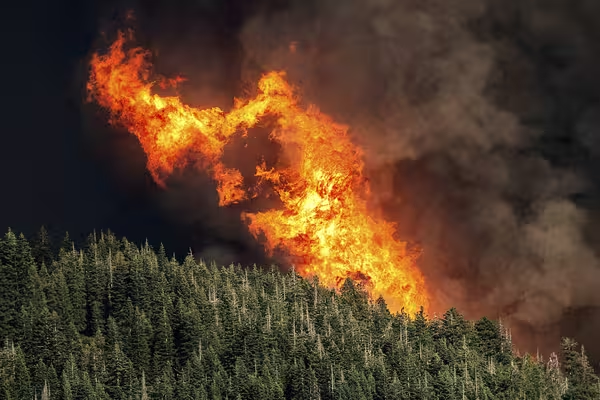
California’s iconic forests, from the towering Sierra redwoods to the sprawling pine woodlands, are vanishing at an alarming rate. While deforestation is often associated with the Amazon or Southeast Asia, groundbreaking research reveals a shocking truth: California is now among the world’s worst deforestation hotspots, and the primary driver is not logging or land clearing—it’s wildfire.
A recent study from the University of California, Davis, has quantified this ecological catastrophe. The findings are stark: between 1985 and 2021, California lost a staggering 6.7% of its tree cover. The most devastating losses have occurred in just the past few years, with wildfire accounting for nearly half of all tree cover loss in the state since 2000. The intensity and scale of modern megafires are transforming vast, carbon-sequestering forests into charred shrublands or non-forested areas, a process that may be irreversible.
From Carbon Sink to Carbon Source: The Climate Change Feedback Loop
Forests are the planet’s lungs, and California’s have been a critical carbon sink. Their rapid decline creates a dangerous feedback loop that accelerates climate change.
- Massive Carbon Emissions: When forests burn, the carbon stored for decades or centuries in trees and soil is released back into the atmosphere as carbon dioxide. The 2020 fire season alone in California emitted an estimated 112 million metric tons of CO2, equivalent to the annual emissions from 24 million cars.
- Loss of Future Sequestration: A destroyed forest stops absorbing carbon. If the land converts to grass or shrub, its capacity to pull CO2 from the air is drastically reduced for generations.
- Increased Warming & Fire Risk: The released greenhouse gases contribute to global warming, which in turn creates hotter, drier conditions that make forests more susceptible to even more severe fires. It’s a vicious, self-perpetuating cycle.
This shift means parts of California’s forested landscape are transitioning from a net absorber of carbon to a net producer, undermining global and state climate goals.
Why Are Modern Fires So Destructive?
The transformation of fire from a natural renewer of the forest to an agent of permanent deforestation is due to a “perfect storm” of factors.
A Century of Fire Suppression
For over 100 years, the policy of aggressively suppressing all fires disrupted natural ecological cycles. Many California forests, like those in the Sierra Nevada, are adapted to frequent, low-intensity fires that clear out underbrush and small trees. Suppression allowed fuels to build up to unnatural and dangerous levels, creating tinderbox conditions.
Climate Change Intensifies the Threat
Human-caused climate change is supercharging the fire environment.
- Hotter Temperatures: Leads to earlier snowmelt, drier soils, and parched vegetation.
- Longer Fire Seasons: The period of high fire risk now extends for more months of the year.
- Increased Vapor Pressure Deficit (VPD): This is a key measure of the atmosphere’s “thirst.” Higher VPD literally sucks moisture from plants, making them explosively flammable.
Forest Density and Drought
Overcrowded forests, weakened by prolonged drought and bark beetle infestations, are unable to access enough water. This creates vast stands of dead and stressed trees—ready fuel for a catastrophic blaze.
The Ecological and Human Toll
The loss extends far beyond carbon metrics. The deforestation driven by megafires has profound consequences.
- Biodiversity Loss: High-severity fires that kill entire forest stands destroy critical habitat for countless species, including the threatened spotted owl and Pacific fisher. The conversion to shrubland permanently alters the ecosystem.
- Watershed Degradation: Forests act as natural water reservoirs, filtering and regulating runoff. Their loss leads to increased erosion, mudslides, and the contamination of crucial water supplies with ash and sediment.
- Community Impact: Wildfires directly threaten lives, homes, and livelihoods. The deforestation that follows leaves communities vulnerable to flooding and landslides for years afterward and devastates recreation-based economies.
A Path Forward: Solutions for a Fire-Resilient Future
While the situation is dire, experts agree it is not hopeless. Addressing the crisis requires a multi-pronged, aggressive approach grounded in science.
Strategic Forest Management
We must urgently increase the scale and pace of proactive forest management.
- Prescribed Fire: Carefully managed, low-intensity fire is one of the most effective tools to safely reduce hazardous fuels, restore ecological health, and protect communities.
- Mechanical Thinning: Removing excess small trees and brush, particularly near communities, can help restore forests to a more open, fire-resilient structure and create strategic fuel breaks.
Protecting Key Carbon Stocks and Refugia
Conservation efforts must prioritize areas with high carbon density and “climate refugia”—places where forests are more likely to persist in a warmer world. Protecting these bastions of biodiversity is a critical hedge against total loss.
Addressing the Root Cause: Climate Change
Ultimately, reducing the greenhouse gas emissions that are warming the planet is the essential long-term solution. Meeting climate targets is, fundamentally, a forest preservation strategy.
Community Adaptation and Investment
Substantial and sustained investment is needed to expand forest treatment programs, harden communities against wildfire (through home hardening and defensible space), and develop new technologies for monitoring forest health and fire risk.
The Time for Action is Now
The UC Davis research serves as a sobering wake-up call. California is not just battling annual wildfire disasters; it is fighting to prevent the permanent loss of its defining forest ecosystems. The rates of deforestation now rival those in the world’s most threatened tropical regions, but the cause is uniquely intertwined with our climate legacy and land management history.
Reversing this trend will require societal will, significant resources, and a commitment to living with fire as a necessary part of the California landscape. By embracing science-based management, accelerating climate action, and investing in resilience, we can work to break the devastating cycle of wildfire-driven deforestation and protect these vital forests for future generations. The fate of California’s natural heritage hangs in the balance.